Why Video Streaming OTT Solutions Fail (And How to Fix Them)


Many video streaming OTT platforms do not fail because the idea is weak. They fail because the system behind them is too fragile.
At launch, everything may seem fine. The app works, the website is live, the catalog is ready, and the player looks stable.
But once real viewers arrive, the cracks begin to show. Playback slows down, buffering increases, costs rise, and content becomes harder to discover.
That is where many OTT businesses lose momentum. A strong OTT solution is not just about going live. It is about building a platform that stays stable, supports growth, protects content, and handles real demand over time.
Fundamentals
What Is a Video Streaming OTT Solution?
A video streaming OTT solution is the full system that allows a business to publish, manage, deliver, and monetize video content across devices. It includes far more than the player users see on screen.
A proper OTT solution covers content ingest, encoding, storage, delivery, apps, subscriptions, security, analytics, and user access. In simple terms, it is the operating layer behind the streaming business.
This matters because many teams think OTT is mainly a design or app problem. It is not. The real strength of a streaming platform depends on what happens behind the scenes and how well every layer works together.
Simple Explanation of a Video Streaming OTT Solution
An OTT platform helps viewers watch content on the web, mobile, smart TVs, and connected devices without relying on traditional cable or broadcast systems. For the viewer, that feels simple. They open the app, choose content, and press play.
For the business, it is much more complex. The system has to prepare video files, deliver them smoothly under different network conditions, manage accounts, control access, track behavior, and support revenue models like subscriptions, ads, or rentals.
That is why OTT should be treated like business infrastructure, not just a content app.
Core Parts of an OTT Solution
A good OTT system is made up of several connected layers. If one layer is weak, the viewer often feels it immediately.
Video Ingest, Encoding, and Transcoding
Before content can stream properly, it needs to be prepared in different formats and quality levels. This allows the platform to serve video based on device type and internet speed.
If encoding is handled poorly, the platform usually suffers in two ways. Playback quality gets worse, and infrastructure costs rise faster than they should.
Storage, CDN, and Delivery
Once content is ready, it has to be stored and delivered efficiently. This is where delivery infrastructure becomes critical.
A strong delivery setup helps content load faster and play more smoothly across regions. A weak one creates slow starts, buffering, and unstable playback.
Apps, Devices, and User Access
Streaming platforms now live across many screens. That includes mobile apps, websites, smart TVs, tablets, and connected TV devices.
Each environment behaves differently. A platform that feels fine on mobile may still feel clumsy on TV. On top of that, the system also needs to manage who can access what, how subscriptions work, and how premium content stays protected.
Common Patterns
Why Many OTT Platforms Struggle After Launch
Many OTT platforms do not collapse at launch. They struggle gradually after launch.
This usually starts when the platform moves from controlled testing to real-world usage. More viewers join. Content libraries grow. More devices enter the mix. Monetization becomes active. Support requests increase. And suddenly, the platform has to prove it can do more than just go live.
That is where weak foundations start becoming visible.
Even small issues can create long-term damage. A slightly slow startup time may reduce confidence. Repeated buffering may reduce watch time. A poor TV interface may lower content discovery. None of these problems always looks dramatic on day one. But together, they quietly reduce retention, trust, and revenue.
Streaming Problems Hurt Viewer Experience
Playback is where most OTT weaknesses become visible first.
Users do not think in terms of encoding logic, delivery paths, or bitrate ladders. They think in terms of what they feel. Does the video start quickly? Does it keep playing? Does it look stable? Can they seek without interruption?
If the answer is no, the platform starts feeling unreliable. And once the viewing experience feels unreliable, users become less patient with everything else.
OTT Failures Increase Churn and Revenue Loss
Streaming quality is directly tied to business performance.
If viewers experience slow starts, failed playback, or unstable sessions, they watch less. If they watch less, engagement drops. If engagement drops, retention weakens. If retention weakens, monetization becomes harder, whether the platform depends on subscriptions, ads, or transactional viewing.
That is why OTT quality problems are never just technical issues. They are revenue issues.
Poor Reliability Damages Brand Trust
Reliability is one of the most important parts of a streaming brand, even though users rarely describe it that way.
When a platform works smoothly, people take it for granted. When it does not, they remember it quickly. A few bad sessions can do more damage than many teams expect, especially during a live event or high-interest release.
In streaming, trust is built through consistency.
Root Causes
The Most Common Reasons Video Streaming OTT Solutions Fail
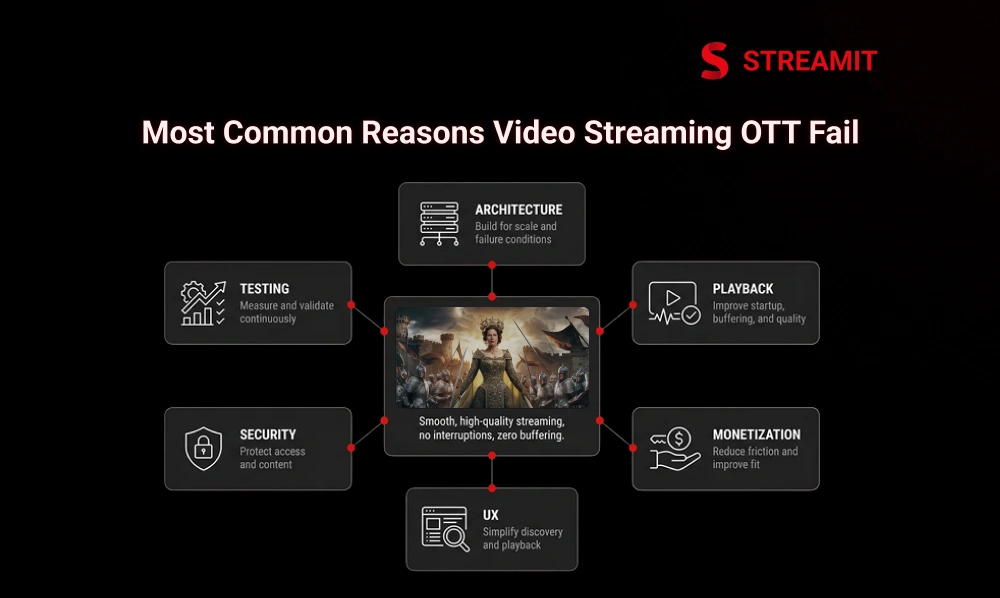
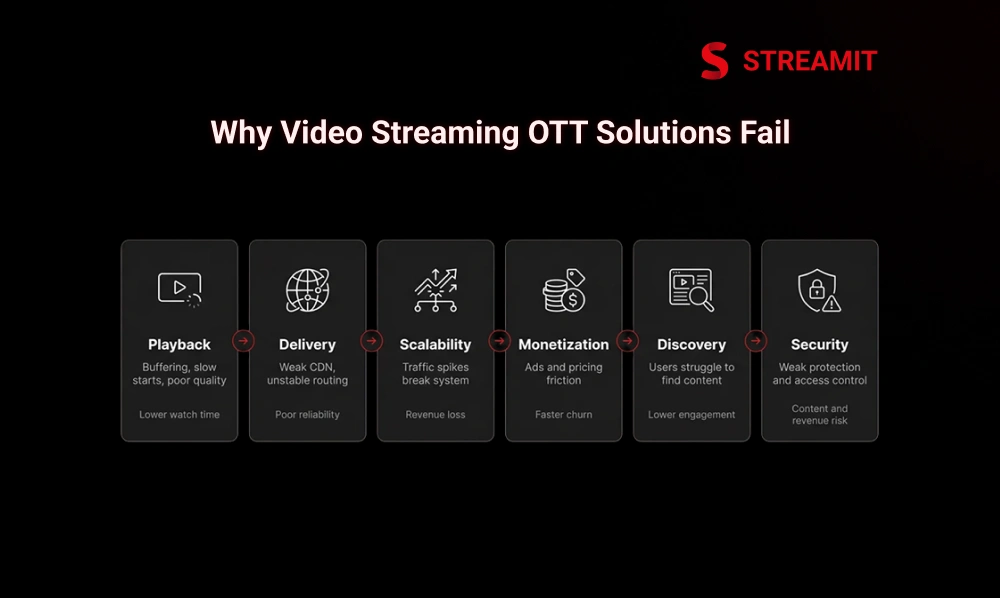
Most OTT failures come from a small set of repeated problems. The pattern is predictable.
| Failure Area | What Goes Wrong | Business Impact |
|---|---|---|
| Playback | Buffering, slow starts, poor quality | Lower watch time |
| Delivery | Weak CDN setup, unstable routing | Poor reliability |
| Scalability | Traffic spikes break the system | Revenue loss |
| Monetization | Ads or pricing create friction | Faster churn |
| Discovery | Users struggle to find content | Lower engagement |
| Security | Weak protection and access control | Content and revenue risk |
When these issues build up, the platform becomes harder to scale and more expensive to fix.
Poor Streaming Performance and Buffering
Poor playback is one of the most common reasons OTT platforms underperform. Users expect the stream to start fast, stay stable, and adapt when network conditions change.
If the platform cannot do that well, viewers notice it immediately.
Weak Encoding and Compression Setup
Encoding is often handled with a one-size-fits-all mindset. That creates unnecessary waste and inconsistent quality.
Some videos need a higher bitrate. Some need less. If the platform treats every video the same way, it usually ends up overspending while still delivering a weak experience.
No Adaptive Bitrate Streaming
A modern OTT platform needs adaptive bitrate streaming that adjusts based on changing internet conditions.
Without it, users are more likely to experience stalls, abrupt quality drops, or forced playback issues. That makes the platform feel fragile in everyday viewing conditions.
Weak CDN or Delivery Strategy
Even well-encoded content can fail if delivery is weak.
If the content is not cached well or routed efficiently, viewers may face slow loads and inconsistent performance depending on where they are watching from. Delivery quality is a major part of perceived platform quality.
Scalability Breaks During Traffic Spikes
Some platforms work well under average conditions and then fail during the exact moments that matter most.
Premieres, live events, sports streams, or successful campaigns all create traffic concentration. That is when scalability gets tested in public.
Live Events Overload the Platform
Live streaming gives teams very little room to recover. If the system starts falling behind, the audience feels it in real time.
This is why live environments need stronger planning than on-demand setups. The margin for error is much smaller.
No Auto-Scaling or Failover Planning
A lot of OTT stacks are built for normal traffic, not stress conditions.
If there is no clear auto-scaling logic or failover setup, the platform becomes vulnerable during spikes. These are often the moments with the highest commercial value, which makes failure even more expensive.
High Infrastructure Costs Kill Profitability
A platform can grow in usage and still become less healthy financially if infrastructure is not managed well.
OTT costs rise quickly when workflows are inefficient, delivery is wasteful, or too many resources are running without enough control.
Inefficient Cloud Resource Usage
Many teams overspend because they overbuild. Too many renditions, too many always-on services, and too little operational discipline quietly hurt margins.
This does not always show up early, but over time, it becomes a serious profitability issue.
Uncontrolled CDN and Bandwidth Costs
Delivery costs can grow faster than expected, especially if caching is weak and too much traffic keeps hitting origin systems.
This is why smarter delivery architecture matters. It protects both performance and cost efficiency at the same time.
Weak Monetization Strategy Limits Growth
A platform may have good content and stable playback, but still struggle because the monetization model does not fit the user experience.
Revenue logic should feel natural to the product. If it creates too much friction, growth slows down.
No Clear AVOD, SVOD, or TVOD Model
A business needs a clear monetization path.
If the platform mixes too many approaches without a strong structure, the user journey starts feeling confusing. Pricing becomes unclear. Value perception weakens. The product feels commercially unfocused.
Poor Ad Delivery and Ad Experience
Ads are part of the product experience in ad-supported platforms.
If ads load badly, interrupt poorly, or reduce session quality, viewers do not separate the ad problem from the platform problem. They blame the whole service.
Poor UX and Content Discovery Reduce Engagement
One of the most overlooked OTT problems is discovery.
Users do not always leave because the content is weak. They often leave because finding relevant content takes too much effort. If the home screen is messy, the search is weak, or recommendations are generic, engagement starts falling.
Slow App Performance Across Devices
Different devices have different expectations.
A TV app needs clear navigation and a simple viewing flow. A mobile app needs speed and low friction. A web app needs responsiveness and clarity. One interface approach does not work equally well across every screen.
Weak Search, Discovery, and Personalization
Discovery should reduce effort. It should help users move from intent to playback faster. If the platform does not guide viewers well, content feels less valuable than it really is.
Security Gaps Create Piracy and Content Risk
Security is not a secondary concern in OTT. It directly affects content protection, access control, revenue protection, and partner trust.
Weak security creates long-term business risk, especially when premium or licensed content is involved.
Weak DRM Protection
Content protection is essential for paid or premium platforms.
If DRM is weak or missing, the business becomes more exposed to piracy, unauthorized sharing, and rights issues.
Account Sharing and Content Theft
Security also includes session logic, access rules, and entitlement control.
If account access is loose and content links are poorly protected, the platform starts losing control over who is watching and how that access is being shared.
Poor Testing Leads to Preventable Failures
A lot of OTT failures are preventable. The problem is that many teams test under ideal conditions instead of real conditions.
That leads to surprise failures that were never really surprising.
No Load or Stress Testing
If a platform has never been tested under serious concurrency, it is not truly ready. It may work in normal usage and still break during the moments that matter most.
Device and Browser Compatibility Issues
OTT products must behave well across many environments.
That includes browsers, mobile operating systems, TVs, connected devices, and different playback conditions. Compatibility is not a one-time task. It is an ongoing discipline.
Solutions
How to Fix Video Streaming OTT Solution Failures
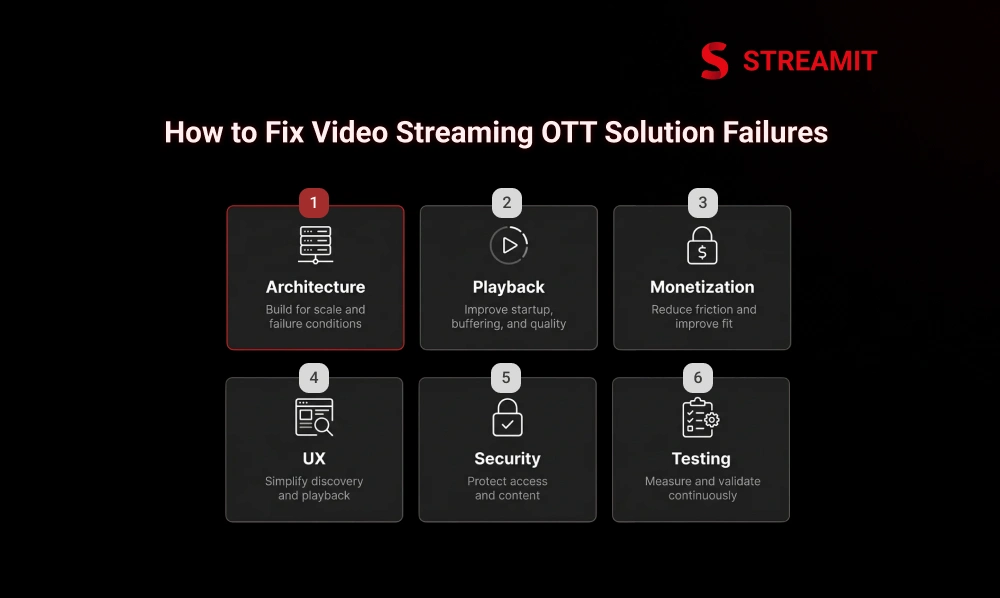
Fixing OTT failures does not start with adding more features. It starts with improving the core system.
That means building stronger architecture, improving playback performance, reducing friction in discovery, choosing better monetization logic, tightening security, and testing continuously.
The strongest OTT platforms are not the ones with the most noise. They are the ones with the most stable fundamentals.
| Fix Area | Focus |
|---|---|
| Architecture | Build for growth and failure conditions |
| Playback | Improve startup, buffering, and quality control |
| Monetization | Reduce friction, improve fit |
| UX | Make discovery and playback easier |
| Security | Protect access and content |
| Testing | Measure and validate continuously |
Build a Scalable OTT Architecture
A scalable architecture is built for traffic variation, not just steady usage.
This means planning for spikes, service failures, and changes in demand before those issues become public outages.
Cloud-Native Infrastructure
Cloud-native design helps different parts of the stack scale more intelligently.
Instead of forcing the whole platform to grow together, teams can scale the layers that actually need it.
Multi-CDN and Delivery Redundancy
Relying on a single delivery path creates unnecessary risk. Multi-CDN setups give the platform more control, better resilience, and more stability across regions and traffic conditions.
Optimize Video Quality and Playback Performance
Playback quality improves when encoding, adaptive delivery, and delivery infrastructure are treated as one system.
That is usually where some of the highest-impact improvements happen.
Adaptive Bitrate Streaming
ABR should be a baseline requirement for any serious OTT platform. It helps playback remain usable under changing real-world conditions.
Better Encoding and Compression Profiles
Smarter encoding reduces waste and improves visible quality more efficiently. That helps the platform serve viewers better while controlling costs more effectively.
Improve Monetization Without Hurting Experience
Monetization should support the product, not interrupt it carelessly. The business model should fit the audience, the content type, and the user journey.
Choose the Right Revenue Model
A clear monetization model creates a clearer product. That improves both conversion and long-term user trust.
Improve Ad Delivery and Tracking
If ads are part of the business, they should be monitored as seriously as content playback. A poor ad experience is still a poor platform experience.
Improve UX Across Web, Mobile, and TV Apps
A good OTT UX reduces effort.
It helps users find something relevant quickly, move through the platform naturally, and return more easily next time.
Faster App Load and Smoother Playback
Startup speed matters. Smooth playback matters. These basics shape how users judge the platform before they ever think about advanced features.
Better Search, Discovery, and Recommendations
Discovery is one of the strongest retention tools in OTT.
Better search and recommendations reduce browsing fatigue and help viewers build a habit faster.
Strengthen Security and Content Protection
Security should be layered across the whole platform. That includes DRM, API security, session control, and entitlement management.
Use Industry-Standard DRM
Premium content needs proper protection.
This is not just about piracy. It is about maintaining long-term control over how content is accessed and distributed.
Secure APIs, Sessions, and Access Control
Access control should be strict, clear, and well-managed. Weak session logic turns product access into a business leak.
Monitor Performance and Test Continuously
Real-time visibility into playback, delivery, and session quality helps teams act faster and operate with more confidence.
Real-Time QoE and Analytics Tracking
Playback metrics should be tied closely to real user outcomes such as engagement, abandonment, and session quality.
Regular Load, Stress, and Device Testing
Continuous testing is what keeps predictable failures from turning into public problems.
Strategy
Build vs Buy: Why Many Custom OTT Solutions Fail
Custom OTT development is attractive because it promises more control. But control without the right operating discipline often becomes complex.
Many custom builds fail because teams underestimate how much ongoing work is required to maintain playback quality, delivery performance, security, compatibility, and infrastructure stability.
Custom development is not the problem by itself. Underestimating it is.
Hidden Risks of Building an OTT Platform From Scratch
When teams build from zero, they take responsibility for every layer of the streaming stack.
That includes player behavior, adaptive streaming, delivery planning, security, analytics, compatibility, and support over time. Together, that becomes a very large long-term commitment.
When a Ready OTT Solution Makes More Sense
A ready OTT solution makes more sense when speed, lower risk, and operational confidence matter more than rebuilding every foundational layer.
The smarter question is not always build or buy. It is which layers need to be owned directly, and which layers should already be production-ready.
Choosing Right
What to Look for in the Right OTT Solution Provider
The right OTT solution provider should do more than help launch a product. They should help reduce future risk.
That means understanding infrastructure, playback, scalability, discovery, monetization, and security as connected parts of the same business system.
End-to-End OTT Infrastructure Support
End-to-end OTT infrastructure support covers the full streaming workflow, from content processing to delivery and playback. It helps the platform run smoothly, scale better, and stay more reliable.
Built-In Scalability, Security, and Monetization
Built-in scalability, security, and monetization help the platform grow safely without adding major fixes later. They make it easier to handle more users, protect content, and support revenue from the start.
Faster Launch, Lower Risk, and Easier Growth
Faster launch, lower risk, and easier growth help OTT platforms go live with more confidence and fewer delays. It also creates a stronger foundation for scaling, improving, and monetizing the platform over time.
Summary
Key Takeaways
OTT Failures Are System Failures
Most platforms fail due to poor playback, poor delivery, limited scalability, and unstable infrastructure – not weak content.
Performance Drives Retention
Buffering, slow startup times, and low reliability reduce viewer trust, watch time, and long-term retention directly.
Scalability Must Be Built Early
Platforms need to handle traffic spikes, live events, and growing demand. A weak scaling strategy creates major risk after launch.
Infrastructure Costs Hurt Profitability
Poor encoding, inefficient cloud usage, and uncontrolled CDN costs can make an OTT platform expensive to operate over time.
Monetization Needs the Right Structure
A clear AVOD, SVOD, or TVOD model is important for long-term growth. Weak ad delivery or poor pricing limits revenue potential.
Security Protects Business Value
Strong DRM, secure access control, and content protection help reduce piracy risks and protect platform revenue long-term.
Important
User experience drives engagement: Slow apps, weak navigation, poor search, and limited personalization make it harder for viewers to find content and stay engaged.
Testing helps prevent avoidable failures: Regular load testing, device testing, and performance monitoring help OTT platforms detect issues before they affect real users.
Fixing OTT failure starts with stronger foundations: Better architecture, adaptive streaming, delivery redundancy, and real-time analytics create a more reliable and scalable platform.
Long-term success depends on platform readiness: The strongest OTT solutions are built not just for launch, but for stable growth, better control, and easier monetization over time.
Final Thoughts
Conclusion
Video streaming OTT solutions fail when they are built for launch day and not for everything that comes after.
As the platform grows, the real test begins. Can it handle traffic spikes? Can it protect content? Can it keep the playback smooth? Can users find what matters quickly? Can it monetize without hurting the experience? Can it scale without destroying margins?
That is the real OTT challenge.
The answer is not more complex. It is a stronger system. One built for performance, control, reliability, and long-term growth.
FAQs
Frequently Asked Questions
-
Why do video streaming OTT solutions fail after launch?
They often fail because they are built for launch, not for real scale. As traffic, devices, and content grow, weak playback, delivery, and infrastructure start causing problems.
-
What are the most common OTT platform challenges that hurt growth?
The biggest challenges are buffering, slow startup times, limited scalability, high infrastructure costs, poor discoverability, weak monetization, and security gaps.
-
How do you reduce buffering in a video streaming OTT?
Improve encoding, use adaptive bitrate streaming, strengthen CDN and caching, and optimize playback across changing network conditions.
-
How can OTT solution providers lower video streaming infrastructure costs?
They can reduce waste in encoding, improve CDN efficiency, optimize cloud usage, and control bandwidth costs without hurting playback quality.
-
How can streaming platforms improve user experience across mobile, web, and TV apps?
They can improve UX by making playback faster, navigation simpler, and content discovery easier across all devices.
-
Why do custom OTT solutions fail more often than expected?
They fail because teams often underestimate the long-term complexity of performance, security, scalability, and device compatibility.