Wowza Alternatives for Live Streaming and OTT Platforms


A streaming platform is not judged by one clean launch. It is judged when live events attract real traffic, subscribers expect smooth playback, content libraries grow, and monetization becomes more complex.
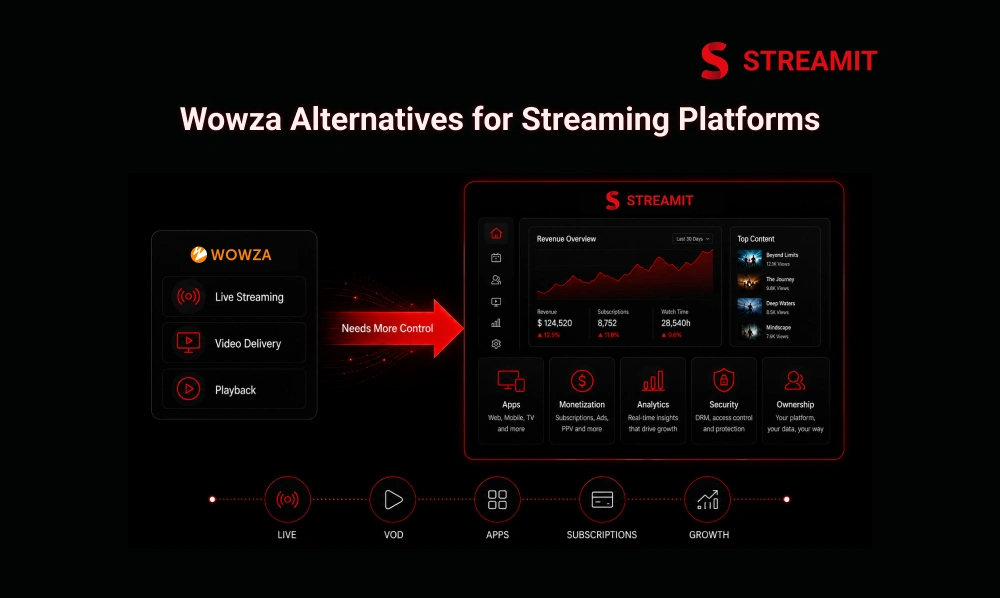
Wowza is a known name for live streaming infrastructure and video delivery. But many teams start looking for Wowza alternatives when they realize their business needs more than a streaming engine. They need apps, payments, analytics, content control, security, and long-term ownership in one connected platform.
Part 1
Why Teams Look for Wowza Alternatives
A 1-week streaming setup can become a 12-month platform limitation. Many teams choose a live streaming platform first because they need to go live quickly. That works well in the early stage, especially for events, broadcasts, and technical video delivery.
The problem appears later. Once the audience grows, the business starts needing better apps, flexible monetization, deeper analytics, stronger security, and a clearer platform roadmap. That is usually when teams begin comparing Wowza alternatives.
Why Wowza Is a Trusted Choice for Live Streaming and Video Delivery
The strongest use case for Wowza is video delivery, not complete OTT business ownership. It supports live streaming workflows, video-on-demand delivery, low-latency needs, and scalable streaming infrastructure for technical teams.
For engineering-led teams, that control can be useful. But for a streaming business, delivery is only one layer. The viewer does not experience the streaming engine directly. They experience the app, payment flow, content discovery, playback quality, and account journey.
Many Streaming Businesses Need More Than a Streaming Engine
A serious OTT platform has at least 8 business layers beyond playback. These include CMS, user management, subscriptions, ads, TV apps, analytics, DRM, notifications, and retention systems.
If these layers are stitched together later, the platform becomes harder to manage. Every new feature creates another dependency. Every dependency adds cost, delay, and operational pressure.
The Best Alternative Depends on Whether You Need Streaming, Apps, or a Complete OTT Platform
Not every Wowza alternative solves the same problem. Some tools focus on live streaming performance. Some help with video APIs. Some offer OTT apps. Some provide a more complete platform foundation.
The right choice depends on your business model. A one-time live event has different needs from a subscription-based OTT brand. A broadcaster has different needs from a fitness, sports, education, or entertainment streaming business.
Part 2
What to Compare in Wowza Alternatives
The wrong comparison is feature list vs feature list. The better comparison is business need vs platform capability. A streaming business should compare how each solution handles performance, content, apps, monetization, security, costs, and ownership.
Here is a simple comparison framework before choosing a Wowza alternative:
| Comparison Area | Why It Matters | What to Check |
|---|---|---|
| Live streaming performance | Protects viewer experience during traffic spikes | Latency, CDN support, adaptive bitrate, uptime |
| OTT apps | Defines how users access your content | Web, mobile, TV, casting, device consistency |
| Monetization | Controls revenue flexibility | SVOD, AVOD, TVOD, PPV, coupons, bundles |
| Security | Protects premium content | DRM, access rules, secure playback, APIs |
| Ownership | Protects long-term control | Code, data, roadmap, infrastructure flexibility |
| Total cost | Prevents surprise expenses | CDN, storage, transcoding, apps, support |
Live Streaming Performance, Latency, and Playback Reliability
A 3-second delay may be fine for a class, but weak for auctions, sports, or interactive events. Low latency matters when the viewer experience depends on real-time interaction.
Teams should compare more than just “live streaming supported.” They should check adaptive streaming, video CDN strategy, buffering control, failover options, and playback consistency across devices.
VOD Management, Content Libraries, and OTT CMS Tools
A streaming business with 50 videos has different needs from one with 5,000 assets. Content organization becomes serious once libraries grow across shows, seasons, categories, languages, and access levels.
A good OTT CMS should make publishing simple without making the platform rigid. Teams should compare metadata control, asset management, thumbnails, trailers, collections, access rules, and admin workflows.
OTT Apps Across Web, Mobile, Smart TV, and Connected Devices
The TV app is often where weak OTT planning becomes visible. A web player can launch quickly, but smart TV and connected device experiences need stronger architecture and design discipline.
Streaming teams should compare app coverage across web, Android, iOS, Android TV, Fire TV, smart TV devices, and casting. The goal is not just availability. The goal is a consistent experience across every screen.
Monetization Models for Subscription, Ads, and Pay-Per-View
Revenue strategy usually changes after the first 90 days. A platform that only supports one model can limit pricing experiments later.
Teams should compare SVOD, AVOD, TVOD, rentals, bundles, coupons, free trials, pay-per-view events, and hybrid monetization. The best OTT solution should let the business test revenue models without rebuilding the platform.
Security, DRM, APIs, and Platform Ownership
Premium content needs more than password protection. Once content has commercial value, security becomes part of the business model.
Teams should compare DRM support, secure streaming, access control, APIs, role-based admin access, and user data ownership. Security should not feel like an add-on after launch.
Pricing, Infrastructure Costs, and Long-Term Scaling
The cheapest license can become the most expensive platform. Many teams compare software pricing but forget CDN, transcoding, storage, TV apps, integrations, and migration costs.
A better approach is to calculate total cost of ownership. This includes setup, monthly usage, engineering time, support, future app expansion, and the cost of changing platforms later.
Part 3
Best Wowza Alternatives by Streaming Business Need
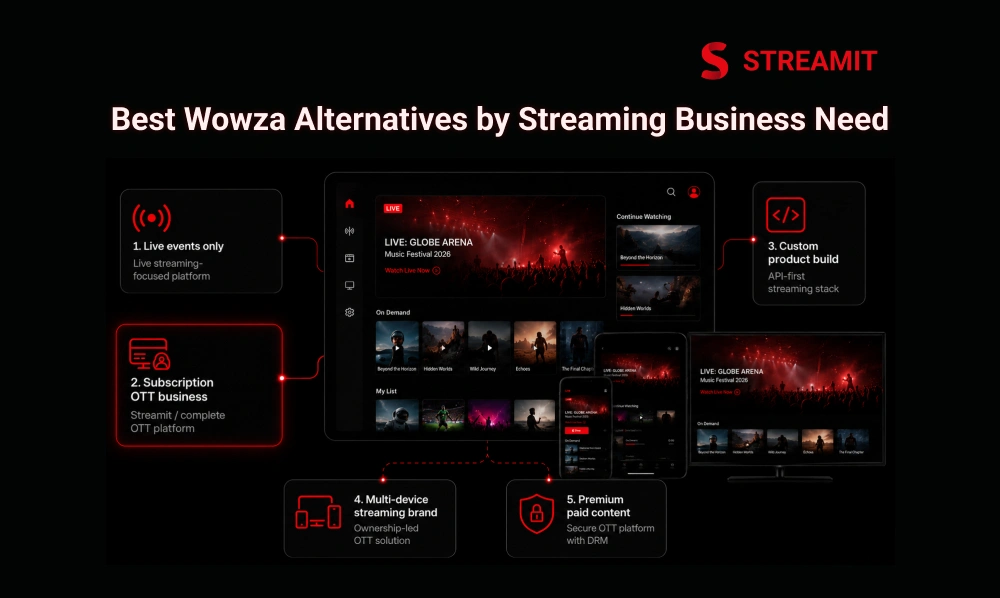
The best Wowza alternative depends on the job you are hiring the platform to do. A live-only workflow needs speed and reliability. A serious OTT business needs apps, revenue systems, analytics, and control.
Use this table as a decision filter:
| Business Need | Better Fit | Main Risk If Ignored |
|---|---|---|
| Live events only | Live streaming-focused platform | Paying for OTT features you do not need |
| Subscription OTT business | Complete OTT platform | Tool stitching and weak retention |
| Custom product build | API-first streaming stack | Higher engineering dependency |
| Multi-device streaming brand | Ownership-led OTT solution | Future app rebuilds and migration cost |
| Premium paid content | Secure OTT platform with DRM | Content leakage and weak access control |
Streamit for Businesses That Want OTT Apps, Monetization, and Ownership
Streamit fits teams that see OTT as a business asset, not just a video player. It brings together live streaming, VOD, web apps, mobile apps, TV apps, monetization, analytics, and platform control.
This is useful for founders and media teams that want a scalable OTT platform solution without losing control over the roadmap. The focus is not only launch speed. The focus is building a platform that can grow.
Full OTT Platform Suites for Platform Ownership
Full-stack OTT solutions are useful when teams want apps, CMS, monetization, and delivery together. They reduce the need to connect too many separate systems in the early stage.
The trade-off is flexibility. Some suites are easier to start with, but harder to shape deeply later. Teams should check how much control they get over code, data, integrations, design, and future platform changes.
Live Streaming-Focused Platforms for Event Workflows
Live-first platforms work well when the main need is broadcasting, not building an OTT business. They can support events, webinars, simulcasts, and simple video delivery workflows.
They are often practical for teams that do not need deep subscriber management, advanced VOD libraries, TV apps, or complex monetization. The risk begins when the business grows beyond live delivery.
API-First Platforms for Custom Streaming Products
API-first platforms are powerful when you have a strong technical team. They give developers building blocks for video upload, transcoding, playback, live streaming, and delivery.
This route can work well for custom products. But it also increases engineering responsibility. Your team must still build the CMS, apps, monetization, analytics, user flows, and admin tools.
Part 4
The Streaming Engine vs OTT Platform Test Most Teams Skip
A streaming engine answers “Can we deliver video?” An OTT platform answers “Can we run a streaming business?” This is the test many teams skip during vendor comparison.
If your goal is only to stream live video, a streaming engine may be enough. If your goal is to acquire users, charge subscribers, manage content, reduce churn, and scale across devices, you need a broader platform.
A Streaming Engine Delivers Video but Does Not Build the Business
Video delivery is only one part of the viewer journey. A business still needs onboarding, search, watchlists, recommendations, payments, support, emails, analytics, and retention workflows.
This is where many teams underestimate the build. They solve playback first, then slowly discover that everything around playback still needs to be planned, designed, built, and maintained.
OTT Apps, Payments, Analytics, and Retention Usually Require Additional Systems
A platform with 5 disconnected tools becomes harder to operate than one well-planned system. Apps, payment gateways, analytics, CRM, notifications, and content controls must work together.
When these systems are not connected properly, teams lose visibility. They cannot clearly see who watched, who paid, who dropped off, and what content is driving revenue.
Calculate the Total Stack Before Comparing License Prices
A $1 saving at the software layer can create $10 of extra work elsewhere. License pricing is only one part of the decision.
Teams should calculate the full stack cost, including streaming infrastructure, CDN, storage, transcoding, apps, integrations, analytics, support, maintenance, and future migration. That gives a more honest comparison.
Avoid Building a Platform That Requires Constant Tool Stitching
Tool stitching looks flexible at first, but expensive later. Every separate tool needs integration, monitoring, updates, and troubleshooting.
A stronger OTT foundation reduces this pressure. It gives teams a cleaner way to manage content, users, monetization, delivery, and growth from one connected base.
Part 6
Why Streamit Fits Teams Looking for a Wowza Alternative
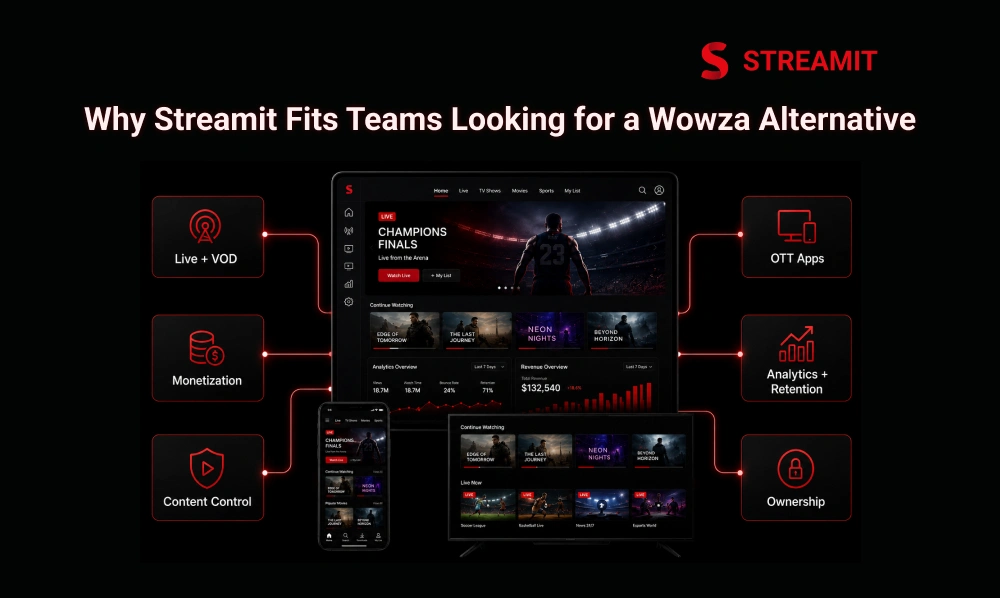
Streamit is a better fit when the requirement moves from streaming delivery to OTT business growth. It is designed for teams that want live streaming, VOD, apps, monetization, analytics, and ownership in one platform direction.
For serious streaming businesses, the question is not “Can we stream?” The better question is “Can we control the platform as the business grows?”
It Supports Live Streaming, VOD, and OTT Apps in One Platform
A connected platform reduces operational drag. Streamit supports live streaming, VOD, web, mobile, and TV app experiences as part of a broader OTT platform solution.
That matters because viewers move across screens. A user may discover content on mobile, continue on web, and watch longer on TV. The platform should support that journey without fragmented systems.
It Supports Monetization, Content Control, Analytics, and Retention
Revenue needs structure, not just a payment button. Streamit supports monetization models, content control, platform analytics, and retention-focused growth.
This helps teams understand what content performs, where users drop off, and how the platform can improve over time. For subscription-based streaming businesses, these signals matter as much as launch features.
It Gives Streaming Brands a Better Base for Long-Term Growth
A strong OTT foundation protects the next 12 months of growth. Streamit is suited for businesses that want ownership, flexibility, scalability, and a platform roadmap they can shape.
That makes it relevant for founders, broadcasters, educators, sports brands, fitness platforms, entertainment businesses, and media teams that want more than a short-term launch.
Summary
Key Takeaways
Wowza Is Strong for Infrastructure, Not Full OTT Ownership
If your business needs OTT apps, monetization, analytics, user control, and retention, compare complete platform capabilities – not only video delivery.
A Streaming Engine Cannot Run the Whole OTT Business
Apps, payments, content access, user journeys, analytics, and support systems still need to work together for the platform to feel reliable to viewers.
Total Cost Matters More Than the Starting License Price
CDN usage, storage, transcoding, DRM, TV apps, integrations, support, and future migration can significantly increase the real cost after launch.
Billing Status and Video Access Should Never Work in Isolation
If payment succeeds but content remains locked, users lose trust quickly and support issues increase – connected systems prevent this failure mode.
Streamit Gives Streaming Businesses a Stronger OTT Foundation
It fits teams that want more than a basic live streaming setup – providing live streaming, VOD, OTT apps, monetization, analytics, and long-term platform ownership.
Choose Your Alternative Based on Your Business Model
A live-event broadcaster has different needs from a subscription OTT brand. Match the platform type to your actual growth stage and revenue model.
Conclusion
Conclusion
Choosing from Wowza alternatives is not only a technical decision. It is a business architecture decision. The platform you choose will shape your app experience, revenue model, support load, content operations, and growth flexibility.
If you only need video delivery, a streaming-first solution may be enough. If you are building a serious OTT business, you need more than a streaming engine. You need a platform that supports live streaming, VOD, apps, monetization, analytics, security, and ownership from the beginning.
Streamit fits that second category. It helps teams move beyond basic streaming infrastructure and build an OTT platform that can support real users, real revenue, and long-term control.
FAQs
Frequently Asked Questions
-
Is Wowza enough to launch a complete OTT platform?
Wowza can support streaming infrastructure and video delivery, but a complete OTT platform needs more layers. You still need apps, CMS, monetization, analytics, user management, security, and retention systems.
-
What is the biggest limitation teams face when using Wowza?
The biggest limitation is that streaming delivery alone does not run the business. Many teams still need to build or connect the app experience, payment flows, content controls, and analytics separately.
-
Can I build OTT apps without using Wowza?
Yes, you can build OTT apps without using Wowza. A complete OTT platform can support live streaming, VOD, web apps, mobile apps, and TV apps through a different architecture.
-
What should I compare besides live streaming quality?
Compare OTT apps, monetization models, CMS tools, DRM, APIs, analytics, platform ownership, and total cost of ownership. Streaming quality matters, but it is not the full business picture.
-
Which Wowza alternative is better for subscription-based streaming businesses?
A subscription-based streaming business should look for a complete OTT platform with SVOD support, user management, analytics, retention tools, and multi-device apps. Streamit fits teams that want this broader platform foundation.
-
What hidden costs should I calculate before choosing a Wowza alternative?
Calculate CDN usage, storage, transcoding, TV app development, DRM, payment gateway integration, APIs, support, and future migration. These costs often appear after launch when traffic and content volume increase.