Cloud Cost Optimization for OTT: Grow Users Without Losing Margins


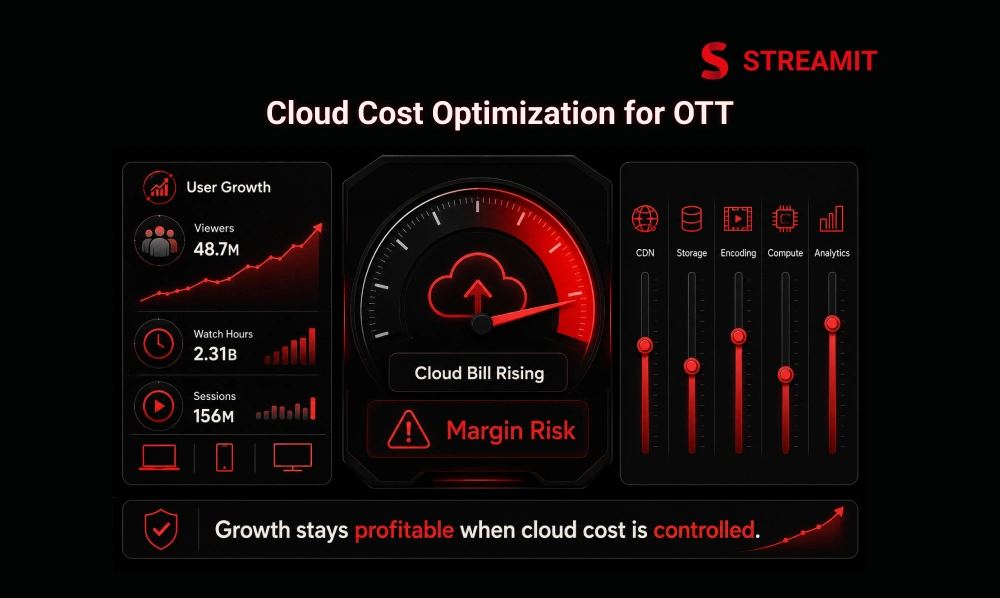
Growth is only healthy when the platform can afford it. In OTT, more users usually mean more streaming hours, more bandwidth, more storage, more encoding, and more background systems running at once.
That is why cloud cost optimization is not just a technical activity. It is a margin protection system. A streaming platform can look successful on the surface and still lose money quietly behind the cloud bill.
Cost Fundamentals
Why Cloud Cost Optimization Matters for OTT Platforms
OTT businesses do not scale like normal websites. A regular website may serve pages. An OTT platform serves large video files, user sessions, watch history, recommendations, payments, DRM, notifications, and multi-device playback.
A 25% increase in users can create a much higher increase in cloud cost if the platform is not planned well. The issue is rarely one big mistake. It is usually many small leaks growing together.
Why OTT Cloud Bills Grow as Users Increase
Every new viewer creates infrastructure activity. They browse content, play videos, switch devices, pause, resume, search, and stream through different network conditions.
When viewing hours rise, CDN usage, data transfer, storage requests, logs, analytics events, and support systems also rise. The cloud bill grows because the platform is doing more work every minute.
The Main Cost Drivers in OTT Infrastructure
The biggest OTT cloud cost drivers are usually video delivery, data transfer, video storage, encoding, transcoding, compute, databases, monitoring, and third-party services.
For most teams, CDN and egress costs deserve special attention. Video is heavy by nature, so inefficient delivery decisions can become expensive faster than expected.
| Cost Area | Why It Grows | What To Watch |
|---|---|---|
| CDN and delivery | More viewing hours | Cost per GB and cache hit ratio |
| Storage | Bigger content library | Hot, warm, and cold storage split |
| Encoding | More formats and bitrates | Duplicate or unnecessary jobs |
| Compute | Traffic and background tasks | Idle resources and over-scaling |
| Analytics | More user events | Retention value vs tracking volume |
Cost Problems
Common Cloud Cost Problems in OTT and Streaming
Most cloud cost problems are not caused by growth itself. They are caused by growth meeting weak infrastructure discipline.
The platform keeps adding users, content, devices, and regions, but nobody asks whether the current setup is still financially efficient.
Over-Provisioned Servers and Idle Resources
Idle resources are silent margin killers. Servers, databases, staging environments, and test systems often keep running even when they are not supporting real users.
For OTT teams, this usually happens after launches, campaigns, or traffic tests. The event ends, but the resources stay active.
Uncontrolled Scaling During Traffic Spikes
Auto scaling is useful, but it is not free intelligence. Poor scaling rules can add too much capacity too quickly during live events, premieres, or marketing pushes.
A traffic spike should not become a blank check. Scaling rules need limits, alerts, and business context.
High Data Transfer and CDN Charges
Streaming delivery cost can rise quickly when too much traffic goes back to the origin or when caching rules are weak. Every unnecessary origin request adds pressure.
The goal is not to reduce video quality blindly. The goal is to deliver the right version of the video from the right location at the right time.
Poor Cost Visibility Across Teams
When product, engineering, marketing, and finance see different numbers, cost control becomes guesswork. Nobody knows which feature, campaign, or region increased spend.
A better system shows cloud cost by workload, environment, user segment, content type, and revenue impact. That makes the cost a business conversation, not only an engineering issue.
Optimization Strategies
How to Reduce OTT Cloud Costs Without Hurting Performance
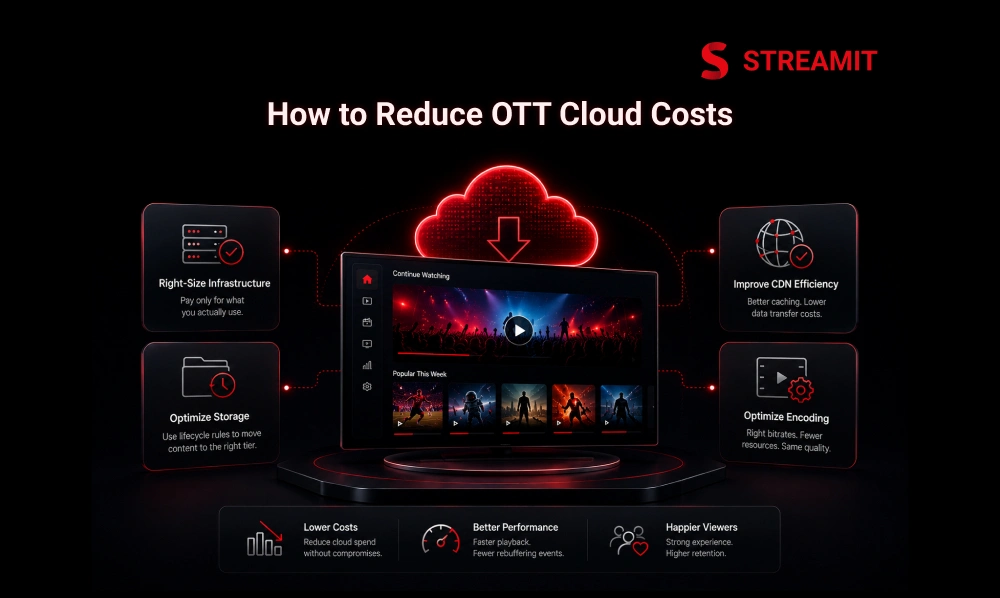
Cutting cloud cost should not mean breaking playback quality. The wrong savings plan can increase buffering, support tickets, and churn.
Good optimization protects both sides: the viewer experience and the business margin.
Right-Size Infrastructure and Remove Unused Resources
Right-sizing means matching infrastructure to actual demand, not imagined demand. Many OTT platforms pay for peak capacity even during normal usage hours.
Start with unused compute, oversized databases, old test environments, orphaned storage, and duplicate monitoring tools. These fixes often create savings without touching the user experience.
Optimize Video Storage and Lifecycle Rules
Not every video needs premium storage forever. New releases, popular titles, archive content, and old campaign videos should not all live in the same storage tier.
Lifecycle rules help move low-demand content into lower-cost storage while keeping active content fast and available. This protects the library without overpaying for every asset.
Improve CDN Caching and Data Transfer Efficiency
CDN optimization is one of the cleanest ways to reduce OTT delivery costs. Better caching reduces repeated origin requests and keeps playback closer to the viewer.
Teams should review cache rules, regional delivery patterns, file packaging, and origin shield usage. Small delivery improvements can matter a lot at scale.
Optimize Encoding, Bitrates, and Transcoding Jobs
The encoding strategy directly affects both quality and cost. Too many bitrate versions can waste storage and delivery time. Too few can hurt playback.
A practical approach is to align bitrate ladders with real viewer devices, network conditions, and content types. A sports stream, a lecture, and a movie may not need the same encoding logic.
FinOps
FinOps Metrics That Help OTT Teams Protect Margins
FinOps is where cloud cost becomes visible, owned, and connected to revenue. For OTT, this is especially important because streaming usage can grow faster than subscription revenue.
The key question is not, “Did our cloud bill increase?” The better question is, “Did cloud cost increase in proportion to active users, watch time, and revenue?”
Build Cloud Cost Ownership Across Teams
Cloud cost should not sit only with engineering. Product decisions, marketing campaigns, content launches, and device expansion all affect infrastructure spend.
When teams see the cost impact of their choices, decisions become sharper. This is where showback, chargeback, tagging, and shared dashboards help.
Track Cost Per User, Cost Per Stream, and Revenue Impact
A platform with 50,000 users and a large cloud spend is not automatically unhealthy. It depends on revenue, active usage, and content economics.
Track cost per active user, cost per stream, cost per viewing hour, and cloud cost as a percentage of revenue. These numbers reveal whether growth is becoming more efficient or more expensive.
| Metric | Why It Matters |
|---|---|
| Cost per active user | Shows user-level infrastructure efficiency |
| Cost per stream | Helps compare content and playback economics |
| Cost per viewing hour | Useful for VOD and live-heavy platforms |
| Cloud cost as % of revenue | Shows margin pressure clearly |
| CDN cost per region | Reveals expensive markets or weak delivery paths |
Set Budgets, Alerts, and Monthly Cost Reviews
Budgets are not only for finance teams. They help OTT teams catch cost movement before it becomes a margin problem.
Monthly reviews should connect spend to product activity. New region launched, new app released, live event hosted, library expanded: every cost movement needs a reason.
Architecture
Architecture Choices That Affect OTT Cloud Cost
Architecture decides how expensive growth becomes. A cheap launch can become costly later if the foundation is not designed for real usage.
This is where many OTT platforms make the wrong trade-off. They optimize for launch speed, then pay for it through rebuilds, outages, and unpredictable bills.
Use Auto Scaling, Load Balancing, and Capacity Planning Carefully
Auto scaling should be planned around traffic behavior, not hope. Live events, weekends, regional peaks, and new releases need different capacity patterns.
Load balancing also matters. If traffic is not distributed well, some systems get overloaded while others sit unused, which hurts both cost and performance.
Compare Serverless, Containers, and Microservices Based on Workload
No architecture style is automatically cheaper. Serverless can be efficient for event-driven workloads, while containers may suit predictable services better.
Microservices can improve control, but they also add operational cost if used too early. The right choice depends on workload, traffic pattern, team maturity, and scale stage.
Action Plan
Step-by-Step Cloud Cost Optimization Plan for OTT
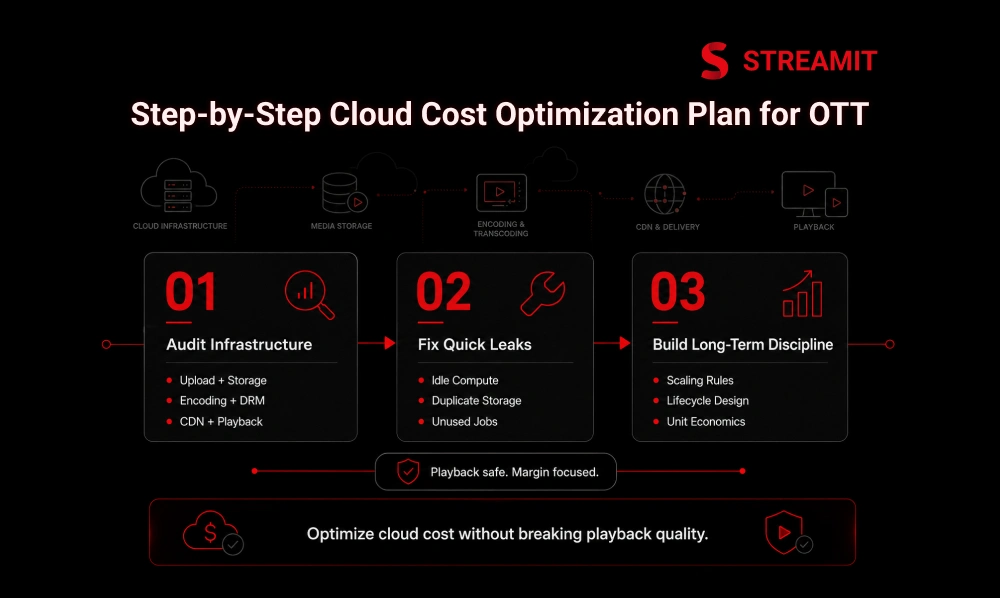
Cloud cost optimization should not start with random cuts. It needs a structured plan that protects playback, revenue, and user trust.
A good plan moves in three phases: understand current spend, fix obvious waste, then build long-term cost discipline into the platform.
-
1Audit Your Current OTT Cloud Infrastructure
Start by mapping the full streaming workflow: upload, storage, encoding, packaging, DRM, CDN, playback, analytics, payments, and support systems. Then connect each cost area to usage. Which services support real users? Which ones support internal processes? Which ones nobody owns anymore?
-
2Fix Quick Cost Leaks First
Quick leaks usually include idle instances, oversized databases, duplicate storage, old logs, unused snapshots, forgotten staging systems, and unnecessary transcoding jobs. These fixes are useful because they reduce cost without changing the product. They also create confidence before deeper architecture changes.
-
3Build a Long-Term Optimization Roadmap
Long-term optimization means cost control becomes part of platform planning. New content formats, new regions, new devices, and new monetization models should be reviewed before rollout. The roadmap should include CDN strategy, storage lifecycle design, encoding standards, scaling rules, observability, and unit economics dashboards.
Margin Protection
How Cloud Cost Optimization Protects OTT Margins
Margin is not protected only by increasing the subscription price. It is protected by making every stream, user, and feature more efficient over time.
This is why mature OTT teams do not treat cloud cost as a backend issue. They treat it as part of the business model.
Lower Infrastructure Cost Per Active User
If cloud cost grows more slowly than active users, the platform becomes more efficient. That is the sign of healthy scaling.
Lower cost per active user gives the business more room to invest in content, retention, marketing, and product improvements without hurting margins.
Reinvest Savings Into User Growth and Content
Cloud savings should not always sit as saved money. In OTT, savings can be redirected into better content, stronger campaigns, device expansion, and retention systems.
The point is not to run the cheapest platform. The point is to run a platform where infrastructure supports growth instead of quietly consuming it.
Streamit Solution
How Streamit Helps OTT Platforms Control Cloud Costs While Scaling
Streamit is built for streaming businesses that want ownership, performance, scalability, and long-term control. That matters because cloud cost is shaped by architecture from day one.
Instead of treating OTT as only an app build, Streamit looks at the platform as a full operating system for content, users, delivery, monetization, analytics, and growth.
Build a Scalable OTT Platform Without Overbuilding Infrastructure
Many teams overbuild because they are afraid of future traffic. Others underbuild because they want to launch quickly. Both decisions can become expensive.
Streamit helps plan a scalable OTT foundation that matches real growth stages. The goal is to support expansion without paying for unnecessary complexity too early.
Improve Streaming Performance Across Web, Mobile, and TV
Cloud cost and performance are connected. Poor delivery design can increase both buffering and infrastructure waste.
Streamit supports OTT experiences across web, mobile, and TV with a focus on smooth playback, delivery planning, and platform reliability. Better performance helps protect both user trust and cost efficiency.
Support Long-Term Growth With Better Platform Planning
The real cost of OTT is not only the launch build. It is the next 12 months of scaling, fixing, optimizing, and expanding.
Streamit helps teams think beyond the first release. That includes infrastructure planning, analytics visibility, monetization logic, user experience, and scalable operations.
Summary
Key Takeaways
Cloud cost optimization is margin protection
OTT platforms should not treat cloud cost as only a technical issue because every extra stream, user, and viewing hour directly affects profitability.
CDN and data transfer costs need close control
If video delivery is not optimized, streaming growth can quickly increase CDN spend and reduce platform margins.
Unused resources quietly waste budget
Idle servers, old test environments, oversized databases, and unnecessary storage can increase cloud bills without improving user experience.
Performance should not be sacrificed for savings
Good cloud cost optimization reduces waste while keeping playback smooth, fast, and reliable across web, mobile, and TV apps.
Cost visibility helps teams make better decisions
When teams track cost per user, cost per stream, and cloud cost versus revenue, they can scale with more control.
Long-term planning matters more than quick cuts
OTT platforms need scalable infrastructure, smart storage rules, CDN efficiency, and regular cost reviews to grow without losing margins.
Conclusion
Conclusion
Cloud cost optimization for OTT is not a one-time cleanup. It is a continuous operating habit that becomes more important as users, content, devices, and regions grow.
The slightly contrarian truth is simple: more users are not always good news if every new stream reduces margin. Growth should make the platform stronger, not more fragile.
For OTT founders and teams, the priority is clear. Build the platform with cost visibility, scalable architecture, and performance discipline from the beginning.
That is where Streamit fits. It helps streaming businesses plan, build, and scale OTT platforms that are designed for real traffic, long-term control, and healthier margins.
FAQs
Frequently Asked Questions
-
What is cloud cost optimization for OTT platforms?
Cloud cost optimization for OTT means reducing unnecessary cloud spend across delivery, storage, encoding, compute, and analytics without hurting playback quality. It helps streaming platforms grow users while protecting margins.
-
What are the biggest cloud cost drivers in OTT and streaming?
The biggest cost drivers are usually CDN bandwidth, data transfer, video storage, transcoding, encoding, compute, databases, and monitoring tools. These costs increase as viewing hours and content libraries grow.
-
How do you calculate cost per user on an OTT platform?
Divide the total relevant cloud cost by the number of active users in the same period. For better accuracy, teams can also track cost per stream, cost per viewing hour, and cloud cost as a percentage of revenue.
-
Can cloud cost optimization improve OTT profit margins?
Yes, because it reduces waste and improves infrastructure efficiency. When the platform spends less to serve each active user or stream, more revenue can stay inside the business.
-
Does cloud cost optimization slow down streaming performance?
Not when done correctly. Good optimization improves delivery efficiency, caching, encoding, and scaling rules, so users can still get smooth playback while the business controls cost.