OTT Platform Architecture: Setup & Hosting Costs Explained


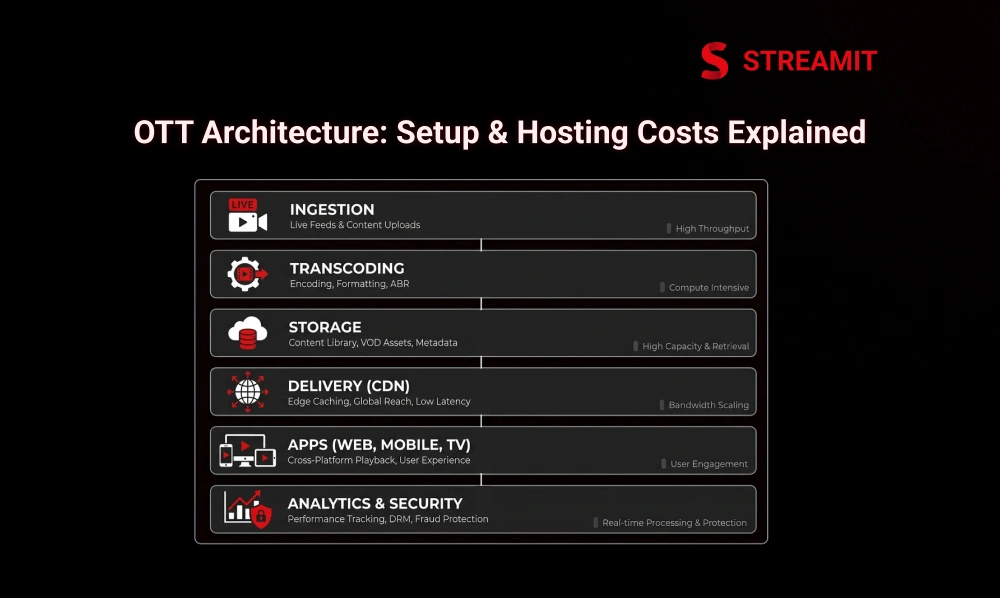
A 5% rebuffering rate means viewers spend 3 seconds waiting for every 60 seconds watched. That is why OTT platform architecture is not just a backend concern. It directly shapes playback quality, session stability, churn, and how efficiently your hosting budget turns into watch time. A modern streaming stack has to handle ingestion, transcoding, storage, delivery, apps, analytics, and security as one connected system, not as disconnected tools.
Most teams underestimate this early. They think they are budgeting for video delivery, when they are actually budgeting for a business system: control plane, data plane, security, monetization support, device coverage, and operating visibility. Serious OTT platforms rarely break because one player fails. They break because architecture decisions made for launch week cannot absorb month-12 complexity.
That is a useful way to read OTT costs. Hosting bills are not random. They usually arise when the architecture does not match the product model, audience pattern, or traffic shape.
Part 1
What Is OTT Platform Architecture in Modern OTT Streaming Solutions
OTT platform architecture is the complete system that powers how video is ingested, processed, stored, secured, delivered across devices, and measured, making modern OTT streaming solutions stable, scalable, and ready for real user demand.
Simple Definition of OTT Platform Architecture for OTT Platforms and Video Streaming OTT Solution Teams
OTT platform architecture is the system design behind how video gets prepared, protected, delivered, and measured. In simple terms, it is the full path from content input to viewer playback, plus the business logic that controls subscriptions, entitlements, analytics, and content operations.
For founders and product teams, that means architecture is not only about servers. It includes the streaming workflow, the CMS, user auth, device apps, CDN setup, analytics instrumentation, and security controls. The stronger the architecture, the easier it becomes to scale without rebuilding core systems later.
How OTT Platforms Work Across Video Delivery, Apps, and Streaming Infrastructure
A working OTT stack takes content from ingest to processing, storage, CDN delivery, playback, and analytics so video can stream smoothly across devices under different network conditions.
That is why OTT infrastructure decisions affect much more than uptime. They influence startup time, rebuffering, device compatibility, bitrate stability, and even monetization readiness.
OTT platform architecture connects ingestion, processing, storage, playback, and analytics
The architecture only works when the chain stays connected end to end. If ingest is fine, but packaging is weak, playback suffers. If delivery works but observability is thin, teams cannot diagnose errors fast enough. If analytics are delayed, cost optimization and retention decisions happen too late.
OTT setup changes by use case, scale, and business model
One architecture does not fit every OTT business. Entertainment libraries, live sports, online learning, fitness streaming, podcasts, and spiritual content all create different pressure points. Some need deep VOD catalogs and recommendation layers. Others live or die on concurrency handling, latency, and live-event resilience.
Part 2
Core Components of OTT Platform Infrastructure and OTT Platform Setup
OTT platform infrastructure and setup include the core layers that keep a streaming business running, from backend systems, databases, and content management to storage, transcoding, delivery, apps, analytics, and security.
Fixed Baseline Components in an OTT Platform Solution
Every serious OTT product has a baseline cost floor before scale even begins. Backend compute, databases, authentication, CMS operations, storage setup, player integration, and monitoring form the minimum operating stack. Those are not optional if the goal is reliability and control.
This baseline is where many budgets get distorted. Teams compare only launch cost, but the more useful comparison is operational completeness. A cheaper setup that lacks observability, clean auth flow, or asset management often becomes more expensive once real usage begins.
| Baseline Layer | What It Does | Why It Matters |
|---|---|---|
| Backend services | APIs, business rules, entitlements | Keeps playback, billing, and app logic in sync |
| Database | Users, plans, watch history, metadata | Supports personalization and continuity |
| Auth & access control | Login, subscriptions, device sessions | Protects revenue and user access |
| CMS & asset operations | Content, metadata, scheduling | Keeps catalog operations manageable |
| Monitoring & logs | Error tracking, uptime, alerts | Reduces the mean time to detect and fix issues |
Backend, database, auth, CMS, and OTT asset management solution layers
The control plane usually determines whether growth feels manageable or chaotic. Content operations, metadata hygiene, entitlement rules, and user identity are what let a platform evolve pricing, access models, and content packaging without tearing up the product later.
Frontend layers for OTT website, streaming app, OTT TV app, and smart TV delivery
Device expansion multiplies complexity faster than most early budgets assume. Web, mobile, TV, and smart TV delivery are not just extra screens. They create extra QA paths, player behavior differences, DRM considerations, release cycles, and analytics fragmentation.
Variable Infrastructure Components That Change Hosting Cost Fast
Three variables usually move the bill first: watch time, bitrate, and delivery geography. Once viewing hours rise, CDN egress, storage growth, and origin traffic begin to compound. That is why hosting costs often look stable for months and then spike quickly.
A CDN in front of storage reduces latency, increases bandwidth efficiency, and can lower the total cost of ownership by offloading origin traffic. That makes the caching strategy a financial decision, not just a performance choice.
Storage, bandwidth, watch time, and peak traffic drive OTT hosting costs
1 Mbps is roughly 0.45 GB per hour. So a stream averaging 2.5 Mbps consumes about 1.125 GB for each hour watched. That is why monthly watch hours matter more than monthly active users alone. A small audience with long sessions can cost more than a bigger audience with shallow consumption.
Peak traffic matters too. Live events compress demand into narrow windows, which raises pressure on ingest, packaging, origin shielding, CDN capacity, and real-time incident response.
Device mix and traffic geography affect streaming platform infrastructure cost
A globally distributed audience is more expensive than a local one, even at the same watch volume. Different regions create different cache behavior, latency paths, and CDN efficiency. Device mix matters too because older devices may need broader codec and rendition support, which increases packaging and testing overhead.
Part 3
Optional OTT Platform Features That Increase Architecture Complexity and Hosting Cost
Optional OTT platform features such as advanced transcoding, adaptive streaming, multi-CDN delivery, edge caching, DRM, and deeper analytics improve streaming quality and control, but they also increase architectural complexity and overall hosting cost.
Video Transcoding, Adaptive Streaming, and Video Compression Layers
Transcoding is where quality control and cost control meet. It converts source video into multiple formats, bitrates, and resolutions so playback can adapt to different screens and networks. That improves resilience, but it also adds processing cost and workflow complexity.
ABR ladders, CMAF, AV1 codec, and H.265 improve playback but add cost
AV1 can deliver up to 50% better compression than AVC in some cases. That can lower delivery weight over time, but it increases encoding complexity and may not be worth using across the full catalog on day one. Likewise, CMAF matters because it improves packaging interoperability across HLS and DASH workflows rather than forcing duplicate packaging paths.
Multi CDN, Edge Caching, and CDN Load Balancing for Better Video Delivery
Better delivery logic often saves money before it saves bragging rights. Edge caching reduces repeated origin fetches, and smarter routing lowers latency while protecting the origin from unnecessary load. Cloud CDN documentation explicitly ties CDN usage to lower latency, lower backend load, and lower cost.
Multi CDN improves uptime and QoE for large or latency-sensitive OTT platforms
Under 1% rebuffering is a practical target, and over 3% is already a serious warning sign. That is why large or latency-sensitive platforms often move toward multi-CDN thinking, not because it sounds enterprise, but because delivery path flexibility helps protect uptime and QoE when traffic surges or regions behave unevenly.
DRM, Video Encryption, and OTT Security Solutions for Protected Content
Premium OTT platforms need strong DRM from the start because weak security leads to piracy, access leaks, and rights issues across different device ecosystems.
Strong security is essential for premium OTT video solutions and enterprise streaming
Security complexity rises with content value, not just with traffic. Subscription platforms, rentals, premium sports, and enterprise libraries need encryption, key management, entitlement rules, and audit visibility built into the stack from the start.
Part 4
OTT Platform Hosting Cost Model Explained by Growth Stage
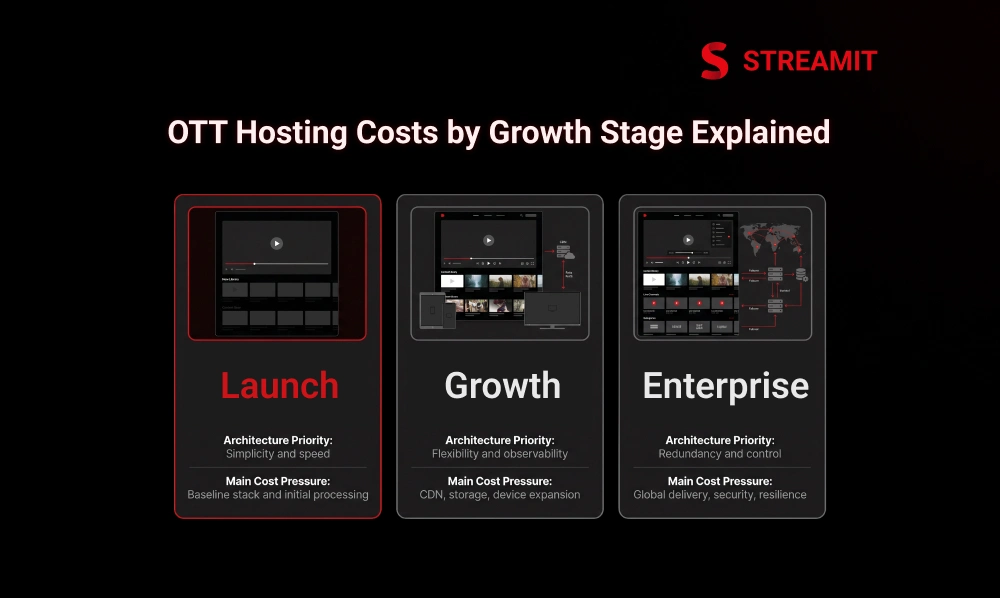
OTT platform hosting cost changes by growth stage because launch, scaling, and enterprise streaming platforms each need different levels of infrastructure, delivery capacity, observability, security, and performance planning.
Launch Stage Architecture and Cost for Small OTT Platforms
Early-stage OTT economics are usually won by discipline, not by feature volume. At launch, the goal is a clean baseline: reliable delivery, clear content operations, core analytics, and enough flexibility to change monetization without re-platforming.
Early-stage OTT setups prioritize speed, simplicity, and controlled hosting costs
A launch-stage stack should favor fewer moving parts, smaller rendition sets, focused device coverage, and disciplined observability. That keeps costs predictable while giving the platform room to learn from user behavior.
Growth Stage Architecture and Cost for Scaling OTT Platforms
The growth stage is where hidden architecture debt starts showing up on the bill. More traffic means more edge spend, more content means more storage and processing, and more devices mean more playback edge cases.
Growth-stage OTT platforms need better CDN strategy, observability, and architecture flexibility
This is usually the stage where cost control becomes an engineering problem. Better logs, delivery telemetry, cache tuning, and performance alerting matter because teams can no longer fix issues by intuition alone.
Enterprise Stage Architecture and Cost for Large OTT Streaming Solutions
Large OTT systems are not optimized for the cheapest monthly cost. They are optimized for reliable cost per delivered viewing hour. That is a different mindset. Redundancy, stronger security, staged failover, and global delivery planning may raise baseline spend while improving business predictability.
Enterprise OTT architecture must balance cost, performance, redundancy, and security
At scale, the wrong kind of savings becomes expensive. Removing redundancy may save budget on paper while increasing outage exposure, rebuffering, and support load during the moments when revenue concentration is highest.
| Growth Stage | Architecture Priority | Main Cost Pressure |
|---|---|---|
| Launch | Simplicity and speed | Baseline stack and initial processing |
| Growth | Flexibility and observability | CDN, storage, device expansion |
| Enterprise | Redundancy and control | Global delivery, security, resilience |
Part 5
How to Estimate OTT Platform Costs Before You Build
Estimating OTT platform costs before you build starts with understanding key cost drivers such as users, watch time, bitrate, storage, delivery, transcoding, and the overall complexity of your streaming setup.
The Inputs That Matter Most in OTT Cost Estimation
Four inputs shape the budget more than most pitch decks admit: users, hours watched, bitrate, and content type. Monthly active users help, but they are not enough. The more useful model is viewer-hours multiplied by delivery weight.
Users, watch time, bitrate, and content type shape your monthly hosting bill
VOD-heavy libraries usually scale more smoothly because demand is spread over time. Live-heavy models push costs into narrow windows and increase the need for delivery headroom, origin protection, and incident readiness.
Live streaming and sports OTT platforms usually cost more than VOD-heavy setups
Concurrency changes the economics faster than catalog size. Sports, ticketed live events, and appointment-viewing content often need stronger delivery redundancy and faster operational response than standard VOD services.
A Simple Formula for Monthly Streaming and CDN Cost Modeling
A practical planning model is:
Cost Formula
Monthly delivery GB ≈ Active viewers × hours watched per viewer × average delivered bitrate (Mbps) × 0.45
Then add the other buckets separately:
-
Storage
Master files and all rendition versions across your content catalog.
-
Transcoding and packaging
Processing cost for converting source video into multiple formats and bitrate ladders.
-
Analytics and monitoring
Telemetry, playback data, and operational alerting infrastructure.
-
DRM and security services
Content protection, key management, and entitlement enforcement.
-
App and backend operations
Compute, API hosting, database, and CMS operations running the platform day-to-day.
Cost planning should include storage, transcoding, CDN, analytics, and security overhead
The delivery bill is only part of the system bill. Teams that model only bandwidth usually under-budget the actual operating stack. Transcoding, analytics, content protection, logging, and backend operations all sit outside the simple CDN equation.
Part 6
Which OTT Platform Setup Makes the Most Sense for Your Use Case
The best OTT platform setup depends on your use case, because different streaming businesses need different levels of speed, control, scalability, device support, and infrastructure flexibility.
White Label OTT Solution, Low Code OTT Solution, or Custom OTT Platform Development
The right choice depends on how much future change your business expects. If the model is straightforward and speed matters most, a lighter setup can be rational. If pricing logic, content structure, device roadmap, and retention systems evolve aggressively, control becomes more valuable.
White-label OTT solutions work best for faster launches and lower setup complexity
White-label and low-code routes work best when the product needs to launch quickly, the operating model is relatively standard, and the team is comfortable with some long-term constraints.
Custom OTT platform development works best for control, scale, and differentiated architecture
Custom architecture makes more sense when the business expects layered monetization, deeper analytics, stronger ownership, and differentiated product behavior. It costs more to design correctly, but it reduces the odds of rebuilding core systems later.
Best OTT Architecture Patterns by OTT Business Type
Use case should decide architecture, not templates. That is where many OTT projects drift into waste.
| OTT Business Type | Architecture Priority |
|---|---|
| Entertainment / VOD | Catalog structure, discovery, device continuity |
| Live sports | Peak concurrency, low-latency delivery, resilience |
| eLearning | Access control, progress tracking, secure libraries |
| Fitness | Live + on-demand mix, mobile reliability, subscriptions |
| Podcast / audio-video | Efficient delivery, feed structure, multi-format support |
| Spiritual / event-led | Community access, live-event reliability, flexible pricing |
Entertainment, live sports, eLearning, fitness, podcast, and spiritual streaming all need different architecture priorities
A VOD-heavy entertainment service optimizes around discovery and throughput efficiency. A sports platform optimizes for concurrency and latency. An education platform cares more about access control, structured libraries, and continuity. The architecture should reflect that business reality early.
Part 7
How to Choose the Right OTT Solution Provider, Cloud Stack, and Hosting Strategy
Choosing the right OTT solution provider, cloud stack, and hosting strategy depends on how well they align with your platform’s scale, content model, delivery needs, security requirements, and long-term growth plans.
What OTT Solution Providers Should Help You Plan Before Launch
Good providers do not start with features. They start with load shape, content mix, device scope, risk tolerance, and operating model. That planning work is what keeps cost forecasts honest.
Hosting, scalability, video delivery, and playback quality must be planned together
Delivery strategy, storage layout, transcoding policy, and app behavior are tightly linked. When those decisions are made in isolation, teams usually pay twice: first during setup, then again during scale correction.
Security, observability, and cost visibility should be built in from day one
The earlier the stack includes alerting, playback telemetry, encryption policy, and cost tracking, the less reactive the platform becomes later.
When AWS, GCP, or Azure Fit Your OTT Platform Architecture Better
Cloud choice should be based on workflow fit, media capabilities, delivery needs, and enterprise requirements, not brand preference alone.
Cloud choice depends on media services, regional delivery, data stack, and pricing model
A practical rule is simple: choose the cloud that best matches your media workflow maturity, data strategy, regional delivery needs, and internal team comfort. Over-optimizing for unit price while under-optimizing for workflow fit usually backfires.
Part 8
How to Optimize OTT Hosting Costs Without Hurting QoE, QoS, or OTT Retention
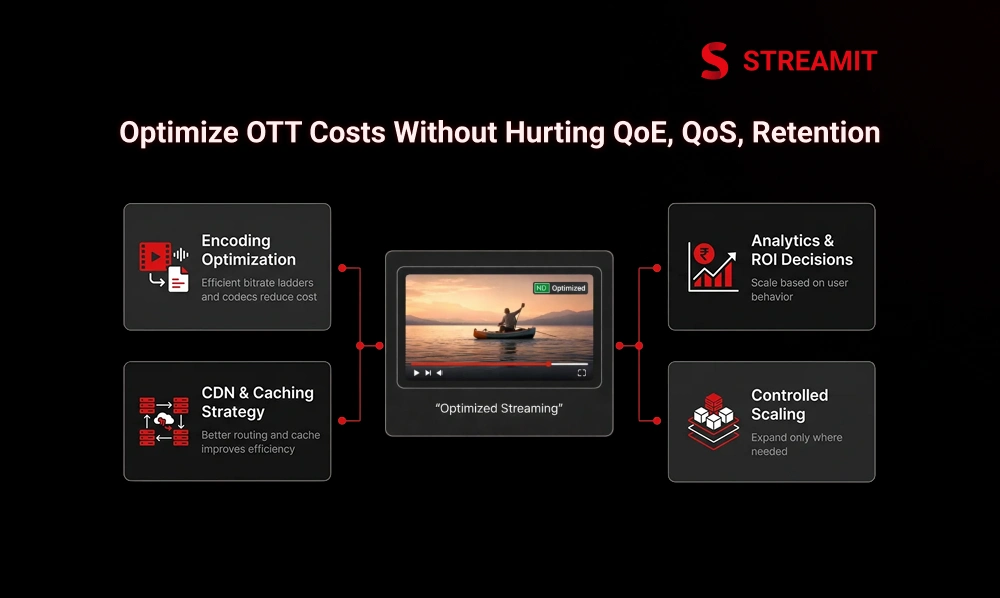
Optimizing OTT hosting costs without hurting QoE, QoS, or retention means reducing infrastructure waste through smarter encoding, caching, delivery, and scaling decisions while keeping playback quality and viewer experience stable.
Improve Cost Efficiency With Better Encoding, Caching, and CDN Strategy
The encoding policy is one of the cleanest levers for cost control. Better ladder design lowers waste without forcing obvious quality drops.
Better bitrate ladders reduce cost while protecting playback quality
Selective use of more efficient codecs can reduce long-term delivery and storage costs. AWS guidance notes that transcoding archives into more bit-efficient codecs, such as AV1 or HEVC, can reduce CDN and storage charges by up to 30% in some scenarios.
Smarter CDN and cache strategy reduces bandwidth spend and streaming issues
Better cache hit rate, cleaner routing, and stronger origin shielding reduce both backend strain and delivery waste. That is why the CDN strategy should be reviewed before traffic crises, not during them.
Use Platform Analytics and Retention Signals to Control Cost More Intelligently
Not every expensive feature earns the right to launch early. Analytics should decide that. If a module does not improve engagement, conversion, retention, or operational efficiency, it should not sit permanently in the stack.
Not every feature or module should be enabled at launch
A restrained launch usually performs better than an overbuilt one. Start with the layers that protect playback, content operations, core analytics, and monetization integrity. Expand only after behavior proves demand.
Scale architecture only where user behavior proves ROI
Watch time, completion rate, churn signals, and playback failure patterns should guide where the next dollar goes. Cost efficiency in OTT is rarely about cutting everything. It is about funding the parts that users actually feel.
Summary
Key Takeaways
Architecture Is a Business System
OTT architecture connects backend systems, content workflows, delivery, apps, analytics, and security – it goes far beyond video streaming alone.
Usage Drives Cost Fastest
Watch time, bitrate, storage, live traffic, and geography have a bigger impact on monthly spend than platform size alone.
Hosting Cost Changes by Stage
Launch, scaling, and enterprise platforms each need different infrastructure levels and control – what works at launch rarely survives growth unmodified.
More Features Mean More Complexity
Adaptive streaming, multi-CDN, DRM, and analytics improve performance but also raise hosting and operational cost.
Setup Should Match the Business
White-label, low-code, and custom OTT platforms fit different goals – the right choice depends on how much flexibility and control the business needs long-term.
Optimize for Experience, Not Just Cost
Smarter encoding ladders and CDN strategy can cut costs by up to 30% without hurting playback quality, retention, or viewer experience.
Conclusion
Conclusion
Most OTT platforms do not get expensive because video is hard. They get expensive because the architecture was too small for the business behind it. If you plan the stack around delivery logic, security, observability, device scope, and monetization maturity from the start, your hosting cost becomes easier to predict, and your product becomes easier to scale.
The better question is not, “What is the cheapest OTT setup?” It is, “What setup keeps playback stable, operating cost visible, and future change possible?” That is typically the architecture that holds up as your platform grows.
FAQs
Frequently Asked Questions
-
What is OTT platform architecture, and why does it matter for OTT streaming solutions?
It is the full system behind ingestion, processing, storage, delivery, apps, analytics, and security. It matters because it shapes both playback quality and long-term operating cost.
-
What are the core components of a streaming platform setup?
The core layers are backend services, database, authentication, CMS/content operations, storage, transcoding, CDN delivery, apps, monitoring, and security.
-
How much does OTT platform hosting cost for a new platform?
It depends less on launch size and more on watch time, bitrate, device scope, and content type. Small platforms can launch lean, but live delivery and multi-device complexity move costs up quickly.
-
What increases OTT platform infrastructure cost the fastest?
High watch time combined with inefficient encoding, poor CDN caching, traffic spikes during live events, and unoptimized delivery architecture tend to drive costs up the fastest.
-
Is custom OTT platform development better than white-label OTT solutions?
It is better when you need control, differentiated workflows, and room to scale. White-label setups are better when speed and lower setup complexity matter more.
-
Which OTT platform features affect hosting cost the most?
Transcoding, adaptive bitrate ladders, CDN strategy, multi-region delivery, DRM, analytics, and live-event architecture have the biggest cost impact.
-
How can I estimate OTT platform costs before launch?
Model viewer-hours first, then multiply by average delivered bitrate to estimate delivery volume. After that, add storage, transcoding, analytics, security, and backend operations.
-
What makes the best OTT streaming solution cost-efficient and scalable?
A strong solution keeps playback stable, keeps origin traffic under control, uses analytics to guide expansion, and avoids rebuilding core systems every time the business evolves.