How White Label OTT Turns Niche Audiences Into Subscribers


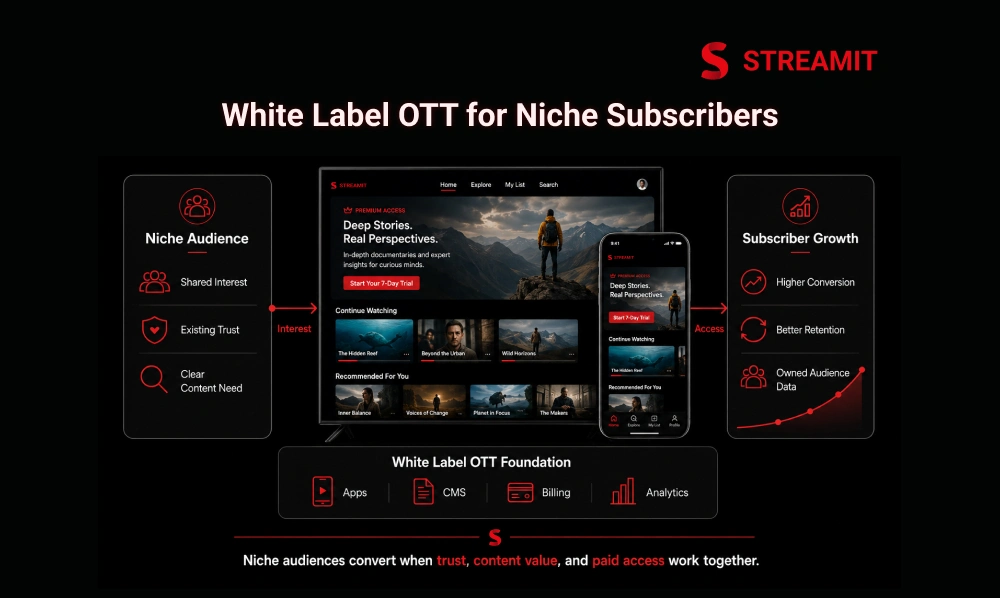
A niche audience does not need millions of viewers; it needs a credible reason to pay. Shared interests clarify demand, but attention alone does not create revenue.
Three systems must connect: content value, conversion, and ownership. A white label OTT platform links them while preserving the subscriber relationship.
Audience Dynamics
Why Niche Audiences Convert Differently in OTT
One focused promise can outperform a broad, unfocused catalog. Niche viewers usually arrive with a specific interest or community connection.
Conversion depends more on depth than reach. A niche platform grows by repeatedly satisfying that need.
Focused Audiences Have Clearer Content Needs
Three signals appear early: preferred topics, formats, and release expectations. These patterns make personalization practical.
Clear needs also simplify packaging. Content can be organized around outcomes, experts, events, or specialist interests.
Relevance Can Matter More Than a Massive Content Library
A catalog of 100 useful videos can beat 10,000 loosely connected titles. Viewers value fast, confident discovery.
Relevance supports OTT retention by reducing browsing fatigue. Smaller niche libraries compete when every collection feels intentional.
Existing Trust Makes Paid Access Easier to Position
One trusted relationship removes part of the acquisition barrier. Followers already understand the creator, organization, or community.
Trust still needs a commercial bridge. Paid access should feel like a deeper continuation, not an unrelated paywall.
Platform Ownership
How White Label OTT Creates an Owned Subscriber Journey
Four moments shape the journey: discovery, signup, viewing, and return. A white label solution keeps them inside one branded experience.
Ownership determines what the business can improve. Control over data, offers, and communication becomes an operating advantage.
Your Brand Controls the Content Experience and Subscriber Relationship
Two types of control matter: visual identity and business rules. Branding covers the interface; ownership covers accounts, access, pricing, and data.
The second layer creates lasting value. The business can shape the journey without external policies or algorithms.
Web, Mobile, and TV Apps Keep Viewers Inside One Ecosystem
Three screens serve different moments. Web supports discovery, mobile adds convenience, and TV encourages longer viewing.
A connected ecosystem reduces friction. Login, entitlements, watch history, and continue-watching should remain consistent across devices.
First-Party Viewer Data Improves Content and Offer Decisions
Five useful signals are starts, completion, watch time, returns, and cancellations. First-party data reveals real viewer value.
Platform analytics should lead to action. They can improve release timing, placement, trials, pricing, and re-engagement.
Conversion Strategy
How to Move Niche Viewers From Free Content to Paid Access
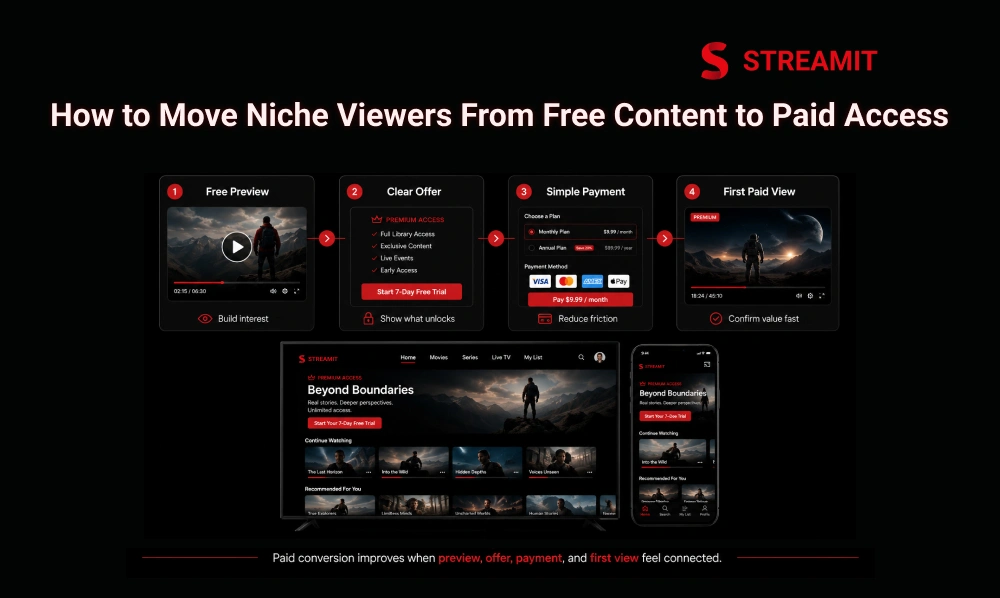
The free-to-paid journey needs one visible value gap. Free content proves relevance; paid access adds depth, exclusivity, or continuity.
Four stages must connect: preview, offer, payment, and first view. Confusion at any stage reduces subscriber conversion.
Free Content Should Create Interest Without Giving Away the Full Value
Reveal the problem freely, but reserve the complete system for members. Free content should build confidence without replacing premium value.
The boundary must feel fair. Viewers should receive real value while clearly understanding what payment unlocks.
Trials, Previews, and Exclusives Should Make the Upgrade Clear
A trial is evidence for the offer, not the offer itself. Users must reach premium value quickly.
Specific exclusives convert better than a vague “premium” label. Examples include archives, live sessions, early access, and member events.
Checkout and Content Access Must Stay Simple Across Devices
Every extra field creates another exit point. Checkout needs familiar payments, clear pricing, renewal terms, and few steps.
Billing and video access should never work in isolation. Payment followed by locked content destroys trust and raises support demand.
Onboarding Should Lead New Subscribers to Relevant Content Quickly
The first 10 minutes should confirm the purchase. Onboarding should direct subscribers to a relevant title, collection, or event.
Do not lead with a long product tour. Fast content discovery matters more than explaining every feature.
Platform Features
Features and Pricing That Improve Subscriber Conversion
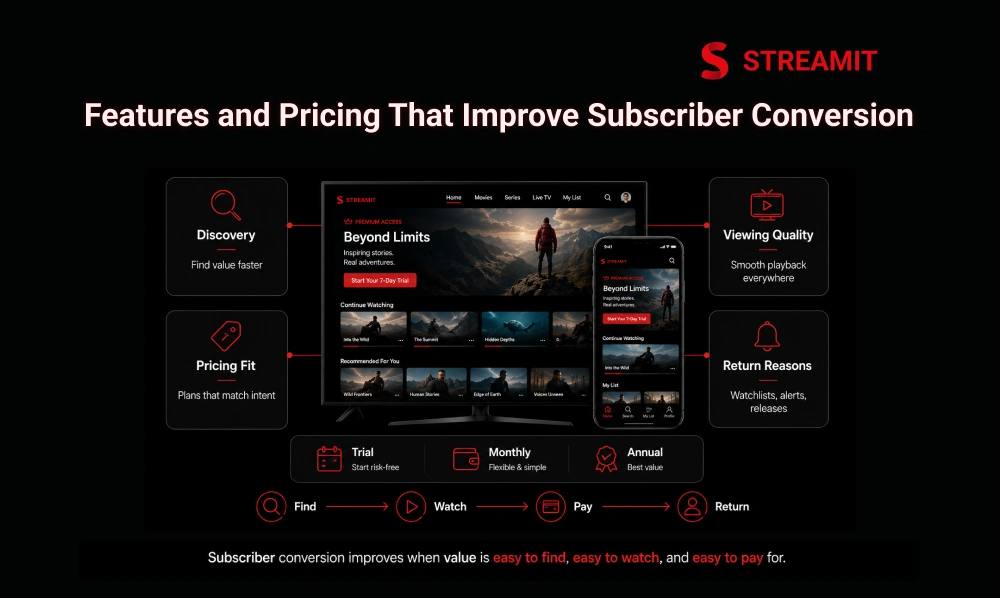
Three conversion levers matter most: discovery, viewing quality, and price acceptance. Features should support those decisions, not lengthen a specification list.
Pricing must reflect audience economics. The platform should support testing without rebuilding the journey.
| Conversion Area | Viewer Need | Platform Support |
|---|---|---|
| Discovery | Fast relevance | Search, metadata, personalization |
| Experience | Reliable viewing | Adaptive streaming, TV apps, sync |
| Payment | Clear value | Trials, plans, bundles |
| Return | Ongoing reasons | Watchlists, notifications, releases |
Personalization, Search, and Metadata Reduce Discovery Friction
A subscriber who cannot find value may assume it is absent. Search, personalization, and metadata shorten the playback path.
Good discovery begins with structure. Consistent titles, categories, people, and topics support stronger recommendations.
Reliable Playback and TV Apps Increase Perceived Subscription Value
One playback failure can outweigh several polished screens. Adaptive streaming protects the viewing moment.
TV access makes a niche service feel more complete. It supports shared and longer viewing sessions.
Pricing Must Match Content Frequency and Audience Value
A monthly price creates a monthly expectation. Pricing should reflect frequency, exclusivity, quality, and return behavior.
SVOD works when value renews with billing. Irregular content may suit annual access, seasonal passes, or TVOD better.
Trials, Bundles, and Hybrid Models Reduce Payment Friction
Three common objections are uncertainty, commitment, and affordability. Trials, bundles, and introductory plans address them without permanent discounts.
Hybrid monetization creates more entry points. SVOD, AVOD, and TVOD can serve different segments when the rules stay simple.
Validation
The Niche Conversion Test Most OTT Brands Skip
A loyal follower is not automatically a qualified subscriber. Payment intent depends on need, usage, and perceived value.
The test must be behavioral. Validate what people watch, revisit, and pay for.
A Loyal Audience Is Not Always Ready for Another Subscription
One recurring payment competes with every existing subscription. Enthusiastic followers may reject an optional or repetitive offer.
Sharper positioning works better than louder promotion. Explain why the service deserves regular attention.
Content Must Be Exclusive, Useful, or Frequent Enough to Justify Payment
At least one of three value drivers must be strong: exclusivity, utility, or frequency. Weakness across all three makes payment hard to defend.
Value must be visible before checkout. Viewers should know what they gain, how it changes, and why alternatives fall short.
The Platform Needs a Clear Reason for Subscribers to Return Regularly
Retention begins before payment. Episodes, events, programs, or community activity should create a return rhythm.
Habit cannot be added later through notifications alone. The content model itself must reward repeat visits.
Subscriber Density Matters More Than Total Follower Count
Ten thousand aligned viewers can outperform one million passive ones. Concentrated interest and trust matter more than raw reach.
Measure density through behavior. Purchases, repeat viewing, attendance, and email response indicate conversion potential.
Retention
How to Retain Niche Subscribers After Conversion
The first payment proves interest; repeated payments begin to prove fit. Retention depends on recurring value after launch momentum fades.
Four systems support retention: programming, habit, re-engagement, and belonging. They should reinforce one another.
Consistent Content Releases Give Subscribers a Reason to Stay
A predictable schedule reduces uncertainty. Subscribers should understand what is coming and when new value will arrive.
Consistency does not require constant volume. Weekly, monthly, seasonal, or event-led programming can build engagement.
Watchlists, Continue Watching, and Personalization Build Habit
Three small features remove repeated effort: watchlists, history, and continue-watching. They preserve viewing intent between sessions.
Recommendations should deepen the niche, not flatten it. Suggestions must reflect real interests and viewing context.
Email, Notifications, and Social Content Bring Viewers Back
A return message should point to something specific. Highlight a new episode, saved title, live session, or unfinished program.
Social content should reopen the viewing loop. Clips and discussions can re-engage subscribers, not only prospects.
Community Access and Member Benefits Strengthen Loyalty
Belonging adds value that a video library cannot easily copy. Discussions, events, and direct access can strengthen loyalty.
Benefits must connect to the core subscription. Separate, low-value extras rarely compensate for weak content.
Analytics
Metrics That Show Whether a Niche Audience Is Converting
Four metric groups matter: acquisition, activation, retention, and value. Analytics should show where viewers progress or stop.
No single number is enough. Conversion may rise while churn worsens, so metrics must be read together.
| Stage | Primary Metric | Question |
|---|---|---|
| Acquisition | Visitor-to-trial | Is the offer clear? |
| Activation | First-week starts | Did users reach value? |
| Retention | Returns and churn | Is habit forming? |
| Value | Lifetime value | Is growth sustainable? |
Visitor-to-Trial and Trial-to-Paid Conversion
Two rates separate interest from payment intent. Visitor-to-trial tests the offer; trial-to-paid tests the experience.
Compare both by channel and segment. Smaller, aligned sources may outperform high-volume traffic.
First-Week Watch Time and Content Start Rate
The first seven days reveal whether onboarding worked. Watch time and starts show whether subscribers reached value.
Low activation needs diagnosis, not more acquisition. The issue may be discovery, access, fit, or onboarding.
Return Frequency, Churn, and Subscriber Lifetime Value
Three measures explain revenue durability. Returns show habit, churn shows loss, and lifetime value shows the result.
Track cohorts, not averages alone. Retention often differs by plan, interest, offer, and source.
Performance by Content Type, Device, and Audience Segment
One platform can contain several subscriber businesses. Live viewers, course users, families, and superfans behave differently.
Device data adds context. It shows where discovery, long sessions, and playback problems occur.
Platform Evaluation
What a White Label OTT Platform Must Support for Subscriber Growth
Seven areas deserve scrutiny: ownership, apps, monetization, analytics, security, integrations, and cost. A provider should explain how they connect after launch.
The cheapest entry price can hide the highest growth cost. Evaluate future subscribers, traffic, support, and migration risk.
Brand, Subscriber Data, and App Ownership Must Be Clear
Three ownership questions need written answers. Who controls app accounts and data, and what happens when the agreement ends?
Brand customization is not enough. Ownership includes audience access, portability, and product freedom.
Monetization, Multi-Device Playback, Analytics, and Retention Must Work Together
Four disconnected systems create four failure points. Payments, apps, analytics, and retention must share identity and entitlement data.
Integration quality reaches the viewer directly. Purchases, device switches, and cancellations should update accurately everywhere.
Security, Integrations, Support, and Growth Costs Must Be Checked Early
One overlooked dependency can become an expensive constraint. Assess security, payments, identity, reporting, and support before commitment.
Model costs at several growth levels. Include delivery, apps, integrations, support, and usage-based fees.
Streamit Solution
Why Streamit Fits Niche Platforms Focused on Subscriber Growth
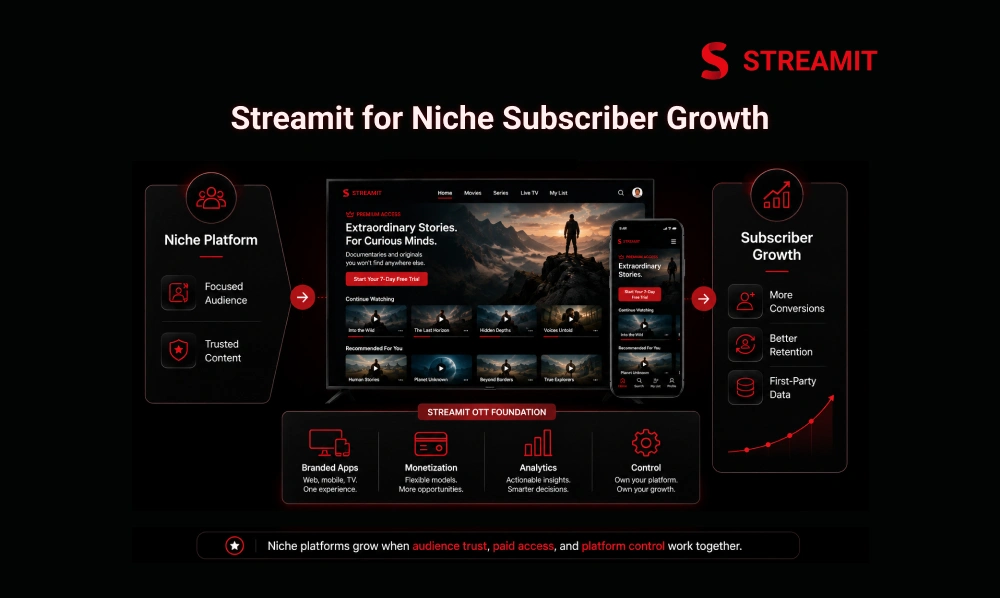
Streamit is built for brands treating streaming as a business, not a campaign. It connects branded apps, monetization, analytics, and control.
The fit is strongest when the niche has room to grow. Teams gain a faster foundation without a rigid roadmap.
It Supports Branded Apps Across Web, Mobile, and TV
Three application layers create one branded ecosystem. Streamit supports experiences across web, mobile, and TV.
Consistency protects conversion and retention. Accounts, access, and viewing progress remain connected across devices.
It Supports Monetization, Discovery, Analytics, and Retention
Four growth functions should share one operating view. Streamit connects monetization, discovery, analytics, and engagement.
That connection improves decisions. Teams can refine offers and programming using viewer behavior.
It Helps Niche Brands Own and Grow Their Subscriber Base
Ownership becomes more valuable with every subscriber acquired. Streamit supports control over the platform, audience, and growth direction.
A scalable platform preserves options. Brands can adjust monetization, retention, and devices without replacing the foundation.
Summary
Key Takeaways
Focused Relevance Outperforms Catalog Size
Niche viewers are more likely to subscribe when content consistently serves a clear interest instead of offering a large but loosely connected library.
Trust Reduces Resistance, Not the Payment Barrier
Existing followers know and trust the brand, but they still need exclusive, useful, or regularly updated content that justifies another subscription.
Free and Paid Content Need a Visible Value Gap
Free content should demonstrate expertise and create interest, while paid access should offer greater depth, exclusivity, convenience, or community benefits.
Billing and Video Access Must Never Work in Isolation
If payment succeeds but content remains locked, users lose trust quickly and support issues increase – integration quality reaches the viewer directly.
Subscriber Density Beats Total Follower Count
A smaller audience with strong purchase intent and repeat engagement can create more sustainable growth than a large but passive following.
Platform Ownership Compounds With Every Subscriber
Control over branded apps, first-party data, pricing, communication, and analytics gives niche OTT businesses more freedom to improve and scale.
Conclusion
Conclusion
A niche audience becomes a subscriber base when trust turns into recurring value. White label OTT supplies the foundation; relevance and return behavior determine growth.
The better platform decision looks beyond launch. Choose infrastructure supporting ownership, multi-device delivery, analytics, monetization, and improvement.
FAQs
Frequently Asked Questions
-
Can a Loyal Niche Audience Still Refuse to Pay for OTT?
Yes. Loyalty creates attention, but payment requires exclusive, useful, or regularly refreshed value that free alternatives cannot replace.
-
Why Do OTT Trials Fail to Convert Niche Viewers?
Trials fail when users reach valuable content too slowly or cannot see the difference between free and paid access.
-
Why Do Niche Subscribers Cancel After the First Month?
Many leave after consuming the main exclusive content. A visible release schedule and clear next reason to return improve retention.
-
Which Metric Shows if a Niche Audience Is Ready to Subscribe?
Paid conversion from a small test is the strongest signal. Read it with first-week viewing, returns, and trial-to-paid conversion.
-
Can Platform Fees Make a Niche OTT Subscription Unprofitable?
Yes. Delivery, payment, app, support, per-user, and revenue-share fees can compress margins, especially with a small subscriber base.
Read Also
Read Also
1. What Is Streamit? AI-First OTT Platform for Streaming Businesses
2. How Netflix’s Recommendation System Boosts Watch Time
3. How to Reduce Buffering in OTT Without Hurting Video Quality
4. 11 Ways to Improve Streaming Performance & Reduce Buffering
5. Subscriber Retention for OTT Platforms: 15 Proven Tactics to Reduce Churn