Build a Subscription-Based Video Platform Using Laravel Cashier


A subscription video platform is not won at checkout. It is won every month after checkout.
Most teams think the hard part is accepting payments. In reality, the hard part is keeping billing, access, content, playback, and user trust aligned as the platform grows. Laravel Cashier can give you a clean foundation for subscription billing, but the business still needs stronger thinking around access rules, renewals, trials, plan changes, failed payments, and long-term subscriber retention.
If you are building a paid video product, the goal is not to create another streaming website. The goal is to build a controlled subscription system where users know what they get, payment logic works quietly in the background, and content access never feels confusing.
Foundations
What a Subscription-Based Video Platform Needs to Do
A paid video platform has 2 products: the content users watch and the access system they pay for. If either one feels weak, the business starts leaking trust.
The platform must support recurring revenue, secure video access, simple plan management, and a viewing experience that keeps users coming back after the first payment.
A Subscription Platform Must Control Access, Not Just Stream Content
Users are not only paying for videos. They are paying for permission, convenience, quality, and continuity.
Your platform should make access rules clear, including who can view each video, when access begins or ends, and what happens after plan upgrades, expiries, or failed payments.
Billing Logic and Content Access Must Work Together
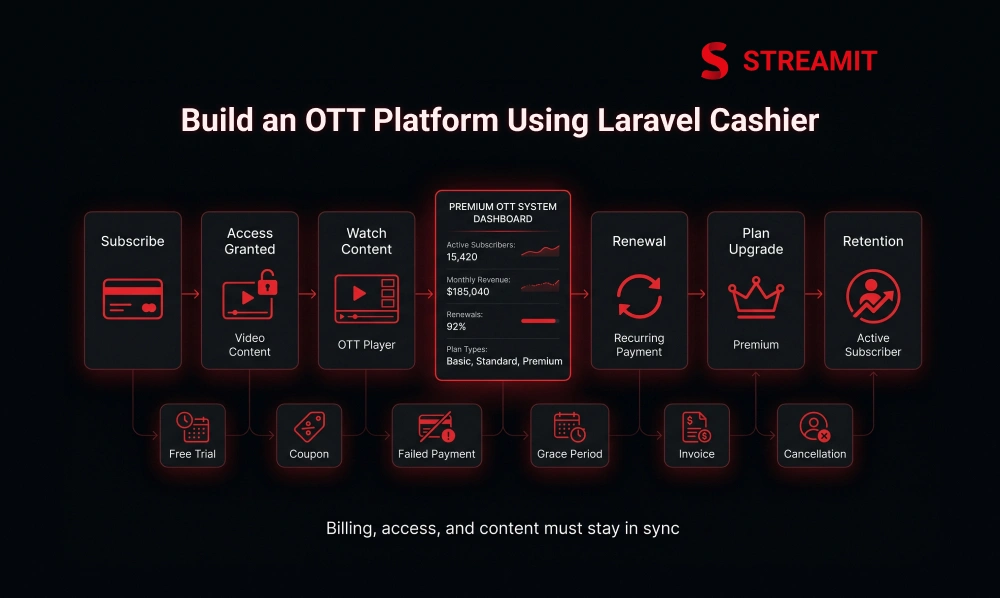
Billing and access cannot sit in separate corners of the product. If payment succeeds but video access fails, support tickets rise fast.
A serious subscription OTT product needs one reliable source of truth for subscription status, entitlement, grace period, and plan rules.
A Good Subscription Product Needs More Than Checkout
Checkout is only the first transaction. The real lifecycle includes trials, renewals, failed payments, invoices, cancellations, win-back flows, and account controls.
If those flows are not planned early, the platform may launch well but struggle once real subscribers start changing plans and payment methods.
Why Laravel Cashier
Why Teams Use Laravel Cashier for Subscription Video Platforms
Laravel Cashier reduces billing complexity, but it does not remove product complexity. That is the important distinction.
It is useful when your Laravel platform needs structured subscription billing without building every billing operation from scratch.
It Handles Plans, Trials, Invoices, and Subscription Changes
Cashier helps manage recurring billing, trials, invoices, coupons, plan swaps, and subscription states through Laravel-friendly methods.
For a video platform, this gives developers a cleaner billing layer so the team can focus more attention on content access, playback, and retention.
It Works Best When Billing, Access Rules, and Product Logic Stay Connected
Cashier works best when it is not treated as a payment add-on. It should connect directly with the user model, plan rules, and content permissions.
The stronger the connection between billing status and platform behavior, the fewer access problems users experience after launch.
Planning
What to Plan Before You Start Building
The first 30 days of planning often decide the next 12 months of platform stability. Early shortcuts become expensive when subscribers grow.
Before development starts, define your audience, content model, pricing structure, device roadmap, and access logic.
Define Your Content Model, Audience, and Pricing Structure
A VOD library, course-style platform, sports archive, creator membership, and entertainment OTT platform all need different subscription logic.
Pricing should match how users consume content, not just what looks attractive on a pricing page.
Decide Whether You Need Monthly Plans, Annual Plans, or Hybrid Billing
Monthly plans reduce buying friction. Annual plans improve cash flow and retention. Hybrid billing gives users choice but adds more plan logic.
The right model depends on content frequency, audience loyalty, and how predictable your release calendar is.
Decide What Content Is Free, Gated, Trial-Based, or Premium
Not every video needs to sit behind the same wall. Some content can attract users, some can convert them, and some can retain them.
A clear content access model helps avoid messy exceptions later.
Decide If You Are Launching Web First or a Full Multi-Device Product
A web-first launch is faster. A full web, mobile, and TV strategy needs more planning around sessions, subscriptions, playback behavior, and device access.
The mistake is not starting small. The mistake is starting small with no path to scale.
| Planning Area | Simple Launch | Scalable Launch |
|---|---|---|
| Pricing | 1 monthly plan | Monthly, annual, trial, premium tiers |
| Access | Logged-in users only | Plan-based content rules |
| Devices | Web only | Web, mobile, and TV roadmap |
| Retention | Basic renewals | Failed payment, win-back, churn signals |
Architecture
Core Architecture of a Subscription-Based Video Platform in Laravel
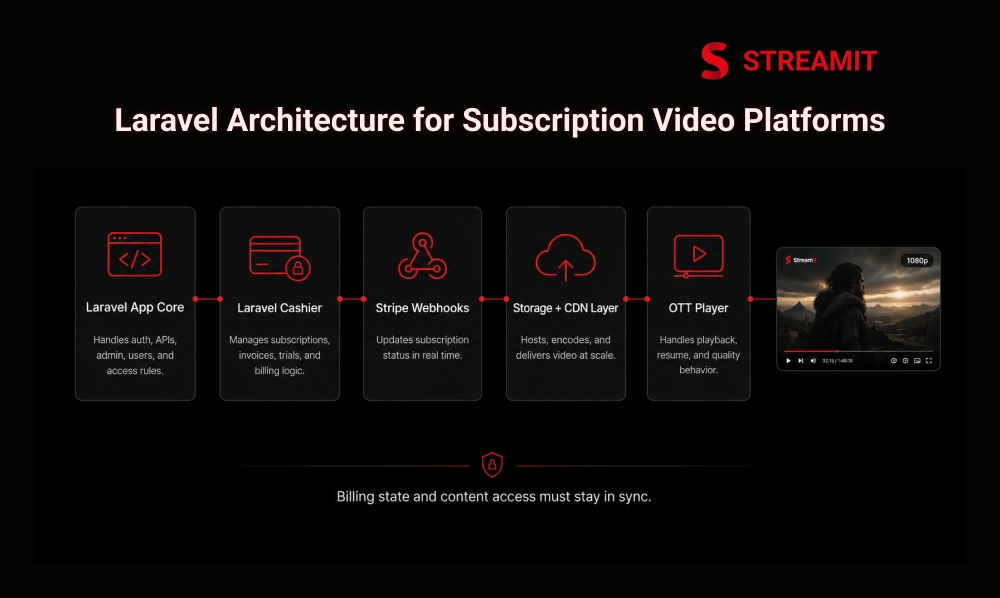
The strongest architecture separates responsibilities without disconnecting them. Laravel should not do everything, but it should control the business logic.
A practical subscription video platform includes Laravel, Cashier, webhook handling, admin controls, video storage, delivery infrastructure, and playback layers.
Laravel for Auth, Billing, APIs, Access Rules, and Admin
Laravel can handle user accounts, authentication, admin workflows, subscription permissions, APIs, and platform logic.
This keeps the business rules structured while the video delivery layer focuses on playback performance.
Cashier for Subscription State, Invoices, and Customer Billing Flows
Cashier helps manage subscription records, billing states, invoices, trials, cancellations, and plan changes.
This gives the platform a clean billing backbone instead of scattered payment conditions across the codebase.
Stripe Webhooks for Renewal, Trial End, Cancellation, and Payment Failure
Webhook events matter because a subscription can be updated even when the user is not active on the platform.
Renewals, payment failures, cancellations, and trial endings must update platform access reliably.
Storage and Delivery Layer for Video Hosting and Playback
Laravel should not be responsible for directly streaming heavy video traffic.
Use the right storage, encoding, CDN, and playback setup so the app stays fast while video delivery remains stable.
| Layer | Main Responsibility |
|---|---|
| Laravel | Users, APIs, admin, access rules |
| Cashier | Subscription billing logic |
| Webhooks | Subscription status updates |
| Storage/CDN | Video hosting and delivery |
| Player | Playback, resume, quality behavior |
Build Process
Step-by-Step Process to Build the Platform
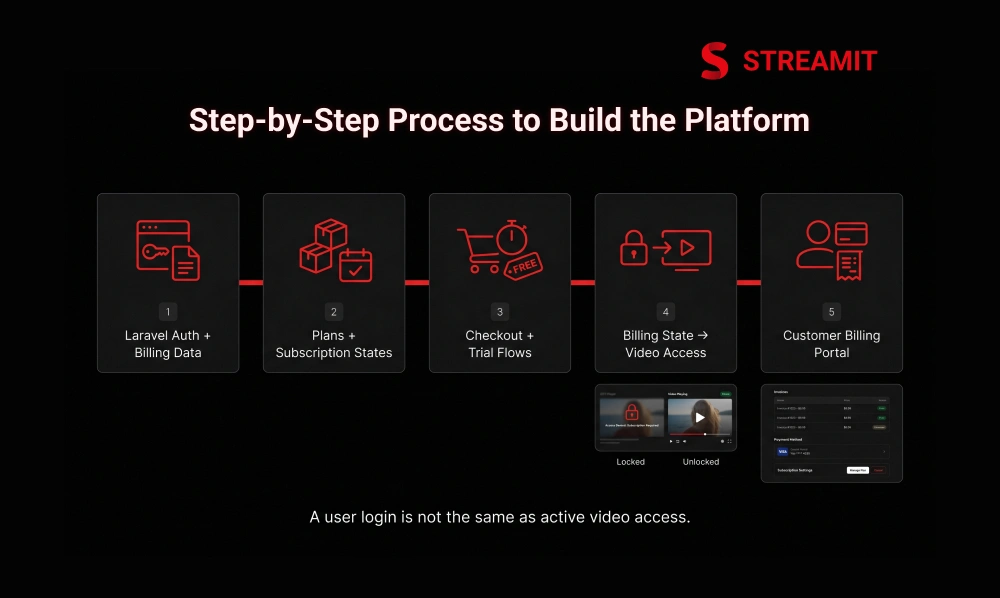
A subscription build should move from billing clarity to access control before adding advanced features. That order prevents expensive rework.
Start with a focused VOD product, then add plan complexity only when the foundation is stable.
-
1
Set Up Laravel, Auth, and Customer Billing Data
Begin with user registration, login, billing profile fields, and a clean subscriber model. The user account must be ready to connect identity, subscription status, and content access.
-
2
Create Plans, Pricing Logic, and Subscription States
Define plans in a way the business can understand, and the system can enforce. Each plan should map to clear permissions, not vague labels.
-
3
Build Checkout, Trial, Upgrade, Downgrade, and Cancellation Flows
Checkout should feel simple, but the backend must handle edge cases. Trials, swaps, cancellations, and billing changes need predictable rules before real users arrive.
-
4
Connect Billing State to Video Access Rules
A user being logged in is not the same as having an active subscription. Your access layer should check active subscription, plan type, content rules, and grace status before playback.
-
5
Add Customer Billing Portal and Self-Service Account Controls
Self-service billing reduces support pressure. Users should be able to update payment methods, view invoices, manage plans, and cancel without contacting your team for every change.
Platform Features
Core Features Every Subscription Video Platform Needs
Features are only valuable when they reduce friction across the subscriber journey.
A strong platform needs account control, content discovery, access logic, billing visibility, and admin management.
User Accounts, Subscription Status, and Access Permissions
Every user should have a clear subscription state.
The platform should know whether the user is trialing, active, past due, canceled, or blocked from premium content.
Content Library, Categories, Search, and Continue Watching
A paid platform must help users find content quickly.
Categories, search, resume watching, watch history, and structured metadata all support retention.
Trial Access, Paid Access, and Plan-Based Content Rules
Trial users may need limited access, while paid users may unlock full libraries or premium sections.
Plan-based rules make monetization more flexible without confusing the viewer.
Billing History, Invoices, and Payment Method Management
Subscribers expect billing transparency.
Invoice history, payment method updates, and plan details should be easy to find inside the account area.
Admin Controls for Users, Plans, Coupons, and Revenue Tracking
Admins need control over users, plans, pricing, coupons, content access, and revenue views. Without this, every small business change becomes a developer task.
Common Gaps
Subscription Logic Teams Often Miss Early
Most subscription problems are not technical surprises. They are planning gaps. Teams usually remember checkout, but forget the conditions that happen after billing begins.
Trial End and Renewal Logic Must Not Break Viewer Access
Trial endings should move users into paid access or restricted access cleanly. If the platform gives mixed signals, users lose confidence quickly.
Failed Payments and Grace Periods Need Clear Recovery Rules
A failed payment should not always mean instant lockout.
Grace periods, retry logic, reminders, and recovery flows protect revenue without creating unnecessary frustration.
Plan Changes Need Smooth Upgrade and Downgrade Handling
Plan changes can affect access, billing dates, invoices, and content permissions. Define whether changes happen instantly, at renewal, or after payment confirmation.
Security
Security, Access Control, and Revenue Protection
A paid video platform is a revenue system, not just a content library. Access must be protected carefully.
Security planning should cover paid content, accounts, trials, coupons, and shared access risks.
Protect Paid Content With Signed Access and Gated Playback
Paid videos should not be exposed through simple public URLs.
Use gated playback, signed access, and time-limited permissions to reduce unauthorized viewing.
Separate Logged-In Access From Active Subscription Access
A logged-in user may not be a paying user. Keep authentication and subscription authorization separate, so access decisions stay accurate.
Watch for Coupon Abuse, Trial Abuse, and Shared Account Risk
Growth campaigns can create abuse if rules are weak. Limit coupon usage, detect repeated trials, and monitor suspicious account patterns.
Post-Launch Risk
What Usually Breaks First After Launch
The first cracks usually appear when real subscribers behave differently from test users. Launch testing often misses failed renewals, plan swaps, support issues, and billing confusion.
Billing Success and Access Logic Go Out of Sync
A payment may succeed while the platform still shows locked content. This usually happens when webhook handling and access checks are not designed properly.
Failed Payments Are Collected Poorly and Increase Churn
Failed payments are not just billing events. They are retention moments. Clear reminders and recovery flows can protect revenue that would otherwise disappear quietly.
Plan Changes Create Confusing Access for Users
Users should never wonder why a plan upgrade did not unlock content. Plan transition rules must be visible in both the backend and user interface.
Teams Track Revenue but Ignore Subscription Health Signals
Revenue tells you what happened. Subscription health tells you what is starting to break before revenue drops.
Analytics
Metrics That Matter in a Subscription Video Platform
A platform with 1,000 subscribers can still be unhealthy if trials, payments, and watch time are weak.
The right metrics connect billing performance with viewer behavior.
Trial-to-Paid Conversion and Active Subscriber Rate
Trial conversion shows whether users see enough value to pay. Active subscriber rate shows whether the paid base is stable or slowly weakening.
Failed Payment Rate, Recovery Rate, and Churn
Failed payment rate shows billing friction. Recovery rate and churn show how well the business protects recurring revenue.
Watch Time by Plan and Revenue by Subscriber Segment
Watch time by plan reveals which subscribers are truly engaged. Revenue by segment helps decide pricing, upsells, and retention strategy.
| Metric | Why It Matters |
|---|---|
| Trial-to-paid conversion | Shows offer strength |
| Failed payment recovery | Protects recurring revenue |
| Churn rate | Reveals retention risk |
| Watch time by plan | Shows product value |
| Revenue by segment | Guides pricing decisions |
Build Investment
Cost, Timeline, and Team Model for This Build
Cost is shaped less by screens and more by logic. Billing flows, access rules, device support, and support systems decide the real effort.
A simple web-first product can move faster. A multi-device subscription OTT platform with complex plans needs deeper planning and a stronger team.
What Changes the Timeline: Billing Flows, Access Rules, and Devices
More devices mean more testing. More plan rules mean more edge cases. More payment scenarios mean more backend validation.
What Changes the Cost: Product Depth, Payment Logic, and Support
Cost rises when the platform needs coupons, annual plans, trials, multiple regions, tax handling, premium access, and admin controls.
The deeper the subscription model, the more careful the architecture needs to be.
In-House Build vs Agency vs Hybrid Team
An in-house team gives control. An agency gives speed and experience. A hybrid model can work well when strategy and execution are clearly divided.
For serious OTT products, the cheapest build is rarely the safest build.
Decision Guide
When Laravel Cashier Is the Right Choice for a Subscription Video Platform
Laravel Cashier is a strong choice when subscriptions are core, but not when billing logic is an afterthought.
It works best for teams that want a Laravel-based product with structured recurring billing and custom access logic.
Use It When Subscription Billing Is a Core Part of the Product
If recurring revenue is central to the business, billing should be built properly from the start. Cashier gives Laravel teams a cleaner way to manage that foundation.
Avoid Overbuilding if You Need Fast Subscription Launch First
Not every platform needs every monetization feature on day one.
Start with the billing flows users need immediately, then add complexity once the product proves demand.
Choose Based on the Billing Complexity You Expect 12 Months Later
Do not only plan for launch week.
Plan for annual billing, coupons, upgrades, failed payments, churn recovery, and new content tiers.
Build Path
A Practical Build Path for Teams Starting With Laravel Cashier
The safest path is simple first, scalable next.
Start with the few flows that affect revenue directly, then expand once billing and access are stable.
Start With VOD, Clean Billing Flows, and Plan-Based Access
A VOD platform with clean plans is the best starting point for most teams. It lets you validate pricing, access rules, and content demand before adding heavier features.
Add Coupons, Upsells, Better Analytics, and Retention Logic Next
Once the base is working, add growth systems.
Coupons, upsells, analytics, and retention flows help increase revenue without rebuilding the foundation.
Add Device Expansion and Live Content Only When Billing and Access Are Stable
Mobile apps, TV apps, and live streaming add complexity. Bring them in once your subscription engine is already reliable.
Platform Solution
Why Streamit Fits Teams Building Paid Video Platforms
Streamit is built for founders who care about what happens after launch.
A paid video platform needs more than a clean interface. It needs subscription logic, secure access, stable delivery, and a platform base that can grow without creating constant rebuild pressure.
It Supports Subscription Logic, Content Access, and Better Streaming Delivery
Streamit supports the wider system around paid video products: monetization, access control, content management, and streaming delivery.
That matters because subscription success depends on both payment reliability and playback quality.
It Supports Growth Without Breaking the Billing and Playback Experience
As the platform grows, billing events, user behavior, and playback traffic become harder to manage.
Streamit helps teams think through that growth before it becomes a support problem.
It Gives Teams a Stronger Base for Building Paid OTT Products
The goal is not to launch fast and rebuild later.
The goal is to build a paid video business with ownership, performance, and long-term control from the beginning.
Summary
Key Takeaways
Cashier Simplifies Billing, Not the Whole Platform
Teams still need to design access rules, content gating, playback delivery, analytics, and subscriber experience properly alongside Laravel Cashier.
Access Control Is as Important as the Checkout
Login, payment status, plan type, trial state, and content permissions must all work together before users can watch premium videos.
Webhooks Are Critical for Subscription Accuracy
Renewals, failed payments, cancellations, trial endings, and plan changes must update access rules automatically through Stripe webhooks.
Grace Periods and Recovery Logic Need Clear Rules
A failed renewal should not always create instant lockout. The platform must know when to warn, limit, recover, or cancel access gracefully.
Security Protects Revenue, Not Just Content
Gated playback, signed access, subscription checks, and abuse prevention help protect premium videos from unauthorized access and trial abuse.
Track Subscription Health, Not Just Revenue
Trial-to-paid conversion, failed payment rate, recovery rate, churn, watch time, and plan-level engagement reveal the real health of the platform.
Conclusion
Conclusion
A subscription-based video platform is not just a Laravel app with checkout added to it. It is a recurring revenue product where billing state, access rules, content value, and playback experience must stay aligned.
Laravel Cashier gives teams a practical foundation for subscription billing. But the real advantage comes from designing the full subscriber lifecycle properly from the beginning. For teams building serious paid OTT products, that is where Streamit fits best: not as a shortcut, but as a stronger base for long-term streaming growth.
FAQs
Frequently Asked Questions
-
What breaks first in a subscription video platform after launch?
Billing status and content access usually break first. A user may pay successfully, but the platform may still fail to unlock the right content if access rules are weak.
-
How should grace periods work in a paid video platform?
Grace periods should protect both user experience and revenue. Give users a short recovery window after failed payment, but define exactly when access becomes limited.
-
Do I need Stripe webhooks to protect paid video access?
Yes, webhook handling is important for keeping subscription status updated after renewals, cancellations, trial endings, and failed payments. Without it, access can easily go out of sync.
-
How do I sync billing status with video access rules correctly?
Use subscription status as part of your access decision, not just login status. The platform should check plan, payment state, grace period, and content permission before playback.
-
How do I recover subscribers after failed renewals?
Use reminders, payment retry flows, grace periods, and simple payment method updates. Failed payments should be treated as recoverable revenue, not instant churn.
-
Should video access depend on login or active subscription status?
Login should only prove identity. Paid video access should depend on active subscription status, plan permissions, and content rules.
Read Also
Read Also
1. OTT Monetization: AVOD vs SVOD vs TVOD vs FAST Compared
2. Best Revenue Models to Monetize Video Content
3. Smart Retention Engine: Driving Growth Through Smarter Monetization
4. 7 Steps to Integrate Payment Gateways in OTT Platforms
5. Subscription vs Ads: Best OTT Monetization Strategy for Your Niche