Cloud vs On-Premise Hosting for Your OTT Platform Guide


Choosing the right hosting model for an OTT platform is not a minor technical decision. It affects streaming quality, uptime, scalability, security, cost structure, and the level of control your business retains as the platform grows.
Many OTT businesses spend significant time on content strategy, monetization, and app experience, but the underlying infrastructure often has just as much impact on long-term success.
When businesses compare cloud vs on-premise hosting for OTT platform growth, the real decision is not about which option sounds more advanced. The better question is which model best aligns with the platform’s traffic behavior, technical maturity, compliance requirements, growth goals, and operational priorities.
For some OTT platforms, cloud hosting creates the flexibility needed to grow without friction. For others, on-premises hosting provides the control required to manage specific workflows, private environments, or strict compliance requirements. In many cases, hybrid hosting becomes the more practical answer because one model alone does not solve every infrastructure challenge.
This guide explains cloud hosting, on-premise OTT hosting, and hybrid OTT hosting in a clear and practical way, so OTT founders and decision-makers can make a more informed infrastructure choice.
Why Hosting Choice Matters for Your OTT Platform
The hosting layer of an OTT platform directly affects how the service performs for viewers and how sustainable it becomes for the business. A weak setup can limit a strong product, while a well-planned infrastructure foundation can support smoother delivery, better retention, and stronger long-term growth.
Hosting affects streaming quality, uptime, and user experience
For an OTT platform, hosting plays a major role in playback quality, service stability, and overall viewer satisfaction. When the OTT infrastructure is stable and designed properly, content loads faster, streams play more smoothly, and users are less likely to experience interruptions. That improves trust in the platform.
If the hosting environment is poorly designed or not built for the platform’s demand pattern, viewers notice the problems quickly. In streaming, users do not separate technical issues from the product experience. To them, buffering, lag, or downtime is the product experience.
Bad hosting can cause buffering, downtime, and poor playback
Poor OTT hosting can lead to buffering, playback inconsistency, slower video startup times, and service interruptions during peak usage. It can also create device-specific issues that make the platform feel unreliable across mobile, web, and TV apps.
For live streaming platforms, these failures are even more damaging because demand is concentrated in a narrow window. A single failed live event can weaken user trust and hurt future engagement.
Good hosting supports smooth delivery, growth, and retention
A strong hosting foundation supports better content delivery, steady uptime, and platform growth without recurring disruption. It creates a more stable viewing experience and reduces the risk of technical issues becoming a barrier to retention.
In OTT, the best infrastructure is often invisible to the user. It allows the content and product experience to carry the platform, while the technical layer quietly handles scale and reliability in the background.
OTT platforms need hosting that matches their business model
Not every OTT platform needs the same infrastructure model. Hosting should match how the platform operates, how audiences behave, and how the business plans to grow.
A sports streaming platform, a VOD subscription service, a private enterprise media portal, and an education-focused OTT product may all have very different infrastructure needs. Their hosting strategy should reflect those differences.
Live streaming and VOD platforms have different hosting needs
Live streaming platforms often deal with traffic spikes, concurrency pressure, and real-time delivery expectations. Their infrastructure needs to respond quickly and stay stable during high-demand moments.
VOD platforms are more likely to focus on content storage, library management, smooth playback across devices, and long-term viewing consistency. Their traffic patterns are usually more distributed, though scale can still become demanding over time.
Startups and enterprise OTT platforms do not choose the same setup
Startups often prioritize speed, flexibility, and lower upfront risk. They usually need infrastructure that supports fast deployment and leaves room for adjustment as the business evolves.
Enterprise OTT platforms often think in broader terms. They may need deeper workflow customization, stronger governance, higher security control, and infrastructure that aligns with internal systems and long-term operational planning.
Cloud vs On-Premise Hosting for OTT Platforms Explained
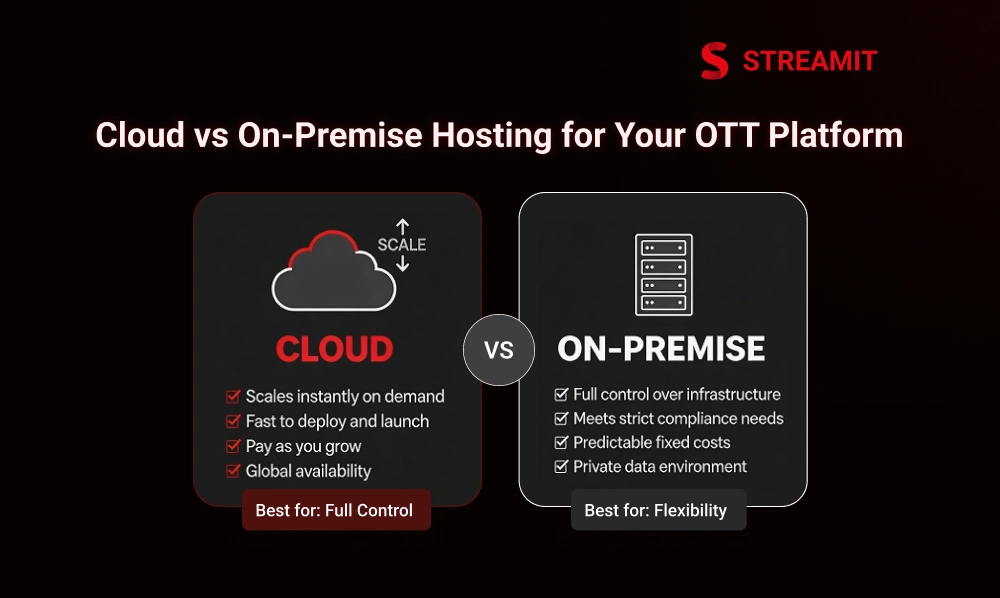
Cloud and on-premise hosting are often treated as opposing choices, but both can be valid depending on the business context. The right decision depends less on industry trends and more on the needs of the platform.
What cloud hosting means for an OTT platform
Cloud hosting for OTT means the platform runs on infrastructure provided through external cloud environments rather than hardware owned directly by the business. Compute, storage, networking, and scaling resources are provisioned as needed.
This model gives OTT businesses more flexibility and usually supports faster deployment. It is often preferred by platforms operating in growth mode or in environments where demand changes quickly.
The platform runs on cloud servers managed by a provider
In a cloud-based setup, the physical infrastructure is managed by the provider. The OTT business still controls the application layer, product behavior, and architecture decisions, but it does not need to purchase or maintain its own physical server environment.
This reduces the burden of setting up and managing hardware, which can be a major advantage in fast-moving businesses.
It gives flexibility, faster setup, and easier scaling
Cloud hosting is often attractive because it allows platforms to launch faster and adjust more easily as demand changes. Capacity can usually be added more quickly than in fixed hardware environments.
That flexibility matters for OTT businesses that expect traffic spikes, regional growth, or changes in product direction over time.
What on-premise hosting means for an OTT platform
On-premise OTT hosting means the platform runs on infrastructure owned and managed directly by the business or its internal technical team. This may include private data centers, dedicated server environments, or tightly controlled internal systems.
This model offers greater control, but it also requires more responsibility for setup, maintenance, upgrades, monitoring, and security operations.
The platform runs on servers owned and managed by your team
With on-premise hosting, the company manages the infrastructure directly. That includes physical hardware, system monitoring, capacity planning, storage setup, and operational continuity.
This can work well when the business has a strong internal technical team and a clear reason to keep infrastructure under direct control.
It gives more control over infrastructure and data
The strongest advantage of on-premise hosting is ownership. The business can shape the infrastructure around exact operational needs, data policies, access controls, and workflow requirements.
For OTT platforms with stricter internal demands, this level of control can be more valuable than the convenience of managed infrastructure.
What hybrid hosting means for OTT platforms
Hybrid OTT hosting combines cloud and on-premise infrastructure in one operating model. Instead of placing everything in one environment, the platform assigns different workloads to different environments based on what makes the most sense.
This is often a strong option for more mature OTT businesses that need both flexibility and control.
Some workloads stay on-premise while others run in the cloud
In a hybrid setup, sensitive data, internal processing, or controlled workflows may stay on-premise, while content delivery, burst capacity, or scalable services run in the cloud.
This allows the business to use each environment where it performs best rather than forcing all workloads into one model.
Hybrid works when one hosting model alone is not enough
Hybrid hosting becomes valuable when the business has competing priorities. It may need cloud scalability for growth and distribution, while also needing on-premise control for certain infrastructure or compliance requirements.
Rather than choosing between control and flexibility, a hybrid platform allows the platform to balance both more deliberately.
| Hosting Model | Best Fit | Main Strength | Main Limitation |
| Cloud Hosting | Startups, growth-stage OTT platforms, variable traffic | Flexibility, faster launch, easier scalability | Ongoing cost can rise with usage |
| On-Premise Hosting | Regulated environments, fixed workloads, private OTT systems | High control over infrastructure and data | Higher upfront investment and maintenance burden |
| Hybrid Hosting | Mature OTT businesses with mixed infrastructure needs | Balances scale and control | Requires more careful planning and integration |
Benefits of Cloud Hosting for OTT Platforms
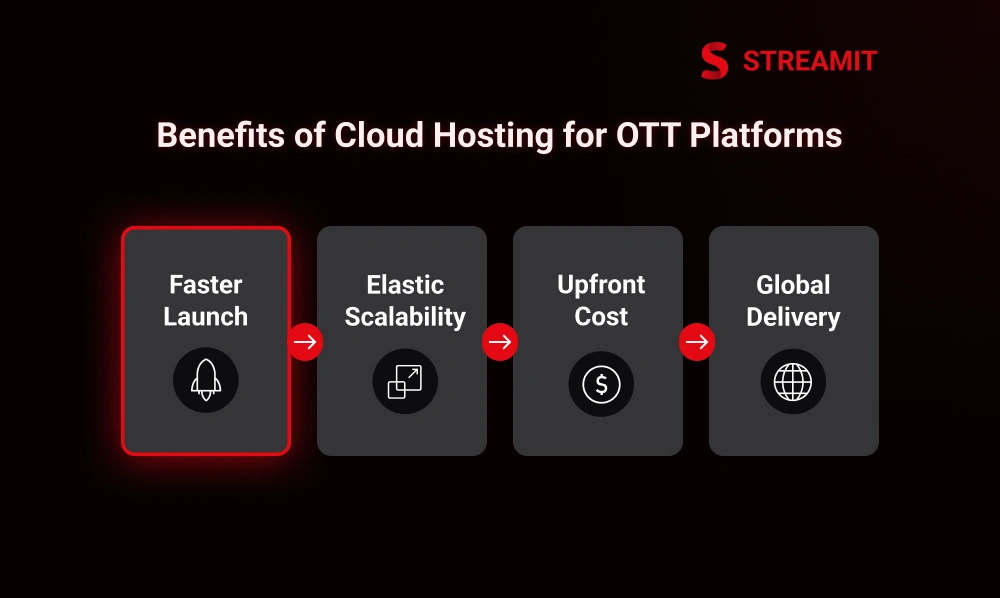
Cloud hosting is often attractive because it supports faster growth, lower starting friction, and a more flexible infrastructure path. For many OTT businesses, especially those still scaling, these are significant advantages.
Faster launch and easier time to market
Cloud infrastructure helps OTT businesses reduce setup delays and move from planning to deployment faster. This is especially useful in markets where timing matters and businesses want to validate demand before making heavier infrastructure commitments.
For platforms trying to launch efficiently, cloud reduces many of the early operational barriers that come with physical infrastructure planning.
No need to spend time setting up physical hardware
Cloud environments can usually be provisioned much faster than physical infrastructure. The business does not need to purchase, install, or prepare hardware before starting platform operations.
This shortens the path from concept to launch and allows technical teams to focus more on the user-facing platform.
Better choice for startups and growing OTT businesses
For startups, cloud hosting is often the more practical starting point because it lowers upfront infrastructure commitment and supports experimentation. It allows the business to grow into its infrastructure instead of locking too much capital into the system early.
For growing OTT businesses, it also makes expansion into new regions or new user segments easier to support.
Better scalability for traffic spikes and growth
One of the biggest advantages of cloud hosting is scalability. OTT traffic is rarely perfectly stable, and streaming platforms often experience sudden peaks caused by content releases, live events, promotions, or audience growth.
Cloud hosting generally handles those shifts more smoothly than fixed-capacity environments.
Useful for live events, sports streaming, and sudden demand
Live events create immediate traffic pressure. A sports match, concert stream, launch broadcast, or exclusive content drop can attract a large number of viewers in a short time.
Cloud hosting is well-suited to this kind of behavior because it supports more elastic infrastructure adjustment when demand increases suddenly.
Cloud helps when user demand changes quickly
OTT growth does not always follow a predictable pattern. Demand may change quickly based on geography, device usage, content performance, or business expansion.
Cloud hosting gives the platform more room to respond to those changes without repeatedly redesigning its infrastructure model.
Lower upfront investment and less maintenance
Cloud hosting often lowers the financial barrier to entry by reducing the need for hardware investment at the beginning. It also reduces some of the internal maintenance work tied to physical infrastructure management.
That makes it attractive for businesses that want to preserve budget flexibility and operational focus.
You avoid large hardware and setup costs
Building an on-premise environment requires spending on servers, networking, storage, and the setup surrounding those systems. Cloud hosting avoids much of that initial capital expenditure.
For OTT businesses early in their lifecycle, this can make the growth path more manageable.
Internal teams spend less time on server management
When infrastructure is managed through cloud environments, internal teams spend less time on physical server operations and more time on product development, content management, and business priorities.
This matters especially in lean teams where engineering time is limited and valuable.
Better support for global OTT delivery
As OTT platforms grow, they often need to serve viewers across regions and devices. Cloud infrastructure generally supports broader delivery and expansion more easily than fixed-location systems.
This is useful for platforms planning regional growth or serving a distributed audience from the start.
Cloud works well for multi-region streaming
Multi-region audiences create delivery complexity. Cloud hosting can make it easier to support a broader geographic reach without rebuilding the infrastructure from the ground up each time the business expands.
This gives growing platforms a more flexible path toward wider distribution.
It supports OTT platforms serving users on many devices
Modern OTT platforms deliver to mobile apps, web browsers, smart TVs, and other connected devices. Supporting these channels requires consistent backend performance across different usage patterns.
Cloud hosting helps platforms support device diversity more efficiently.
Benefits of On-Premise Hosting for OTT Platforms
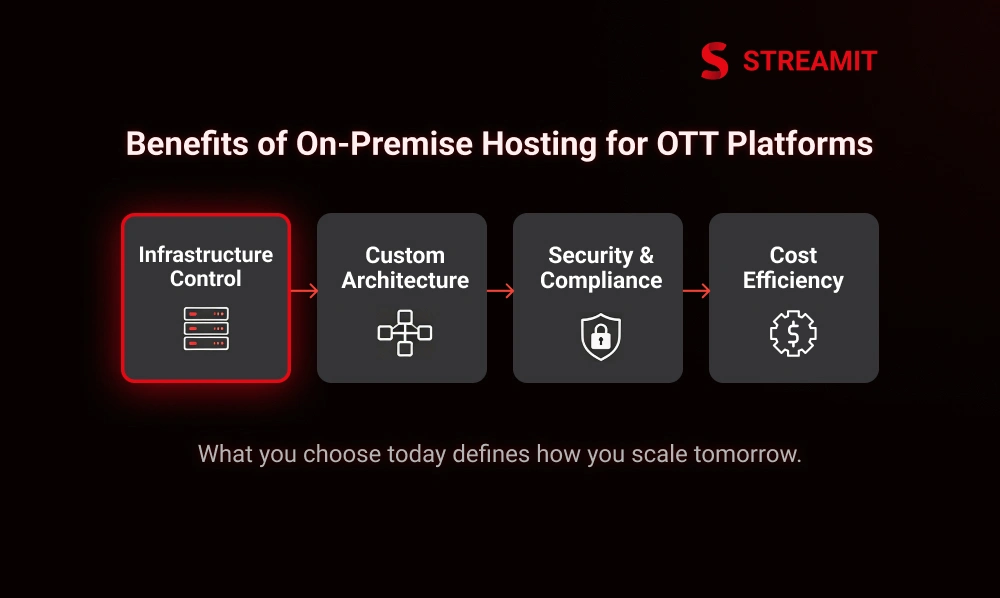
On-premise hosting remains relevant because control still matters in many OTT environments. For some businesses, direct ownership of infrastructure offers advantages that cloud environments do not fully replace.
More control over servers, storage, and workflows
On-premise infrastructure allows businesses to define their environment with more precision. They can manage how systems are configured, where data is stored, how workflows are routed, and how access is controlled.
This control can be especially valuable when the platform has specialized technical requirements.
Teams can build infrastructure around their exact needs
Some OTT businesses need a custom infrastructure design that aligns with internal processes, content handling rules, or specific technical workflows. On-premise hosting makes that easier because the business is not limited by a standard provider environment.
This can create a better fit for highly specific operational needs.
This helps when the OTT platform needs a unique setup
If the platform depends on unusual integrations, tightly managed workflows, or special infrastructure requirements, on-premise can be the better choice.
The more unique the operating model becomes, the more useful infrastructure ownership tends to be.
Better fit for strict security and compliance needs
For some OTT businesses, security and compliance are not only operational concerns. They are structural requirements that shape how the platform must be built and maintained.
In these cases, direct infrastructure control may provide more confidence and clearer governance.
Some businesses need tighter control over content and user data
OTT platforms often manage valuable content and sensitive user information. In some cases, businesses need more direct oversight over where that data lives and how it is accessed.
On-premise environments make that level of data control easier to maintain.
On-premise can help in regulated industries and private environments
Private OTT systems, regulated sectors, and enterprise video environments often require stricter oversight. In those situations, on-premise hosting may align better with legal, operational, or contractual obligations.
This is where infrastructure control becomes part of the business requirement itself.
Can be more cost-effective for fixed long-term workloads
Cloud is not always the cheapest option over time. For businesses with predictable workloads and stable technical requirements, on-premise hosting can become financially efficient in the long run.
That is especially true when recurring cloud costs begin to compound.
Useful when traffic is stable and workloads are easy to predict
If traffic patterns are stable and capacity needs are easy to estimate, on-premise systems can sometimes be planned more efficiently than cloud usage-based environments.
This makes them a more realistic option for businesses with fixed viewing behavior and steady demand.
Long-term ownership may reduce repeated cloud costs
Cloud costs can continue to rise as bandwidth, storage, and platform usage increase. For video-heavy businesses, those recurring charges can become significant.
Owning infrastructure can reduce repeated external hosting spend over time, provided the business can manage the environment effectively.
Cloud vs On-Premise Hosting Cost for OTT Platforms
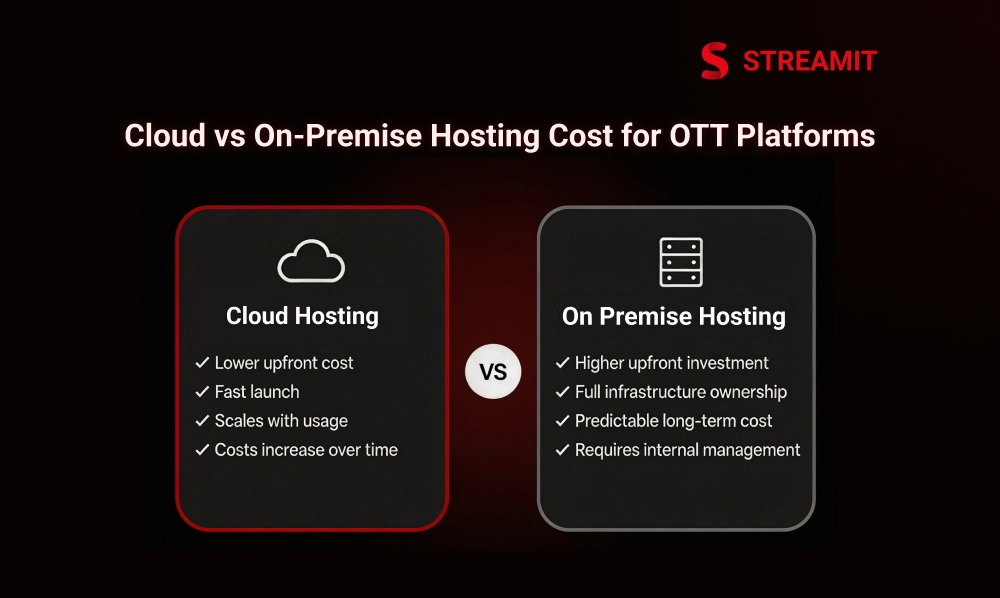
Hosting cost is one of the most commonly misunderstood parts of OTT infrastructure planning. The mistake many businesses make is comparing only the starting cost instead of the full lifecycle cost.
Upfront cost vs long-term cost
Cloud and on-premise hosting distribute costs very differently. Cloud usually lowers the cost of getting started, while on-premises tends to require a heavier initial investment.
The better option depends on whether the business values immediate flexibility or long-term ownership more.
Cloud usually has a lower upfront cost
Cloud hosting lets OTT platforms launch without major upfront spending on hardware and facilities. This lowers early financial pressure and gives the business more freedom to allocate capital elsewhere.
That is one reason cloud is often preferred in the early stages.
On-premises usually requires a higher initial investment
On-premise environments require spending on servers, storage, networking, setup, and internal operations capability before the platform begins running at full scale.
That makes the entry cost higher, but it can change the long-term financial equation depending on platform growth.
Hidden costs in both hosting models
Both hosting models come with hidden costs. The difference is that those costs appear in different places.
A realistic hosting decision should account for the less visible expenses before the platform grows into them.
Cloud costs can rise with bandwidth, storage, and scaling
Cloud can seem cost-effective at first, but OTT businesses consume large amounts of bandwidth and storage. As traffic and content library size grow, those usage-based costs can increase quickly.
That is why cloud cost planning must look beyond the first stage of the platform.
On-premise costs can rise with hardware, power, and staffing
On-premise environments carry their own long-term costs. These may include maintenance, hardware refresh cycles, electricity, cooling, space, monitoring tools, and staffing.
These costs may not look as visible as a monthly cloud bill, but they still matter heavily in total cost planning.
| Cost Factor | Cloud Hosting | On-Premise Hosting |
| Upfront Infrastructure Cost | Lower | Higher |
| Ongoing Bandwidth Cost | Can scale up quickly with usage | More predictable in some environments |
| Storage Cost | Usage-based and variable | Capacity-based and planned ahead |
| Maintenance Cost | Lower internal physical maintenance | Higher internal maintenance responsibility |
| Staffing Need | Smaller infrastructure team possible | A stronger internal technical team is usually needed |
| Cost Predictability | Lower over long-term rapid growth | Higher when workloads are stable |
Performance, Scalability, and Reliability in OTT Hosting
Performance in OTT depends on more than just where the platform is hosted. The broader architecture matters just as much as the hosting model itself.
Performance depends on more than just server location
A platform’s performance is shaped by multiple technical layers, including content delivery, transcoding, storage, and network design. Hosting is an important part of that picture, but not the only one.
A poorly designed cloud setup can still underperform. A well-managed on-premise setup can still deliver excellent results if the workload fits it properly.
CDN, transcoding, storage, and network design all matter
OTT performance depends on how content is stored, processed, and delivered. CDN setup affects delivery speed. Transcoding affects how the video behaves across devices and network conditions. Storage and routing affect responsiveness and stability.
That means hosting decisions should be made as part of the full platform architecture, not in isolation.
The right setup improves playback quality and uptime
When infrastructure is aligned properly, the platform can deliver better startup times, smoother playback, and fewer interruptions. It also becomes more resilient under pressure.
This improves both user experience and long-term platform credibility.
Cloud is stronger for scale and fast traffic changes
Cloud hosting is generally stronger when the business expects traffic volatility, rapid growth, or high-concurrency moments. It offers the flexibility to adapt without being limited by fixed hardware capacity.
That makes it especially valuable for platforms that cannot fully predict demand.
It handles burst traffic and global delivery more easily
Burst traffic is one of the clearest challenges in OTT infrastructure. Cloud environments are usually better positioned to respond when demand rises sharply or audience distribution expands across regions.
This reduces the chance of capacity becoming the reason the platform fails during growth moments.
On-premises can work well for controlled and stable workloads
On-premise systems can perform very well when demand is predictable and the platform is designed for known technical conditions. They may offer a more controlled performance environment in those situations.
This is why on-premise remains viable for certain OTT use cases.
It can be useful when teams need tighter control over performance
Some OTT businesses need more direct influence over latency, routing, storage behavior, or internal processing. In these cases, on-premises can provide a more precise operational environment.
That precision can matter when workflow control is more important than elasticity.
Reliability and disaster recovery should be part of the decision
Reliability should be part of the hosting decision from the beginning. Every OTT platform needs a plan for redundancy, recovery, backup, and service continuity.
A strong hosting model is not just one that performs well when things go right. It recovers well when things go wrong.
Downtime planning matters for both cloud and on-premise hosting
Cloud and on-premise environments both require redundancy planning. Neither becomes fully reliable on its own.
OTT businesses should review backup design, failover readiness, and recovery expectations before choosing a long-term infrastructure model.
Security and Compliance in Cloud vs On-Premise OTT Hosting
Security and compliance play a major role in OTT hosting decisions, especially for platforms that manage premium content, personal data, restricted media assets, or private user environments.
Security matters because OTT platforms manage content and user data
OTT businesses handle assets that have both commercial and privacy value. That includes subscriber data, content libraries, user behavior information, and often payment-related interactions.
As a result, hosting decisions should always include a security review and not be treated as a pure performance conversation.
Weak security can hurt trust and revenue
Weak security can expose user data, compromise content protection, and damage platform trust. The cost is not only technical. It can affect retention, partnerships, and business reputation.
In OTT, security is closely tied to long-term commercial stability.
Cloud hosting can reduce internal security workload
Cloud environments often include security tooling, managed updates, and support layers that reduce some of the burden on internal teams.
This can be a practical advantage for businesses that do not want to build every infrastructure protection layer themselves.
Providers often offer built-in security and backup tools
Many cloud environments support encryption, access controls, monitoring, firewall layers, and backup options as part of the broader infrastructure stack.
These features do not remove the need for smart architecture, but they can strengthen the baseline security posture.
On-premises gives more direct control over data and access
On-premise hosting gives businesses more authority over where data is stored, how access is segmented, and how systems are governed internally.
This can be useful when the business needs deeper infrastructure-level control over security decisions.
This can matter more for regulated and private OTT platforms
Private OTT systems and regulated industries often need more customized access controls and tighter internal oversight. In those situations, on-premise environments may provide a better operational fit.
That is where direct infrastructure ownership becomes strategically important.
When Hybrid Hosting Is the Best Choice for an OTT Platform
Hybrid hosting often becomes the right answer when the platform has outgrown a simple hosting decision. It allows the business to place workloads based on function rather than forcing everything into one environment.
Hybrid works well when OTT platforms need both control and scale
A hybrid approach is useful when the platform needs cloud flexibility for some services and tighter on-premise control for others. This often reflects the reality of mature OTT systems more accurately than a pure cloud or pure on-premise model.
It supports a more deliberate infrastructure strategy.
Sensitive workloads can stay in-house while delivery runs in the cloud
A platform may keep private data environments, internal processing, or restricted workflows on-premise while using cloud infrastructure for scalable content delivery, wider distribution, or burst demand handling.
This separation allows the business to protect what needs control and scale what needs reach.
Hybrid helps balance performance, security, and cost
Hybrid hosting can create a better balance between operational control, cost efficiency, and traffic flexibility. It allows infrastructure decisions to be made workload by workload instead of as one rigid platform-wide rule.
That makes it especially useful for OTT businesses with layered technical priorities.
Hybrid is often a strong option for enterprise OTT platforms
Enterprise OTT systems often include legacy environments, internal compliance needs, and more complex operational demands. Hybrid hosting supports those realities by allowing gradual infrastructure evolution.
It gives larger platforms room to modernize without forcing a disruptive all-at-once migration.
It supports gradual growth without moving everything at once
Some businesses want the benefits of cloud without fully moving off their existing infrastructure. Hybrid supports that path by allowing phased adoption.
This often creates a more stable transition and gives the business more control over infrastructure change.
How to Choose the Right Hosting Model for Your OTT Platform
Choosing the right hosting model requires more than comparing features. It requires understanding how the platform operates, what kind of growth it expects, and what level of internal capability exists to support the infrastructure.
Choose based on your traffic, budget, and growth stage
Traffic behavior, available budget, and growth stage are some of the strongest early decision filters. A platform with volatile growth and changing product priorities has different infrastructure needs than one with fixed demand and a stable operating model.
The right choice should support both present requirements and future direction.
Cloud is often better for fast growth and flexibility
Cloud is often the better fit when the OTT platform needs quick deployment, flexible infrastructure, and room to adjust as the audience grows or shifts.
It gives the business more operational freedom in the growth phase.
On-premises is often better for control and fixed workloads
On-premise is usually the stronger fit when the business values infrastructure control, stable workload planning, and tighter internal governance over fast deployment.
It makes more sense when the company is prepared to manage the environment directly.
Review your internal team, technical skills, and compliance needs
The internal team matters as much as the infrastructure model itself. A hosting decision should reflect whether the business has the technical, operational, and security capabilities to manage the chosen environment successfully.
Compliance requirements should also be part of the decision from the beginning, not added later.
Your internal resources should shape the hosting decision
A platform should not choose an infrastructure model that exceeds its internal readiness. More control only helps when the business can support it. More flexibility only works when it is still governed well.
The best hosting model is one that matches the business’s real operational capacity.
Compare total cost, not just starting cost
The full cost of OTT hosting includes scaling, maintenance, staffing, downtime risk, security effort, and future infrastructure expansion. Looking only at setup cost creates a misleading comparison.
A smarter decision looks at lifecycle value rather than first-stage affordability.
Include scaling, maintenance, security, and downtime in the review
OTT businesses should include growth-related costs, team effort, backup planning, reliability needs, and operational risk in the final review.
That creates a more complete decision and reduces future surprises.
Key Takeaways
- Hosting Shapes OTT Growth: This blog explained that hosting is not just a backend decision. It directly affects streaming quality, uptime, scalability, security, cost, and how much long-term control an OTT business keeps as it grows.
- Cloud Hosting Supports Flexibility: Cloud hosting is often the stronger choice for OTT platforms that need faster launch, lower upfront investment, and the ability to scale quickly as traffic changes.
- On-Premise Hosting Offers More Control: On-premise hosting gives businesses deeper control over servers, storage, workflows, and data, making it a strong fit for platforms with strict security, compliance, or custom infrastructure needs.
- Hybrid Hosting Creates Balance: Hybrid OTT hosting combines cloud flexibility with on-premise control, making it a practical option for platforms that need both scalability and tighter infrastructure oversight.
- Cloud Helps with Faster Expansion: Cloud environments make it easier to support traffic spikes, global delivery, and multi-device viewing, which is especially useful for growing OTT businesses and live-event platforms.
- On-Premise Can Work for Stable Workloads: On-premise hosting can become more effective for businesses with predictable traffic, fixed workloads, and the internal technical capacity to manage infrastructure directly.
- Cost Should Be Viewed Long-Term: The blog highlighted that cloud usually has a lower upfront cost, while on-premise often requires a higher initial investment. However, both models carry hidden costs that should be reviewed through the total cost of ownership.
- Performance Depends on Full Infrastructure Design: OTT performance is influenced by more than hosting alone. CDN setup, transcoding, storage, network design, and reliability planning all play a major role in playback quality and uptime.
- Security and Compliance Matter in the Final Decision: The blog emphasized that hosting should also be evaluated through the lens of content protection, user data security, compliance needs, and long-term operational confidence.
Conclusion
Cloud vs on-premise hosting for OTT platform growth is not a trend-based choice. It is a strategic infrastructure decision that affects product quality, financial efficiency, risk exposure, and long-term control.
Cloud hosting usually makes more sense for businesses that want faster deployment, lower upfront investment, and easier scalability. On-premise hosting remains valuable for businesses that need tighter infrastructure control, stronger governance, or a better fit for fixed long-term workloads. Hybrid hosting is often the most balanced option for mature OTT platforms that need both flexibility and control in the same environment.
The more useful question is not which hosting model is universally best. The better question is which model gives your OTT platform the strongest foundation for stable delivery, efficient growth, and long-term operational confidence.
FAQs
Is cloud hosting better than on-premise hosting for an OTT platform?
Cloud hosting is often better for OTT platforms that need faster launch, flexible scaling, and lower upfront cost. On-premise can be better when the platform needs more direct control, stricter compliance, or fixed workload planning.
Which is more cost-effective for OTT platforms: cloud hosting or on-premise hosting?
Cloud is often more cost-effective in the early stage because it reduces capital investment. On-premises can become more cost-effective over time when workloads are stable, and the business can manage infrastructure efficiently.
How does cloud hosting improve OTT platform scalability and performance?
Cloud hosting improves OTT scalability by allowing the platform to adjust capacity more easily during traffic spikes, live events, and expansion phases. It also supports broader distribution and more flexible infrastructure changes.
How does on-premise hosting help with OTT platform security and compliance?
On-premise hosting gives the business more direct control over servers, storage, data handling, and access policies. This can be useful for platforms with stricter governance or private deployment requirements.
Is hybrid hosting the best option for modern OTT platforms?
Hybrid hosting is often the best option when an OTT platform needs both infrastructure control and cloud-based scalability. It is especially useful for mature platforms with mixed workload requirements.
Read Also
1. Lowest Latency Video Streaming: 7 Proven Ways to Reduce Delay
2. Why Mobile Optimisation Matters for OTT Platforms Today
3. Why Streaming Startups Fail Within 18 Months?