Brightcove Alternatives for Live Streaming, VOD and OTT Apps


A streaming platform decision is rarely about video alone. It becomes serious when live events, VOD libraries, OTT apps, payments, data, support, and long-term platform control all need to work together.
Brightcove is a strong enterprise video platform, but it is not the automatic answer for every streaming business. The right Brightcove alternative depends on whether your team needs reliable hosting, branded apps, deeper monetization, or a platform foundation you can own and scale.
Overview
Why Teams Look for Brightcove Alternatives
Most teams do not leave an enterprise video platform because it fails at playback. They start comparing alternatives when the business model becomes more complex than uploading, managing, and distributing video.
At that point, the question changes from “Can this platform stream?” to “Can this platform support our next 12 months of growth?” That includes apps, retention, analytics, monetization, migration, and operational control.
Brightcove Works Well for Enterprise Video, Live Streaming, and OTT Delivery
Enterprise video teams usually choose Brightcove for reliability, scale, and structured video operations. It supports professional video hosting, live streaming, VOD publishing, analytics, APIs, monetization, and OTT delivery.
That makes it a strong fit for companies that need a mature video layer. But when the goal becomes a complete streaming business, teams often need to compare what sits beyond the video layer.
Growing Streaming Brands Often Need More Control Over Apps and Ownership
Once a streaming brand grows, app ownership starts affecting revenue, not just branding. Web, mobile, and TV apps influence conversion, watch time, user data, support workflows, and store presence.
A hosted video stack may solve delivery, but it may not give enough control over user experience, subscription logic, custom workflows, or long-term product direction. That gap is where many Brightcove alternatives become relevant.
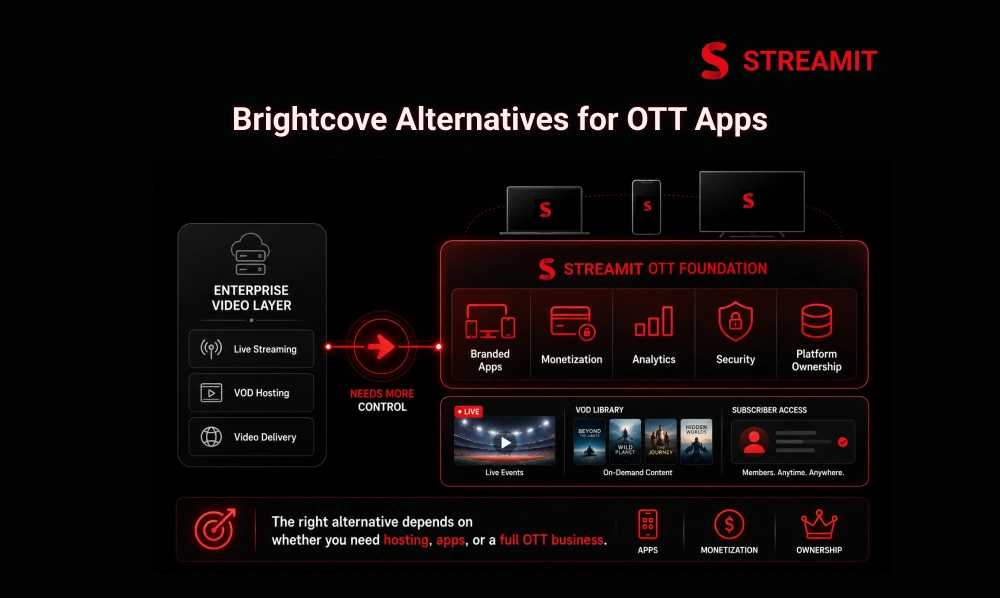
The Right Alternative Depends on Whether You Need Hosting, Apps, or a Full OTT Business
There are 3 very different buyer needs hiding under one keyword: Brightcove alternatives. Some teams need hosting. Some need apps. Some need a complete OTT platform solution.
Choosing without this clarity creates expensive confusion. A simple video streaming platform can look affordable early, then become limiting when the team needs custom monetization, TV apps, entitlement rules, analytics, and stronger ownership.
Comparison
What to Compare in Brightcove Alternatives
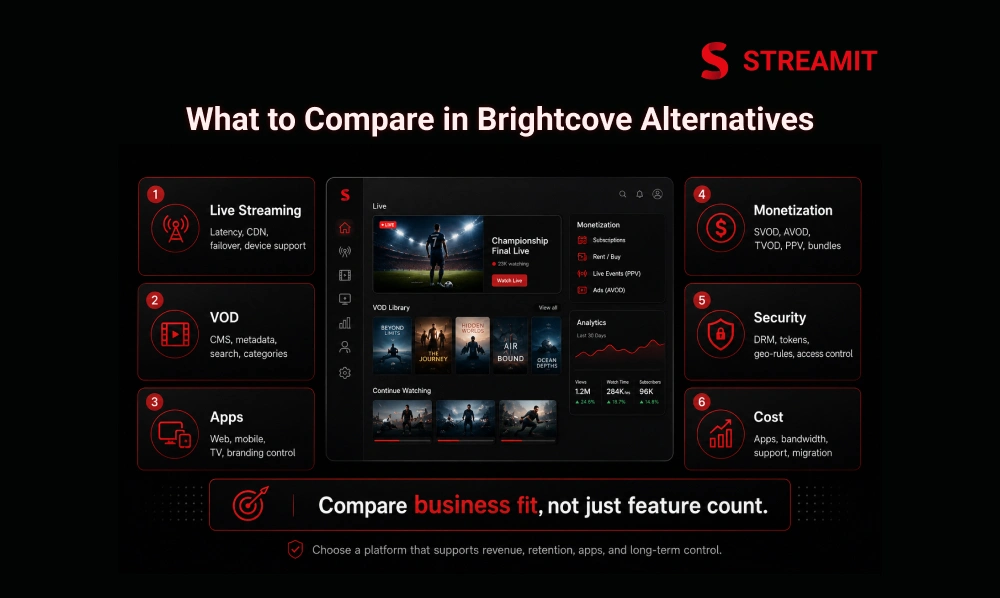
The strongest comparison is not feature count. It is whether the platform can support the way your streaming business will actually make money, retain users, and operate at scale.
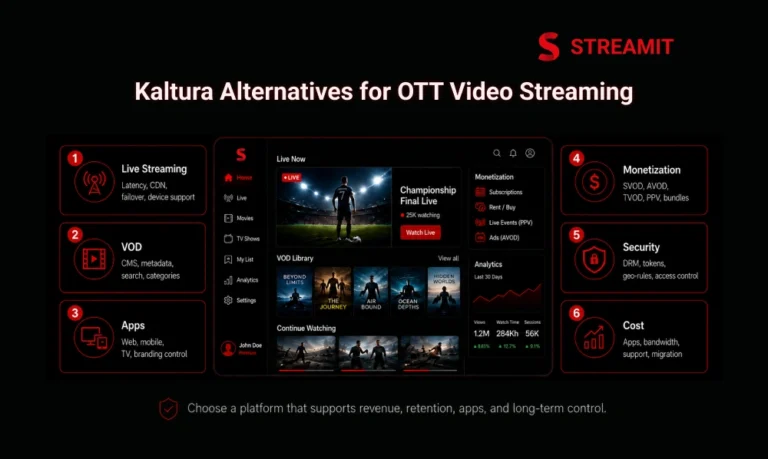
Use the table below as a practical filter before shortlisting any Brightcove alternative.
| Comparison Area | Why It Matters | What to Check |
|---|---|---|
| Live streaming | Protects event quality and trust | Latency, CDN, failover, device support |
| VOD | Supports library growth | CMS, metadata, search, categories |
| Apps | Owns user experience | Web, mobile, TV, branding control |
| Monetization | Drives revenue | SVOD, AVOD, TVOD, PPV, bundles |
| Security | Protects premium content | DRM, tokens, geo-rules, access control |
| Cost | Affects margin | Apps, bandwidth, support, migration |
Live Streaming Quality, Latency, CDN, and Playback Stability
One failed live event can damage trust faster than 100 good VOD sessions can repair it. Live streaming platforms should be judged on startup speed, adaptive bitrate, latency, CDN strategy, monitoring, and fallback planning.
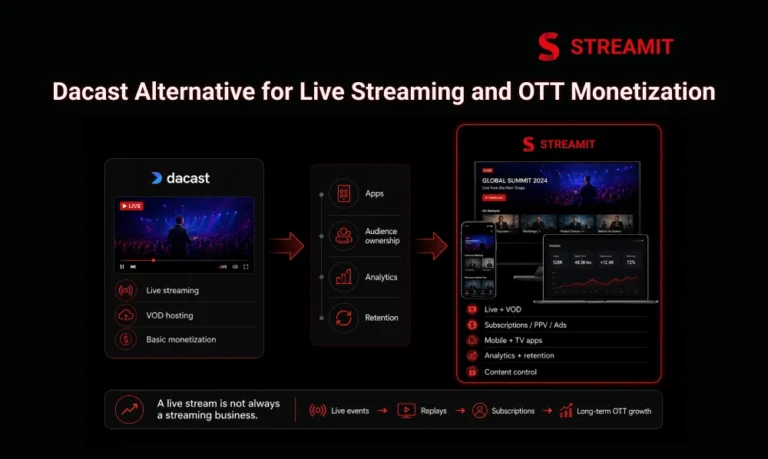
For paid events, sports, news, webinars, and worship streams, “works in demo” is not enough. Teams should ask how the platform behaves during spikes, weak networks, multiple devices, and long broadcasts.
VOD Hosting, CMS, Content Library, and OTT App Support
A VOD library becomes harder to manage after the first 500 assets. Content tagging, collections, metadata, access rules, search, watch history, thumbnails, and continue-watching flows all start to matter.
A good Brightcove alternative should make the content team faster, not more dependent on developers. If every library change needs technical effort, scale will quietly slow down operations.
Monetization for Subscriptions, Ads, Pay-Per-View, and Hybrid Revenue
Most OTT businesses do not grow with only one revenue model forever. Subscriptions may work early, but live events, rentals, ads, sponsorships, bundles, and premium plans often become important later.
The platform should support monetization flexibility without breaking user access. Billing, entitlements, renewals, cancellations, refunds, and content permissions should work as one connected system.
Security, DRM, APIs, Customization, and Platform Ownership
Security is not a checkbox when content is paid, licensed, or exclusive. DRM, signed URLs, geo-blocking, device limits, session rules, and role-based admin access help protect the business.
APIs and customization matter for the same reason. A serious OTT platform should connect with payments, CRM, analytics, marketing tools, recommendation systems, and internal workflows without forcing the business into one rigid path.
Pricing, Support, Implementation Time, and Scaling Costs
The cheapest quote is rarely the cheapest platform after 12 months. App builds, DRM setup, CDN consumption, TV app launches, migration work, integrations, support needs, and custom workflows can all increase the overall cost faster than expected.
Teams should compare ownership cost, not only monthly fees. The better question is: what will this platform cost when the audience grows, the library expands, and the business needs more control?
Alternatives
Best Brightcove Alternatives by Streaming Business Need
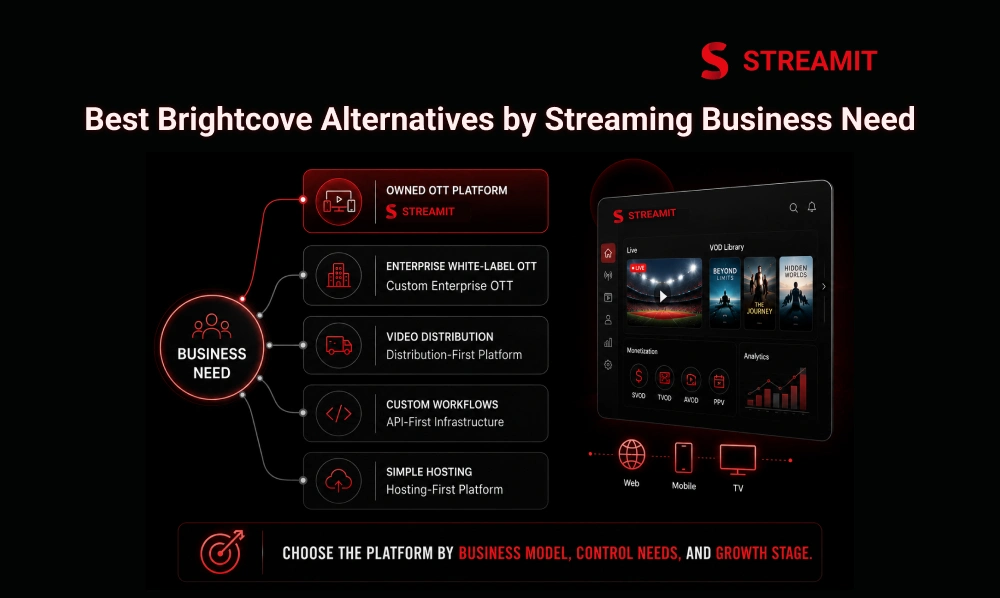
There is no single best Brightcove alternative for every team. A broadcaster, creator network, sports platform, education brand, and enterprise media company all need different levels of control.
Here is a cleaner way to think about the market before choosing a platform.
| Business Need | Better Fit |
|---|---|
| Owned OTT platform with apps | Streamit |
| Enterprise white-label OTT | Custom enterprise OTT solutions |
| Video distribution operations | Distribution-first video platforms |
| Custom developer workflows | API-first video infrastructure |
| Simple video hosting | Hosting-first platforms |
Streamit for Brands That Want Live, VOD, OTT Apps, and Monetization Together
Streamit fits teams that see streaming as a business, not a temporary video project. It brings live, VOD, branded apps, monetization, content control, analytics, and long-term platform ownership into one OTT platform solution.
This makes it useful for founders and media teams that want more than hosting. The focus is on building a streaming platform that can support real traffic, paid access, multi-device delivery, and future product decisions.
Muvi or VPlayed for Enterprise OTT Ownership and Customization
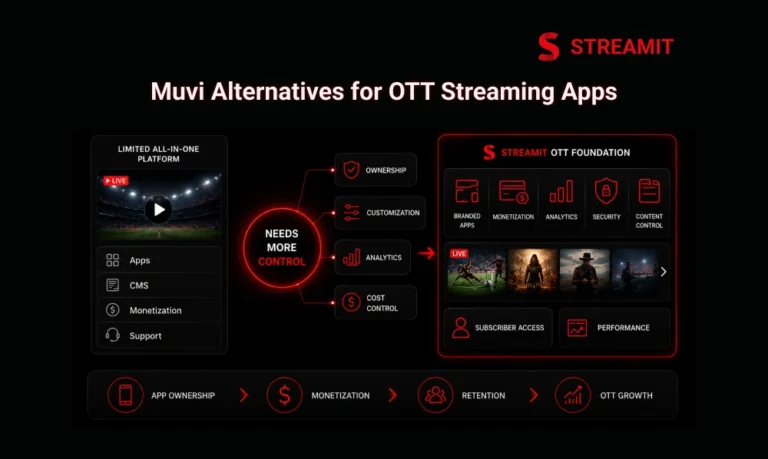
Enterprise OTT buyers often look for white-label control and faster market entry. Platforms in this category usually appeal to teams that want branded apps, packaged OTT features, monetization options, and customization support.
The trade-off is depth of fit. Before choosing this type of platform, teams should check how much control they truly get over code, data, infrastructure, app experience, and long-term product changes.
Zype for Video Distribution and OTT Operations
Some teams are focused more on managing video distribution efficiently than building a fully custom OTT app experience. Distribution-first platforms can help manage video libraries, publish content across channels, and support OTT operations with structured workflows.
This can be a good fit for teams managing large volumes of content across multiple endpoints. But if the main goal is product ownership, app-level differentiation, and custom monetization logic, the fit test should go deeper.
Cloudinary or API-First Platforms for Custom Video Workflows
Developer-led teams may prefer APIs over ready-made OTT systems. API-first platforms are useful when the business already has a product team and wants more control over encoding, delivery, transformations, and custom video workflows.
This path gives flexibility, but it also increases responsibility. Your team must design the OTT experience, user system, monetization layer, analytics, content operations, and support workflows around the infrastructure.
Evaluation
The Enterprise OTT Fit Test Most Teams Skip
The wrong platform often looks right during the first demo. That happens because demos usually show launch capability, not operational pressure, hidden cost, or 12-month platform complexity.
Before comparing Brightcove alternatives, teams should define what they are really buying: infrastructure, apps, monetization, ownership, or growth capability.
Decide If You Need Enterprise Video Hosting or an Owned OTT App
Hosting and ownership are not the same decision. Enterprise video hosting helps you manage and deliver content, while an owned OTT app shapes the full viewer experience and business model.
If your team only needs secure playback, hosting may be enough. If you need subscriptions, branded TV apps, user journeys, retention, payment control, and product flexibility, you need a stronger OTT platform solution.
Check Whether Your Main Problem Is Playback, Monetization, Apps, or Control
Every platform search should start with the real bottleneck. If playback is unstable, prioritize CDN, encoding, latency, and monitoring. If revenue is weak, examine monetization and entitlement design.
If apps feel generic, compare customization and UX control. If growth feels restricted, examine APIs, data ownership, infrastructure choices, and whether the platform can adapt as your business changes.
Count Hidden Costs Like Apps, DRM, APIs, CDN, Support, and Migration
Hidden costs usually appear after the contract, not before it. TV apps, DRM, custom integrations, advanced analytics, migration, CDN overages, support tiers, and developer time can reshape the final budget.
A platform with a lower entry cost may still become expensive if every meaningful change needs paid customization. The better approach is to map the full operating cost before signing.
Avoid Choosing a Platform That Solves Hosting but Not Business Growth
A streaming business does not grow because videos play. It grows when discovery, pricing, retention, app experience, analytics, and content strategy work together.
This is where many teams make the wrong choice. They select a platform that solves video delivery, then later discover it does not support the business systems needed to increase revenue and reduce churn.
Why Streamit
Why Streamit Fits Teams Looking for a Brightcove Alternative
Streamit is built for teams that want control beyond the player. It is positioned for businesses that need live streaming, VOD, branded apps, monetization, analytics, and platform ownership working together.
For medium to high-ticket OTT projects, this matters. The buyer is not simply purchasing software; they are choosing the base their streaming business will depend on for years.
It Supports Live, VOD, Branded Apps, and Multi-Device OTT Delivery
Multi-device delivery is no longer a premium feature. Viewers expect a consistent experience across web, mobile, and TV, especially when they are paying for content.
Streamit helps teams build that foundation with branded OTT apps and content experiences across screens. The value is not just launch speed; it is having a platform structure that can keep supporting growth after launch.
It Supports Monetization, Content Control, Analytics, and Retention
Revenue depends on what happens after the first login. Subscriptions, rentals, pay-per-view, content access, watch history, analytics, and retention flows need to work together.
Streamit supports streaming businesses that need operational control over these areas. That makes it stronger for teams that care about subscriber behavior, not only video uploads.
It Gives Streaming Brands a Better Base for Long-Term OTT Growth
The best OTT platform is the one that does not force a rebuild too early. A platform should support new content types, new devices, new pricing models, and new audience segments as the business matures.
Streamit is a practical fit for teams that want to avoid short-term platform decisions. It gives streaming brands a more controlled base for scale, ownership, and long-term growth.
Summary
Key Takeaways
Brightcove Is Strong – But Fit Depends on Your Model
Brightcove works well for enterprise video, live streaming, and structured delivery. Compare alternatives when apps, ownership, monetization, and product control become more important.
Compare Business Capability, Not Just Features
Evaluate live reliability, VOD management, OTT apps, monetization, security, APIs, support, migration, and total cost of ownership rather than feature count alone.
Streamit Is Best Suited for Owned OTT Growth
Streamit fits teams that want live, VOD, branded apps, monetization, analytics, and control in one platform foundation.
A 12-Month View Beats a Launch-Week View
The right platform should still make sense after more users, more content, more devices, and more revenue pressure enter the business.
Hidden Costs Appear After the Contract
TV apps, DRM, CDN overages, integrations, and support tiers can reshape the final budget. Map the full operating cost before signing any platform deal.
Hosting and Ownership Are Different Decisions
If you need subscriptions, branded TV apps, retention, payment control, and product flexibility, you need more than a video hosting layer.
Conclusion
Conclusion
Brightcove alternatives should be judged by business fit, not popularity. Brightcove can be a strong option for enterprise video and streaming operations, but every growing OTT brand needs to ask a harder question: what do we need to own?
If your main goal is hosting, many video streaming platforms can work. If your goal is to build a branded OTT business with live, VOD, apps, monetization, analytics, and long-term control, Streamit becomes a stronger fit.
The smartest choice is not the platform with the longest feature list. It is the one that protects your growth, supports your users, and gives your team enough control to keep improving the streaming business over time.
FAQs
Frequently Asked Questions
-
Is Brightcove better for hosting or full OTT apps?
Brightcove is strong for enterprise video hosting, live streaming, VOD, and OTT delivery. For teams that need deeper app ownership, custom monetization, and long-term product control, it is worth comparing full OTT platform alternatives.
-
What should brands compare beyond Brightcove pricing?
Brands should compare apps, DRM, CDN, APIs, monetization, analytics, migration, support, and scaling costs. The real cost is not only the monthly fee; it is the total operating cost after growth begins.
-
Which Brightcove alternative is better for OTT monetization?
Streamit is a strong fit for brands that want monetization connected with apps, content control, analytics, and long-term ownership. The best choice depends on whether you need subscriptions, ads, pay-per-view, rentals, or hybrid models.
-
What DRM features should a Brightcove alternative include?
A Brightcove alternative should support DRM, signed access, secure playback, geo-rules, device control, and entitlement protection. These features matter most when content is premium, licensed, paid, or region-specific.
-
Can Brightcove alternatives support live and VOD together?
Yes, many Brightcove alternatives support both live streaming and VOD. The important question is whether live, VOD, apps, monetization, analytics, and user access work together without creating operational gaps.
Read Also
Read Also
1. Best Vimeo Alternatives for OTT and Streaming Platforms
2. Streamit vs Muvi: 7 Features You Can’t Ignore in 2026
3. Streamit vs Uscreen: Which OTT Platform Is Better in 2026?
4. Streamit vs Dacast: Which Streaming Platform Is Better in 2026?
5. Streamit vs Vodlix: Which OTT Platform Is Better in 2026?