Dacast Alternative for Live Streaming and OTT Monetization


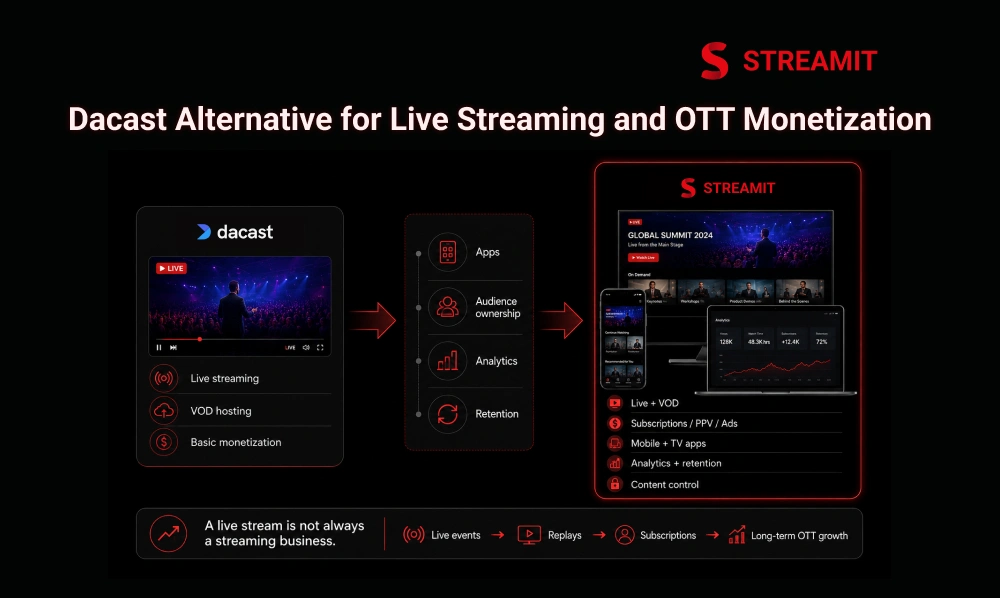
A live stream is not always a streaming business. Many teams start with one successful event, webinar, class, or broadcast and then realize the bigger opportunity is not just going live. It is owning the audience, monetizing the content library, and building a repeatable OTT revenue model.
That is why teams compare Dacast alternatives. Dacast can support live streaming, VOD hosting, and monetization, but growing brands often need more than a video hosting layer. They need apps, control, analytics, retention systems, security, and a platform foundation that can keep working after the first traffic spike.
The Problem
Why Teams Look for a Dacast Alternative
The first platform decision often looks technical, but it becomes commercial very quickly. Teams do not switch because one feature is missing. They switch because their business model outgrows the limits of the current setup.
For a serious streaming brand, the question is not “Can this platform stream video?” The better question is “Can this platform support revenue, ownership, user experience, and scale for the next 12 months?”
Dacast Works Well for Live Streaming, VOD, and Basic Monetization
Dacast is a known option for teams that need live streaming, video hosting, pay-per-view, subscriptions, ads, and secure delivery. For event-led businesses, broadcasters, trainers, and organizations, that can be enough to start.
The limitation usually appears later. Once the business needs branded apps, deeper retention flows, stronger product control, or custom monetization logic, a basic streaming stack can start feeling narrow.
Growing Streaming Brands Often Need More Control Over Apps and Revenue
Revenue control matters more as the audience grows. A platform that works for one event may not support multiple plans, replay access, regional pricing, bundles, user roles, coupons, trials, or recurring memberships with enough flexibility.
App ownership also becomes important. If viewers expect mobile apps, TV apps, personalized libraries, watchlists, and smooth playback, the brand needs more than an embedded player. It needs a complete OTT experience.
The Right Alternative Depends on Whether You Need Hosting, Apps, or a Full OTT Business
Not every Dacast alternative solves the same problem. Some platforms are stronger for live workflows. Some are better for protected video delivery. Some focus on developer APIs. Others are built for full OTT monetization.
The wrong choice happens when teams compare only pricing or feature lists. The right choice starts with the business model: live events, subscription library, premium courses, fitness programs, media network, sports streaming, or enterprise OTT.
Comparison Guide
What to Compare in a Dacast Alternative
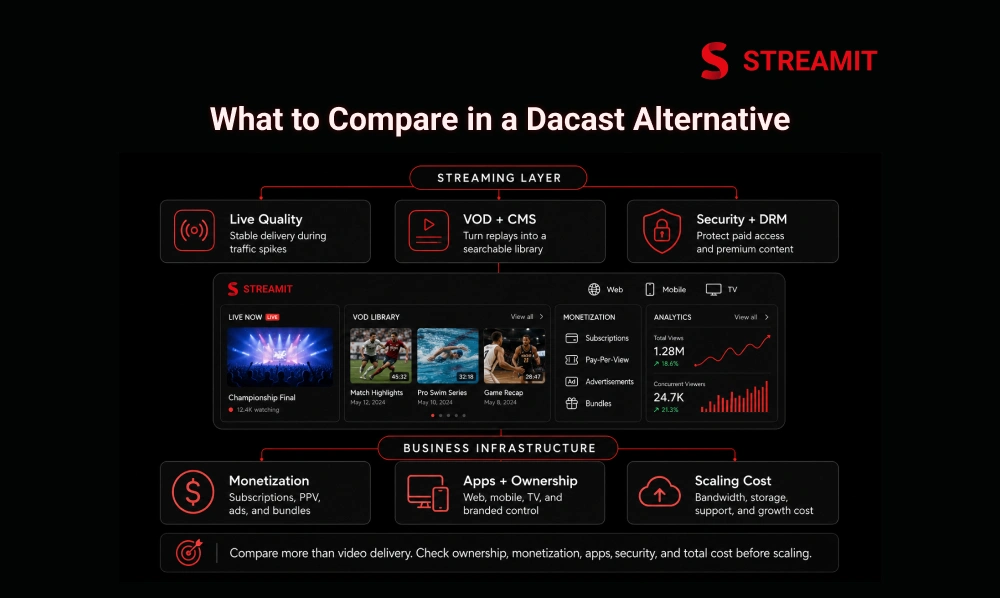
A good comparison should separate streaming features from business infrastructure. Live quality, CDN, and storage matter, but they are only one part of the decision.
The deeper comparison is ownership. Teams should ask who controls the user journey, payment logic, apps, data, security rules, content access, and long-term roadmap.
| Comparison Area | Why It Matters |
|---|---|
| Live streaming quality | Protects the main viewing experience during high-traffic moments |
| VOD and CMS | Turns past content into a searchable revenue asset |
| Monetization | Supports subscriptions, PPV, ads, bundles, and hybrid models |
| Security and DRM | Protects premium content and paid access |
| Apps and ownership | Builds a branded experience across web, mobile, and TV |
| Pricing structure | Reveals long-term bandwidth, storage, support, and scaling cost |
Live Streaming Quality, Latency, CDN, and Playback Stability
Live streaming is unforgiving. If playback fails during a paid event, the damage is immediate because users are watching in real time and support pressure rises quickly.
A strong alternative should support stable delivery, adaptive playback, CDN readiness, and traffic planning. Low latency is useful, but reliability matters more when the audience is paying.
VOD Hosting, CMS, Content Library, and Multi-Device Apps
Live content becomes more valuable when it turns into a VOD library. Replays, clips, archives, course modules, and premium collections can continue earning after the event ends.
The CMS should make content easy to organize, tag, schedule, publish, restrict, and promote. Multi-device apps then turn that library into a complete OTT product instead of a storage folder with a player.
Monetization Options Like Subscriptions, Pay-Per-View, Ads, and Hybrid Models
Monetization should match viewer behavior. Subscriptions work when users return often, while pay-per-view works better for premium one-time events, workshops, sports matches, or exclusive releases.
Many streaming businesses eventually need hybrid models. A platform may need free previews, paid replays, ad-supported content, premium bundles, monthly access, and enterprise licensing inside one ecosystem.
Security, DRM, APIs, Customization, and Platform Ownership
Security is not only about stopping piracy. It is also about making sure the right user gets the right content at the right time, based on payment status, plan rules, expiry, region, and device access.
APIs and customization matter when the business model becomes specific. A serious OTT brand should not rebuild its platform every time it needs a new pricing rule, content flow, or integration.
Pricing, Bandwidth, Storage, Support, and Scaling Costs
A low starting price can hide expensive scaling. Bandwidth, storage, transcoding, CDN usage, support, DRM, apps, and integrations can change the real monthly cost.
The smarter comparison is total cost of ownership. A platform is not cheaper if it saves money at launch but creates migration pressure after audience growth.
Platform Options
Best Dacast Alternatives by Streaming Business Need
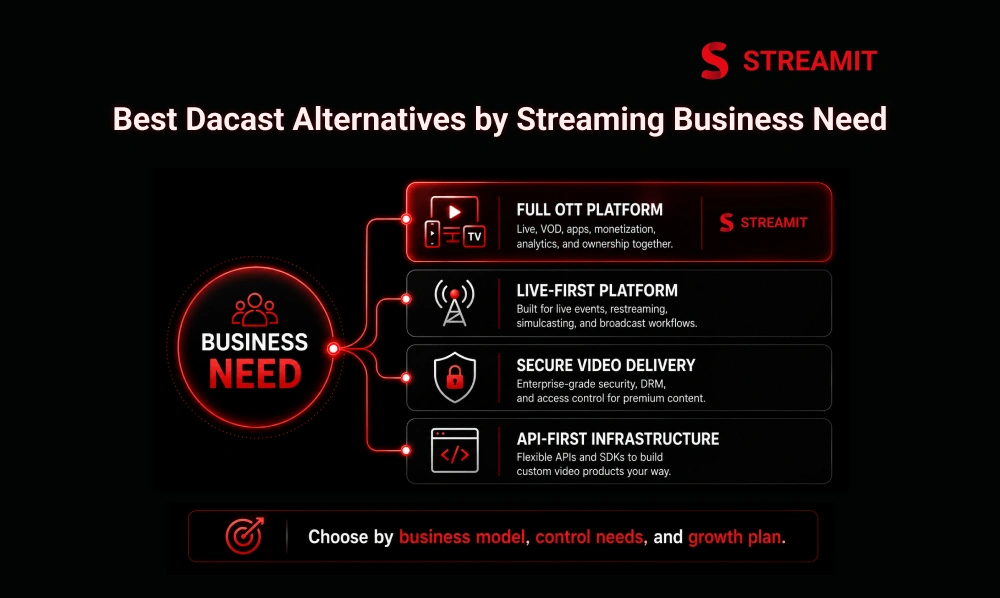
The best Dacast alternative depends on the job the platform must perform. A live-event team, a media network, a fitness brand, and an education platform do not need the same setup.
Instead of chasing the longest feature list, compare alternatives by operating model. The platform should fit how the business earns, scales, protects content, and keeps viewers returning.
| Business Need | Best-Fit Platform Type |
|---|---|
| Live + VOD + apps + monetization | Full OTT platform |
| Only live streaming workflows | Live-first streaming platform |
| Strong content protection | Secure video delivery platform |
| Deep custom product build | API-first infrastructure |
| Long-term brand ownership | Custom OTT ecosystem |
Streamit for Brands That Want Live, VOD, Apps, and OTT Monetization Together
Streamit fits teams that want to move beyond video hosting and build a branded OTT business. It brings live streaming, VOD, mobile apps, TV apps, monetization, analytics, and content control into one growth-focused foundation.
This is useful for teams that care about performance, ownership, and long-term control. The goal is not to launch a quick “Netflix-like” app. The goal is to build a streaming product that can support real revenue and real audience behavior.
Live-First Platforms for Teams Focused Mainly on Live Streaming Workflows
Some teams mainly need live streaming workflows, event delivery, restreaming, simulcasting, or broadcast management. For them, a live-first platform may be a practical choice.
The tradeoff is that live-first tools may not always solve deeper OTT needs. If the business depends on apps, subscriptions, replays, retention, and user data, live delivery alone may become a narrow base.
Secure Video Delivery Platforms for Strong Content Protection
Security-first platforms are useful when content protection is the main priority. This can apply to education, premium training, licensed media, certification programs, or high-value private video libraries.
However, protection alone is not the full OTT business. The platform still needs a clean user journey, flexible monetization, analytics, and device-ready viewing if the goal is paid growth.
API-First Platforms for Teams Building Custom Video Products
API-first platforms work well for teams with strong technical resources and a clear custom product roadmap. They provide flexibility for developers building unique workflows around video.
The risk is ownership of complexity. APIs give control, but the business still needs product strategy, design, apps, billing, entitlement, analytics, support, and operational discipline.
Strategic Insight
The Live-to-OTT Gap Most Teams Miss
A successful live stream creates attention, but attention does not automatically create recurring revenue. The gap between live streaming and OTT growth is where many teams lose momentum.
The real opportunity starts after the stream. Replays, highlights, recommendations, offers, subscriptions, and follow-up campaigns turn one-time viewers into repeat users.
A Successful Live Event Does Not Automatically Create a Streaming Business
A live event can generate a strong revenue spike. But if the user journey ends when the stream ends, the business has to restart from zero for the next event.
OTT growth needs continuity. Viewers should know what to watch next, what they can unlock, and why they should return without waiting for another live date.
Replays, Catalogs, Recommendations, and Follow-Up Offers Extend Revenue
Replays give paid content a longer shelf life. A workshop, class, match, concert, or conference can keep earning when it becomes searchable, packaged, and promoted.
Catalog structure matters here. Categories, collections, recommendations, watch history, and continue-watching flows help users discover more value after their first purchase.
Monetization Should Continue After the Live Stream Ends
The best streaming businesses do not treat monetization as a single checkout. They create multiple revenue paths from the same content asset.
A live event can become a replay, a course module, a premium bundle, a subscription hook, or a gated member benefit. That is where OTT monetization becomes more strategic than simple pay-per-view.
The Streamit Advantage
Why Streamit Fits Teams Looking for a Dacast Alternative
Streamit is built for teams that want more than a streaming tool. It is for brands that want to build a controlled OTT business across live, VOD, web, mobile, and TV.
That makes it a strong fit for founders, broadcasters, creators, educators, fitness brands, sports media, and entertainment teams that care about long-term monetization and platform ownership.
It Supports Live, VOD, Branded Apps, and Multi-Device OTT Delivery
Viewers do not think in platform categories. They expect content to work smoothly on the device they prefer, whether that is a browser, phone, tablet, or TV.
Streamit supports this broader OTT journey. The brand can create a more complete viewing experience instead of depending on scattered tools for live streaming, VOD, apps, and monetization.
It Supports Monetization, Content Control, Analytics, and Retention
Monetization works better when it connects with content access and user behavior. Subscriptions, pay-per-view, ads, bundles, and hybrid models need clean rules behind them.
Streamit also supports the business layer around streaming. Analytics, content control, retention thinking, and platform flexibility help teams improve revenue after launch, not just publish content.
It Gives Streaming Brands a Better Base for Long-Term OTT Growth
Most platform problems do not show up on day one. They show up when traffic grows, users expect better apps, monetization becomes more complex, or the team needs stronger control.
Streamit gives teams a base designed for that next stage. It helps streaming brands think beyond launch and build for performance, ownership, and revenue durability.
Summary
Key Takeaways
Live Streaming Is Not a Full OTT Business
A successful live event creates attention, but long-term revenue depends on replays, catalogs, subscriptions, recommendations, and repeat viewing.
Your Business Model Drives the Right Alternative
Some teams need simple live delivery, while others need branded apps, VOD, monetization, analytics, security, and platform ownership.
Monetization Should Outlast the Live Stream
Pay-per-view can work for one-time events, but replays, bundles, subscriptions, and gated content help increase subscriber lifetime value.
Judge Pricing by Total Ownership Cost
Bandwidth, storage, CDN usage, DRM, apps, support, APIs, and integrations can change the real cost as the platform grows.
Billing and Content Access Must Work Together
If payment succeeds but content remains locked, users lose trust quickly and support issues increase – these systems must stay in sync.
Streamit Gives Teams Control Over OTT Growth
It provides a stronger base for live, VOD, apps, monetization, analytics, retention, and long-term platform ownership.
Conclusion
Conclusion
Choosing a Dacast alternative is not only about finding another live streaming platform. It is about deciding what kind of streaming business you want to build.
If the goal is simple live delivery, a basic streaming platform may be enough. But if the goal is OTT monetization, branded apps, subscriber retention, secure access, and long-term control, the platform decision needs to be more strategic. Streamit fits teams that want to build for growth, not just launch quickly.
FAQs
Frequently Asked Questions
-
Is Dacast enough for a full OTT streaming business?
Dacast can support live streaming, VOD, and monetization, but a full OTT business may need deeper control over apps, retention, data, user journeys, and long-term platform ownership.
-
What should brands compare beyond Dacast pricing?
Brands should compare bandwidth, storage, apps, DRM, APIs, payment flexibility, migration options, support, analytics, and the total cost of scaling over time.
-
Which Dacast alternative is better for OTT monetization?
The better alternative is the one that supports the full monetization journey, including subscriptions, pay-per-view, ads, bundles, replays, content access rules, and retention workflows.
-
What security features should a Dacast alternative include?
A strong alternative should include secure access control, DRM support, signed playback, payment-based entitlements, role-based permissions, and protection against unauthorized sharing.
-
When is pay-per-view better than subscriptions for live streaming?
Pay-per-view works better for premium one-time events, workshops, sports matches, conferences, concerts, or exclusive releases where users pay for a specific experience.
-
How can live streams keep earning after the event ends?
Live streams can keep earning through paid replays, VOD libraries, premium bundles, subscription access, highlight clips, follow-up offers, and content recommendations.