Netflix Retention Secrets OTT Platforms Must Learn

Streaming platforms often assume growth is driven solely by content libraries. The reality is more structural. Netflix maintains retention rates estimated above 90% in mature markets, not because viewers are loyal, but because the product removes reasons to leave.
Retention in streaming is rarely about incentives or discounts. It is about reducing friction in every moment of the viewing experience. From discovery to playback to recommendations, the platform quietly eliminates the small frustrations that cause viewers to cancel.
For OTT founders and product teams, the lesson is not to imitate Netflix features. It is to understand the retention system behind them. The companies that succeed in streaming build platforms designed for continuous engagement, not occasional usage.
This guide breaks down the real Netflix retention secrets and the practical OTT retention strategies that platforms can apply to reduce churn and build long-term viewer loyalty.
Why Netflix Has the Highest Retention in Streaming?
More than 65% of Netflix viewing comes from recommendations rather than search. That single statistic explains why Netflix retains subscribers better than most streaming platforms.
Retention is not achieved through reward programs or discounts. Instead, Netflix builds a system where viewers continuously discover something relevant to watch. When discovery feels effortless, cancellation rarely becomes a priority.
The platform operates as a behavioural ecosystem. Data improves recommendations, recommendations increase watch time, and higher engagement strengthens the product over time.
Netflix keeps viewers without loyalty programs
Most subscription services use loyalty programs to reduce churn. Netflix rarely relies on rewards or points because engagement itself acts as the retention mechanism.
When viewers consistently find relevant content, the need for incentives disappears. The platform becomes part of daily routines rather than a service that requires persuasion.
Netflix focuses on engagement instead of acquisition
Many streaming platforms spend heavily on acquisition campaigns. Netflix prioritises engagement because acquisition without retention simply increases churn volume.
By optimising discovery, playback quality, and recommendations, Netflix ensures that each new subscriber has a higher chance of staying.
The Netflix retention flywheel
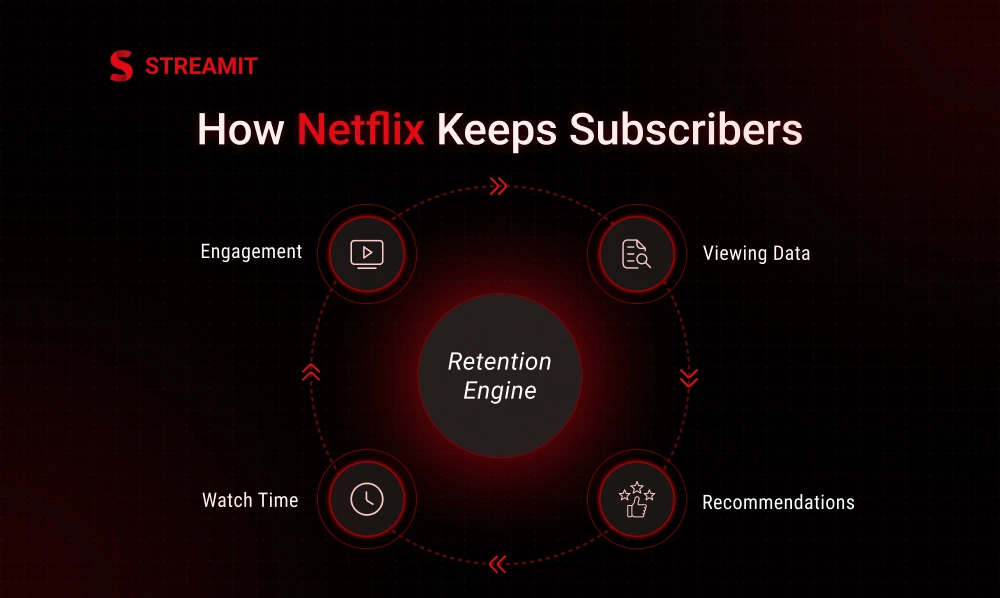
Retention at Netflix functions as a feedback loop. The more viewers watch, the smarter the system becomes, and the easier it is for viewers to keep watching.
This creates a self-reinforcing growth model where engagement continuously improves the platform.
More viewing data improves recommendations
More viewing data allows algorithms to refine personalisation with increasing accuracy.
Better discovery increases watch time
When viewers quickly find relevant titles, session length increases and churn risk drops.
What Is OTT Retention?
Acquiring a streaming subscriber often costs 5-7 times more than retaining one. This is why mature OTT platforms prioritise retention metrics over pure growth numbers.
OTT retention refers to the percentage of subscribers who continue paying for a streaming service over time. The stronger the retention rate, the more predictable the platform’s revenue and growth.
In subscription businesses, retention determines lifetime value. Platforms that retain viewers longer can invest more aggressively in content, infrastructure, and product improvements.
OTT Retention definition
OTT retention is the percentage of users who remain subscribed to a streaming platform over a defined period.
It measures whether the platform consistently delivers enough value for subscribers to continue paying.
OTT Churn Rate explained
Churn rate represents the percentage of users who cancel their subscriptions during a specific timeframe.
High churn often signals problems in discovery, content relevance, or streaming performance.
Why Retention Matters More Than Acquisition?
Subscriber growth can appear impressive while retention quietly declines. Platforms that focus only on acquisition often build unstable revenue models.
Retention strengthens customer lifetime value and makes long-term investment decisions easier.
The Real Reasons OTT Subscribers Cancel
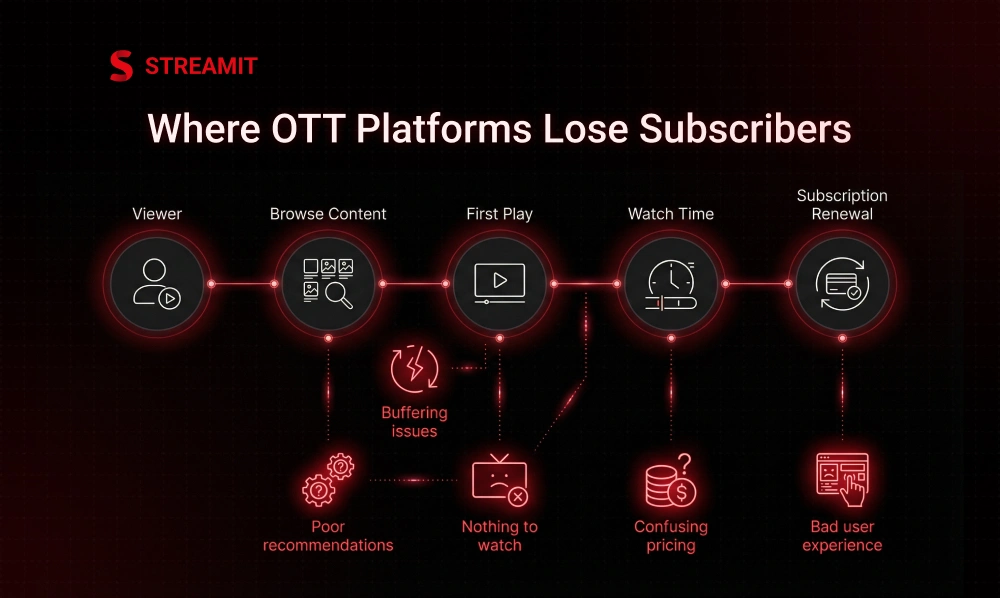
Nearly 40% of viewers reduce watch time after a single buffering incident. Small frustrations accumulate quickly in streaming platforms.
Most cancellations are not emotional decisions. They happen when the platform gradually becomes less convenient or less relevant.
Understanding why users cancel is the first step in reducing OTT churn.
“Nothing to watch” problem
Even large libraries can feel empty when discovery fails. When viewers cannot find relevant content quickly, the perception becomes “nothing to watch”.
This is rarely a content problem. It is usually a discovery and recommendation problem.
Poor streaming experience
Playback issues break trust immediately. Buffering, crashes, or long startup times signal an unreliable product experience.
Once viewers encounter repeated performance problems, churn becomes inevitable.
Confusing pricing plans
Complex pricing structures create hesitation. Viewers prefer simple subscription models that are easy to understand.
When pricing feels unclear, cancellation becomes the easiest decision.
Weak onboarding experience
The first session determines whether viewers stay. If the platform fails to understand user preferences early, recommendations remain weak.
Effective onboarding quickly gathers signals about viewer interests.
Top 5 Reasons users cancel OTT Subscriptions
| Reason | Impact on Retention |
| Lack of relevant content | Viewers feel the library is limited |
| Poor streaming quality | Trust in the platform decreases |
| High subscription cost | Perceived value drops |
| Difficult content discovery | Viewers stop browsing |
| Bad user experience | Friction increases churn risk |
Netflix Retention Secret #1 – Personalisation at Scale
Netflix personalises nearly every element of the interface, including thumbnails and categories. Two users opening the same app rarely see the same homepage.
This approach ensures that the platform feels immediately relevant to each viewer. Personalisation reduces browsing time and increases the probability of starting a session.
Over time, this small advantage compounds into stronger engagement.
The Netflix homepage is different for every user
Netflix does not show the same homepage to every subscriber. The platform dynamically adjusts content rows, featured titles, and categories based on each viewer’s watching behaviour.
This personalized layout helps viewers quickly find something relevant to watch, reducing browsing fatigue and increasing watch time. By continuously learning from user activity, Netflix ensures the homepage remains aligned with individual viewing preferences.
Personalised thumbnails increase clicks
Netflix often shows different thumbnails for the same title depending on viewer preferences. The platform selects images that are more likely to attract a specific user based on their past viewing behaviour.
This small visual change significantly increases click-through rates and encourages viewers to start watching faster. By aligning thumbnails with user interests, Netflix improves content discovery and keeps engagement high.
Personalised categories and content rows
Netflix dynamically generates categories and content rows based on each viewer’s watching patterns. Instead of relying only on fixed genres, the platform creates personalised rows that reflect individual interests and viewing history.
This structure helps users discover relevant content faster without searching through the entire library. By presenting tailored categories, Netflix reduces browsing time and increases the chances that viewers start watching something quickly.
Continue Watching keeps users engaged
The “Continue Watching” row removes the friction of finding unfinished content. It allows viewers to resume shows or movies exactly where they left off without searching again.
This simple feature shortens the path between opening the app and starting playback. By making it easy to return to ongoing content, Netflix encourages longer sessions and consistent viewer engagement.
Netflix Retention Secret #2 – AI Recommendation Engine
Recommendation systems influence nearly 80% of viewing decisions on Netflix. Without them, large content libraries would overwhelm viewers.
Recommendation engines analyse user behaviour patterns and predict which titles are most relevant. This dramatically improves discovery efficiency.
The more signals the system receives, the stronger the recommendations become.
How do recommendation engines reduce churn?
Recommendation engines reduce churn by helping viewers discover relevant content quickly. Instead of searching through a large library, users receive personalised suggestions based on their viewing behaviour.
When viewers consistently find something interesting to watch, they spend more time on the platform and feel greater value from their subscription. This steady engagement lowers the chances of cancellation and strengthens long-term retention.
Data signals used in recommendations
Recommendation systems rely on multiple viewer behaviour signals to predict what someone is likely to watch next. These signals help the platform understand preferences, engagement patterns, and viewing habits.
By analysing these data points continuously, the recommendation engine becomes more accurate over time. This allows the platform to surface content that feels relevant to each user, improving discovery and increasing watch time.
Watch history
Watch history shows what content a viewer has watched in the past, helping the platform understand their preferences and recommend similar titles.
Completion rate
Completion rate measures how often viewers finish the content they start. A high completion rate indicates strong interest in a specific genre, theme, or type of storytelling.
Device usage
Device usage shows which devices viewers prefer for watching content, such as mobile, smart TV, or desktop. This data helps platforms understand viewing habits and adjust recommendations based on how and where users watch.
Time of day viewing
Time of day viewing tracks when users typically watch content. This helps platforms recommend different types of shows based on viewing patterns, such as lighter content during the day and longer series in the evening.
Cold start problem and how Netflix solves it
The cold start problem occurs when a new user joins the platform, and there is little or no viewing data to generate accurate recommendations. Without enough signals, recommendation systems struggle to understand user preferences.
Netflix addresses this by using onboarding questions, trending titles, and broadly popular content to generate initial suggestions. As users begin watching and interacting with content, the system quickly collects behaviour data and improves recommendations over time.
Netflix Retention Secret #3 – Frictionless Streaming Experience
Video startup time strongly influences viewer satisfaction. Even a two-second delay can reduce engagement.
Netflix invests heavily in infrastructure that prioritises playback reliability. The goal is simple: the viewer should never think about the technology.
A frictionless experience keeps attention focused entirely on content.
Fast playback and low buffering
Fast playback and minimal buffering are critical for a smooth streaming experience. When videos start quickly and play without interruptions, viewers are more likely to stay engaged and continue watching.
Netflix achieves this through technologies like adaptive bitrate streaming and optimised content delivery networks. These systems adjust video quality based on internet speed, ensuring stable playback across different devices and network conditions.
Easy content discovery
Easy content discovery helps viewers find something interesting to watch without spending too much time browsing. When the platform surfaces relevant titles quickly, users are more likely to start watching and continue exploring.
Netflix improves discovery through personalised rows, smart recommendations, and clearly organised categories. This reduces decision fatigue and helps viewers move from browsing to playback in just a few clicks.
Simple navigation and fewer clicks
Simple navigation allows viewers to move through the platform without confusion. When menus are clear, and content is easy to reach, users can start watching quickly without unnecessary steps.
Netflix keeps the interface clean and structured so viewers can access titles, categories, and recommendations within a few clicks. This reduces friction and makes the overall streaming experience smoother.
Accessibility features that improve retention
Accessibility features help more viewers enjoy content comfortably across different regions and needs. When platforms support diverse audiences, engagement naturally increases.
Netflix offers subtitles, multiple audio languages, and accessibility options that make content easier to watch for a wider audience. These features improve the overall viewing experience and encourage users to continue using the platform.
Netflix Retention Secret #4 – Content Strategy That Builds Loyalty
Netflix spends billions annually on content because differentiation drives retention. Exclusive shows create emotional connections with audiences.
Original content ensures viewers cannot access the same experience elsewhere. This strengthens platform identity.
Strategic content investments build long-term loyalty.
Original content builds differentiation
Original content helps a streaming platform stand out in a crowded market. When viewers find shows or movies that are exclusive to one platform, it creates a clear reason to subscribe and stay.
Netflix invests heavily in original productions to build a unique content identity. These exclusive titles attract new viewers while also strengthening long-term subscriber loyalty.
Event shows create global buzz
Events generate widespread attention and cultural conversations across audiences. When a major series launches, it often becomes a shared viewing moment that draws both new and returning viewers.
Netflix strategically releases high-impact shows that create global buzz and social media discussions. This visibility increases platform engagement and encourages viewers to stay subscribed to follow the next big release.
Content release strategy (weekly vs binge)
Content release strategy influences how viewers engage with a series over time. Platforms may release all episodes at once for binge-watching or follow a weekly schedule to sustain viewer interest.
Netflix is known for its binge release model, allowing audiences to watch entire seasons in one sitting. This approach increases watch time and keeps viewers deeply engaged with the platform.
Regional and localised content
Regional and localised content helps streaming platforms connect with audiences in different markets. When viewers see stories, languages, and cultural themes that reflect their region, engagement naturally increases.
Netflix invests in localised productions across multiple countries to expand its global audience. This strategy allows the platform to attract regional viewers while strengthening long-term subscriber retention.
Netflix Retention Secret #5 – Engagement Loops That Bring Viewers Back
Daily usage habits are one of the strongest retention signals in digital products. Netflix designs features that encourage viewers to return regularly.
Small engagement triggers often produce large behavioural effects over time.
When these triggers align with viewer habits, retention increases naturally.
Smart notifications and reminders
Smart notifications remind viewers about new releases, upcoming episodes, or unfinished shows. These timely prompts bring users back to the platform and encourage them to continue watching.
Netflix uses notifications strategically to re-engage viewers without overwhelming them. By highlighting relevant content at the right moment, the platform increases returning sessions and strengthens viewer retention.
Autoplay next episode
Autoplay automatically starts the next episode once the current one ends. This removes the need for viewers to manually select the next part of the series.
By reducing small decision points between episodes, Netflix encourages longer viewing sessions and continuous engagement with the platform.
Watchlists and content bookmarking
Watchlists allow viewers to save shows and movies they want to watch later. This feature helps users organise content and return to the platform when they are ready to start watching.
Content bookmarking also reduces the chances of viewers forgetting about titles they discovered earlier. By keeping interesting content easily accessible, streaming platforms encourage future viewing sessions and ongoing engagement.
Trending and Top 10 rows
Trending and Top 10 rows highlight the most-watched or popular content on the platform. This gives viewers a quick view of what others are currently watching.
By showcasing popular titles, Netflix uses social proof to guide viewer choices. This helps users discover content faster and encourages them to start watching without spending too much time browsing.
Psychological Tricks Netflix Uses to Increase Retention
Human attention naturally follows curiosity loops. Netflix structures its content and interface around this principle.
Behavioural psychology plays a subtle role in viewer engagement. The platform reduces cognitive effort while increasing anticipation.
These mechanisms encourage longer sessions and repeat visits.
Cliffhangers increase binge-watching
Cliffhangers leave a story unresolved at the end of an episode, creating curiosity about what happens next. This narrative technique encourages viewers to immediately start the following episode.
Netflix often uses cliffhangers in series storytelling to maintain momentum between episodes. The anticipation built at the end of each episode naturally leads to longer viewing sessions and increased binge-watching.
Habit loops that build daily viewing
Habit loops form when viewers repeatedly return to a platform as part of their routine. When watching becomes a regular habit, the platform turns into a daily entertainment destination rather than an occasional visit.
Netflix encourages this behaviour through features like personalised recommendations, autoplay, and reminders for unfinished shows. These small triggers bring viewers back regularly and gradually build consistent viewing habits.
Social proof using trending content
Social proof influences viewer decisions by showing what others are currently watching on the platform. When users see popular or trending titles, they are more likely to explore those shows.
Netflix uses rows like “Trending Now” or “Top 10” to highlight widely watched content. This helps viewers discover titles faster and builds confidence that the content is worth watching.
Decision simplification to avoid choice overload
Large content libraries can overwhelm viewers when too many choices appear at once. When users spend too much time deciding what to watch, they may leave the platform without starting anything.
Netflix simplifies decisions through curated rows, personalised recommendations, and clear content groupings. This helps viewers quickly pick something relevant and move from browsing to watching.
Technical Factors That Affect Streaming Retention
Playback stability is one of the strongest predictors of subscriber satisfaction. Even high-quality content cannot compensate for technical failures.
OTT platforms must treat infrastructure as a core retention strategy rather than a backend function.
Reliable performance strengthens trust in the product.
Startup time and buffering ratio
Startup time measures how quickly a video begins playing after a user clicks on it, while buffering ratio tracks how often playback pauses during streaming. Both directly affect the viewer’s perception of platform reliability.
When videos start quickly and play without interruptions, viewers are more likely to continue watching. Reducing startup delays and buffering helps streaming platforms deliver a smoother experience and improve long-term retention.
CDN performance
CDN performance determines how quickly video content is delivered to viewers across different locations. A well-optimised content delivery network reduces latency and ensures smooth playback even during high traffic.
Netflix relies on a globally distributed CDN to place content closer to users. This improves streaming speed, minimises buffering, and maintains a consistent viewing experience across regions.
Adaptive bitrate streaming
Adaptive bitrate streaming automatically adjusts video quality based on the viewer’s internet speed. When the connection is strong, the platform delivers higher video quality, and when the connection slows, it lowers the bitrate to prevent buffering.
This technology helps maintain smooth playback across different network conditions. By reducing interruptions and keeping videos playing continuously, adaptive bitrate streaming improves the overall viewing experience.
App crash rate and playback errors
App crash rate and playback errors directly affect the reliability of a streaming platform. When users frequently experience crashes or video playback failures, it disrupts the viewing experience and reduces trust in the platform.
Netflix focuses heavily on application stability to minimise interruptions. A stable app ensures smoother playback sessions and helps keep viewers engaged for longer periods.
Netflix vs Typical OTT Platforms (Retention Comparison)
Most streaming platforms attempt to replicate Netflix features but overlook the underlying systems. The difference often lies in infrastructure and data capabilities.
The table below highlights structural differences between Netflix and typical OTT platforms.
| Factor | Netflix Approach | Typical OTT Platform |
| Personalization | Highly individualised interface | Limited personalization |
| Recommendation system | AI-driven with deep data signals | Basic content suggestions |
| Streaming performance | Global CDN optimization | Regional infrastructure |
| Content strategy | Strong original programming | Licensed content dependence |
| Engagement loops | Integrated behavioural design | Feature-driven approach |
OTT Retention Metrics Every Platform Should Track
Retention improves only when platforms measure the right metrics. Many OTT businesses track vanity metrics such as downloads instead of behavioural signals.
Effective retention strategies rely on data that reflects real viewer engagement. Understanding these metrics helps identify early churn risks.
Churn rate
Churn rate measures the percentage of subscribers who cancel their streaming service within a specific period. It helps platforms understand how many users they are losing over time.
A rising churn rate often signals issues with content discovery, streaming performance, or overall user experience. Monitoring this metric helps OTT platforms identify problems early and improve retention strategies.
Activation rate
Churn rate measures the percentage of subscribers who cancel their streaming service within a specific period. It helps platforms understand how many users they are losing over time.
A rising churn rate often signals problems with content discovery, streaming performance, or overall user experience. Tracking this metric helps OTT platforms detect retention issues early and take steps to reduce cancellations.
Average watch time
Average watch time measures how long viewers spend watching content during a session. It reflects how engaging the platform’s content and recommendations are.
Higher watch time usually indicates stronger viewer interest and better content discovery. OTT platforms track this metric to understand engagement patterns and improve retention strategies.
ARPU and LTV
ARPU (Average Revenue Per User) measures the average revenue generated from each subscriber over a specific period. It helps platforms understand how much value each user brings to the business.
LTV (Lifetime Value) estimates the total revenue a subscriber generates throughout their relationship with the platform. Together, these metrics help OTT platforms evaluate long-term profitability and guide retention strategies.
Common Mistakes OTT Platforms Make
Many streaming platforms fail not because of competition, but because of strategic Many OTT platforms struggle with retention because they focus more on launching features and acquiring users than improving long-term engagement.
Another common mistake is ignoring infrastructure and streaming performance. Without reliable playback and strong discovery systems, even large content libraries fail to keep viewers interested.
Successful platforms focus on user experience, stable performance, and meaningful retention metrics to build sustainable growth.
Copying Netflix without a data infrastructure
Many OTT platforms try to replicate Netflix features like personalised recommendations and dynamic content rows. However, without a strong data infrastructure, these features cannot function effectively.
Netflix relies on large-scale data collection and analytics to power its personalisation systems. Platforms that attempt to copy the interface without the underlying data capabilities often fail to deliver the same user experience.
Ignoring streaming performance
Streaming performance directly affects how viewers experience a platform. When videos buffer frequently, start slowly, or drop in quality, users quickly lose patience.
Platforms that ignore performance optimisation risk losing subscribers even if their content library is strong. Stable playback, fast startup time, and reliable infrastructure are essential for maintaining viewer satisfaction.
Tracking vanity metrics instead of retention metrics
Many OTT platforms focus on metrics like app downloads or total sign-ups. While these numbers may look impressive, they do not reveal whether viewers continue using the platform.
Retention metrics such as churn rate, watch time, and subscriber lifetime value provide a clearer picture of platform health. Focusing on these signals helps streaming platforms understand real engagement and improve long-term growth.
Key Takeaways
- Netflix Retention Strategy: Netflix maintains high subscriber retention by focusing on engagement systems rather than loyalty programs. Personalization, discovery, and seamless streaming experiences form the core of its retention model.
- Retention Over Acquisition: Successful OTT platforms prioritize long-term viewer retention over rapid subscriber growth. Strong retention improves customer lifetime value and creates stable revenue.
- Personalization Drives Engagement: Netflix personalizes the homepage, thumbnails, categories, and recommendations for each user, helping viewers discover relevant content quickly and increasing watch time.
- AI Recommendation Systems: Netflix uses viewer behavior signals such as watch history, completion rate, device usage, and viewing patterns to power personalized content recommendations.
- Frictionless Streaming Experience: Fast playback, low buffering, simple navigation, and reliable streaming infrastructure improve viewer satisfaction and keep audiences engaged longer.
- Content Strategy Builds Loyalty: Original content, event-driven releases, and localized productions help Netflix differentiate its platform and strengthen subscriber loyalty.
- Engagement Features Increase Watch Time: Features like autoplay, watchlists, trending rows, and smart notifications encourage viewers to return frequently and build consistent viewing habits.
- Viewer Psychology Influences Retention: Netflix leverages cliffhangers, social proof, habit loops, and simplified content discovery to extend viewing sessions.
- Technical Infrastructure Supports Retention: Factors such as startup time, CDN performance, adaptive bitrate streaming, and application stability play a major role in streaming reliability.
- Tracking the Right OTT Metrics: Metrics like churn rate, activation rate, average watch time, ARPU, and lifetime value help OTT platforms understand engagement and improve retention strategies.
- Common OTT Platform Mistakes: Many platforms fail by copying Netflix features without proper data infrastructure, ignoring streaming performance, or focusing on vanity metrics instead of retention signals.
Netflix Retention Playbook
The Netflix retention playbook focuses on improving engagement through personalized discovery and smooth streaming performance. Platforms that combine recommendations and a strong user experience retain viewers longer.
Netflix AI Framework Playbook
The Netflix AI Framework Playbook explains how streaming platforms use AI to analyze viewer behavior and deliver personalized content recommendations. This approach improves discovery, engagement, and long-term subscriber retention across the platform.
Conclusion
Streaming success is rarely about launching the biggest content library. It is about building a system that continuously reduces friction for viewers.
Netflix’s retention advantage comes from a combination of personalisation, reliable infrastructure, intelligent recommendations, and behavioural design.
For OTT platforms, the goal is not to replicate Netflix exactly. It is to understand the retention principles behind the product. Platforms that focus on discovery, performance, and engagement will naturally reduce churn over time.
In streaming, the real competitive advantage is not content alone. It is the system that keeps viewers watching.
FAQs
1. What are Netflix’s retention secrets and why do they work?
It includes personalisation, recommendation engines, frictionless streaming, and engagement loops. These systems reduce decision fatigue and continuously guide viewers toward relevant content.
2. What features help OTT platforms increase watch time?
Personalised recommendations, autoplay, watchlists, trending rows, and push notifications significantly increase engagement. These features shorten discovery time and encourage longer viewing sessions.
3. Which OTT metrics should platforms track to improve retention?
Important metrics include churn rate, activation rate, average watch time, ARPU, and customer lifetime value. Tracking these signals helps platforms detect retention problems early.
4. What psychological tricks does Netflix use to keep viewers watching?
Netflix uses storytelling techniques like cliffhangers, habit loops through autoplay, and social proof via trending rows. These methods subtly influence viewing behaviour.
5. What are the most important retention features for a streaming platform?
Key features include recommendation engines, personalised interfaces, reliable streaming performance, and easy discovery systems. Together, they create a frictionless viewing experience.
6. How can new OTT platforms improve retention like Netflix?
New platforms should prioritise data infrastructure, recommendation systems, and streaming performance. Retention improves when discovery becomes effortless, and playback remains reliable.
Read Also
1. Top OTT Solution Providers for Modern Streaming Platforms
2. 10 Powerful Netflix Retention Strategies Every Brand Should Use
3. The Subscriber Retention Secrets Netflix Doesn’t Want Streaming Platforms to Know
4. 7 Psychological Tricks Netflix Uses to Keep Viewers in a Loop
5. 7 Reasons Why OTT Platforms Will Fail in 2026 Without Retention