How Personalized Watchlists Improve OTT User Engagement


Most OTT platforms do not lose momentum due to a lack of content. They lose momentum because users cannot move from interest to playback without friction.
In OTT, even a little extra browsing can weaken session intent. If discovery feels slow, repetitive, or disconnected from past behavior, that intent fades quickly. Personalized watchlists help reduce decision fatigue and guide users back to relevant content.
For serious OTT platforms, this is not just a cosmetic UX feature. It is part of the product logic behind engagement, retention, and long-term platform value. A personalized watchlist helps users return more easily and discover content more smoothly.
Viewer engagement is not built through volume alone. It depends on relevance, timing, and consistency. The platforms that hold attention best are the ones that make choice easier and turn passive interest into repeat viewing.
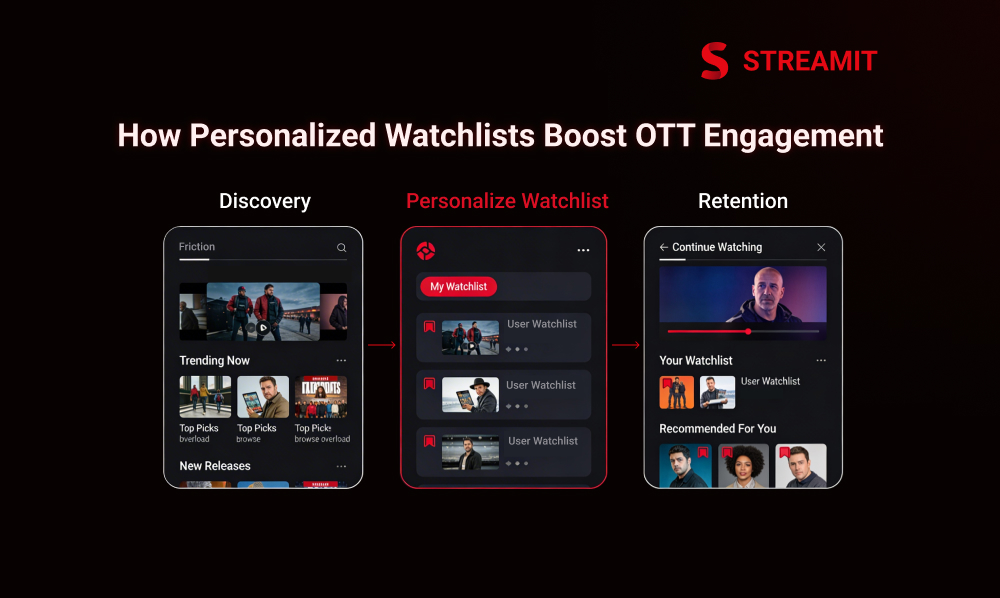
That is why personalized watchlists deserve more attention in OTT product strategy. They sit between discovery and retention, helping users remember what mattered and helping platforms surface the right content at the right time.
Why OTT Users Struggle With Content Discovery
Content discovery has become one of the most underestimated problems in OTT. Teams often assume the challenge is content acquisition or recommendation quality alone, but many user journeys weaken before those systems can even do their job.
The discovery layer now shapes whether the content library feels rich or overwhelming. When that layer is weak, even strong catalogs feel harder to use. That directly affects OTT user engagement, viewer satisfaction, and return behavior.
OTT users have more content choices than ever
OTT users now enter platforms with more options than ever across genres, formats, and categories. In practice, more choice only helps when the platform can organize it in a way that feels clear and relevant.
A broad content catalog can increase perceived value, but it also raises the cost of decision-making. Users do not measure the platform only by what it offers. They also measure it by how easily they can find something worth watching.
Large content libraries make browsing harder
A large content library can quickly become a browsing problem when the platform does not surface relevance well. Titles compete for attention, rows begin to feel repetitive, and users start scanning instead of selecting.
This often creates a misleading situation for OTT teams. The content exists, but the path to it feels heavier than it should. When that happens, the catalog stops feeling like an asset and starts feeling like work.
Too many choices can reduce viewing time
More options do not always increase viewing. In many cases, they slow down decision-making and shorten the actual time spent watching. Users hesitate, compare too many titles, or leave the session without starting anything.
That is why content discovery matters so much to viewer engagement. When the product asks users to do too much sorting on their own, viewing time drops before content quality even has a chance to prove itself.
Poor discovery lowers OTT user engagement
Weak discovery systems create small moments of friction that add up. The homepage feels generic, search becomes the main way to navigate, and users stop trusting the platform to understand what they might want next.
Engagement usually declines before churn becomes visible. Users browse longer, watch less often, and return with lower intent. That pattern often starts with discovery, not with pricing or content supply.
Users leave when they cannot find relevant content fast
Users do not open an OTT app hoping to solve a browsing puzzle. They want a clear route to something that matches their mood, intent, or history. When they cannot find that quickly, session momentum weakens.
This affects OTT engagement more than many teams realize. The problem is not always that users dislike the content. Often, they simply do not reach it in time.
Search alone cannot solve the discovery problem
Search is useful, but it is only one part of the solution. Many OTT sessions begin without that level of clarity.
Users may know the mood they are in, the kind of content they want, or the title they meant to watch later, but not the exact search term. That is why discovery needs layers such as personalized watchlists, continue watching, contextual recommendations, and homepage relevance. Search helps fulfill known intent. Watchlists help preserve and reactivate it.
| Discovery Issue | What Users Experience | Business Effect |
| Large catalog with weak structure | Browsing fatigue | Lower content starts |
| Slow access to relevant titles | Frustration | Reduced session quality |
| Search-led navigation only | Effort-heavy journey | Lower engagement |
| No saved-intent layer | Rediscover each session | Weaker retention |
What Personalized Watchlists Mean for OTT Users
A watchlist is often treated like a basic save feature. That is too narrow. For OTT users, a strong personalized watchlist plays a more strategic role in how they return to content, manage viewing intent, and move through the platform with less friction.
The real value of a personalized watchlist is not storage. It is continuity. It remembers where interest happened and helps that interest become viewed later.
Personalized watchlists are more than saved content lists
The simplest version of a watchlist is a saved folder. That can be useful, but it is limited. A personalized watchlist should do more than hold titles in one place.
It should reflect what the user saved, how recently they engaged with that content, what they watched after saving it, and what now deserves priority. That is where the feature becomes part of OTT personalization instead of remaining a passive utility.
They combine saved titles with user behavior
A personalized watchlist becomes more useful when it responds to behavior rather than relying only on manual saves. Watch history, partial viewing, repeat clicks, skipped content, and browsing patterns all help shape what should stay visible and what should move down.
This gives the watchlist more context. It starts to reflect not just what the user once saved, but what still matters.
They help OTT users return to relevant content faster
Most OTT users do not want to rediscover the same title every time they open the platform. If they already showed intent, the product should respect that and reduce the distance back to that content.
Personalized watchlists help by bringing saved and relevant content closer to the moment of return. That supports better content discovery and a smoother OTT user experience.
Personalized watchlists are different from general recommendations
Recommendations and watchlists are often grouped, but they serve different purposes. Both support relevance, but they operate at different points in the user journey.
Recommendations help expand possibilities. Personalized watchlists help preserve intent.
Recommendations suggest what to watch next
Recommendations are designed to introduce likely-interest content based on patterns such as viewing behavior, genre preference, or similar content logic. They help users explore beyond what they have already chosen.
This makes them useful for broad discovery, especially when the user is open to suggestions and not attached to a specific saved interest.
Watchlists help users save intent and come back later
A watchlist is more deliberate. It reflects a choice the user already made. That makes it especially valuable for later viewing, unfinished discovery, and return journeys.
This difference matters. Recommended answer: “What might you like now?” Personalized watchlists answer, “What did you already care enough to save, and how do we make that easier to come back to?”
| Feature | Primary Role | Best User Moment |
| Recommendations | Discovery expansion | When the user is exploring |
| Personalized watchlist | Intent preservation | When the user wants to return later |
| Continue watching | Session continuity | When the user left something unfinished |
| Search | Known-title access | When the user knows what to find |
Why Personalized Watchlists Improve OTT User Engagement
Personalized watchlists improve OTT user engagement because they remove friction where users often hesitate. Instead of starting from scratch, viewers re-enter the platform with a relevant path already waiting for them.
Less browsing pressure often creates better viewing behavior. That is the deeper value of the watchlist. It simplifies re-entry, shortens the route to playback, and supports more consistent usage.
Personalized watchlists reduce browsing friction
Friction in OTT is rarely dramatic. It comes from repeated small delays, too many decisions, and discovery journeys that feel disconnected from past intent. Personalized watchlists reduce that load.
They help users move from app open to playback with fewer steps and less mental sorting. That makes the entire OTT user experience feel more responsive.
Less effort helps OTT users start watching faster
The fewer decisions a user has to make before watching, the more likely they are to begin a session. Personalized watchlists do not eliminate choice, but they narrow it in a meaningful way.
This is especially useful when users are short on time, watching on mobile, or returning to something they saved earlier. A saved-intent layer helps playback start sooner.
Easier discovery can increase repeat visits
When the platform consistently remembers relevant interests, users are more likely to return because the cost of coming back feels lower. They know they will not need to rebuild context from the beginning.
That improves repeat visits over time. The product begins to feel easier to re-enter, which supports stronger OTT retention.
Personalized watchlists help build viewing habits
Habit formation in OTT is rarely created by content volume alone. It is created by repeated low-friction returns. Personalized watchlists help establish those returns by making the next session easier to start.
That makes them valuable not only for engagement, but for long-term viewer behavior.
Saved titles give users a reason to come back
A saved title creates unfinished intent. The viewer may not act on it immediately, but the platform now has a meaningful reason to bring them back.
This is particularly effective for film users wanted to watch later, ongoing series, and niche content that needs a reminder to stay visible.
Better watchlists help turn intent into actual viewing
Interest alone has limited value if it never becomes playback. Personalized watchlists improve that transition by keeping relevant saved items accessible, timely, and easier to resume.
That is where viewer engagement becomes more measurable. The watchlist stops being a passive feature and starts influencing actual viewing behavior.
How Personalized Watchlists Work on an OTT Platform
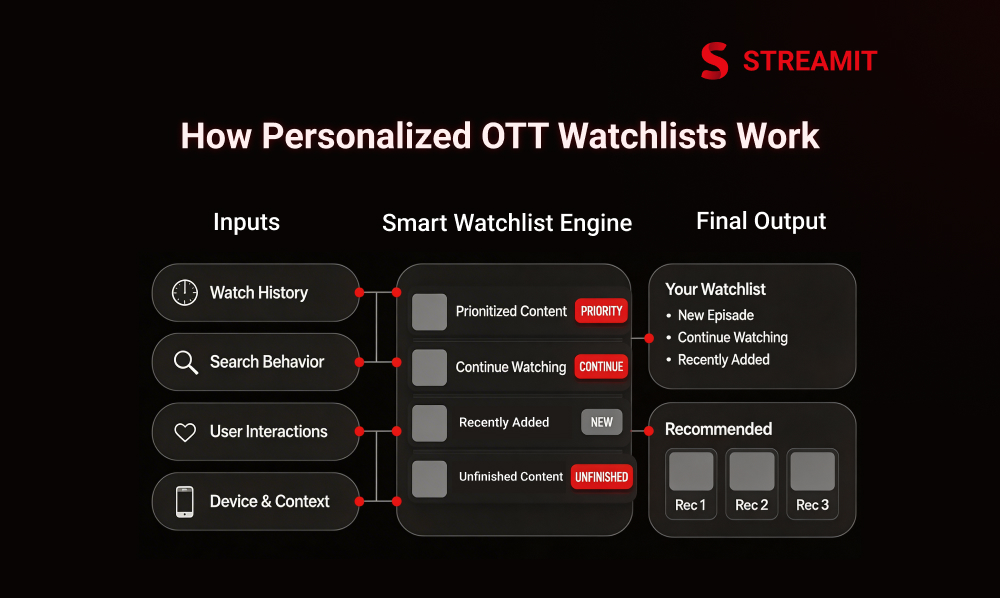
A personalized watchlist works well when it is fed by the right signals and shaped by clear ranking logic. It is not just a design feature. It is a data-informed product layer.
Strong watchlists usually come from disciplined signal use, not from feature complexity. The platform needs to understand behavior well enough to decide what belongs at the top, what should stay visible, and what should change.
User data shapes the watchlist experience
The quality of the watchlist depends on the quality of the user signals behind it. The platform should not treat every save equally or assume all interests remain static.
User data gives the watchlist its relevance. Without that, it becomes a flat list with little guidance value.
Watch the history shows of interest
Watching history is one of the clearest ways to understand what content the user actually values. It shows real consumption rather than surface-level curiosity.
That makes it useful for ranking related saved titles, unfinished items, or genres that deserve higher priority.
Search behavior and clicks show active intent
Search behavior, title page clicks, trailer views, and repeated content-page visits reveal interest before viewing starts. These are useful signals, especially for newer users with limited watch history.
They help the platform understand what the user may want soon, not just what they watched in the past.
Device, time, and session behavior add context
User intent can vary by device, time of day, and session length. A viewer may prefer short content on mobile during weekday breaks and longer-form viewing on TV at night.
That context can help personalized watchlists become more relevant. It adds situational understanding instead of relying only on static content preference.
Recommendation logic makes watchlists more relevant
A watchlist becomes more effective when ranking logic is applied thoughtfully. This does not need to be complex at the start, but it should be intentional.
The goal is not to over-automate the feature. It is to keep the list useful.
Genre preference helps surface better content
If users consistently engage with certain genres, the watchlist should reflect that. Genre preference helps prioritize saved content that aligns with established viewing patterns.
This gives the watchlist a more natural order and improves the chances of converting saved intent into viewing.
Similar-content logic improves watchlist suggestions
The watchlist can also support adjacent discovery. If a user saves one title, the platform can suggest a similar title inside the watchlist environment without forcing a full discovery restart.
This keeps the feature active and makes it more useful than a simple storage shelf.
Real-time behavior keeps the watchlist fresh
Freshness matters. If the watchlist never changes in response to recent viewing, it starts to feel static and outdated.
Real-time behavior signals help keep saved content relevant, reorder unfinished interests, and surface newly important titles at the right moment.
| Signal Type | What It Reveals | Watchlist Benefit |
| Watch history | Proven interest | Better ranking |
| Search activity | Current intent | Faster return to relevant titles |
| Click behavior | Consideration stage | Better visibility of likely content |
| Device behavior | Viewing context | More suitable prioritization |
| Session timing | Use pattern | Smarter content ordering |
Features That Make Personalized Watchlists More Effective
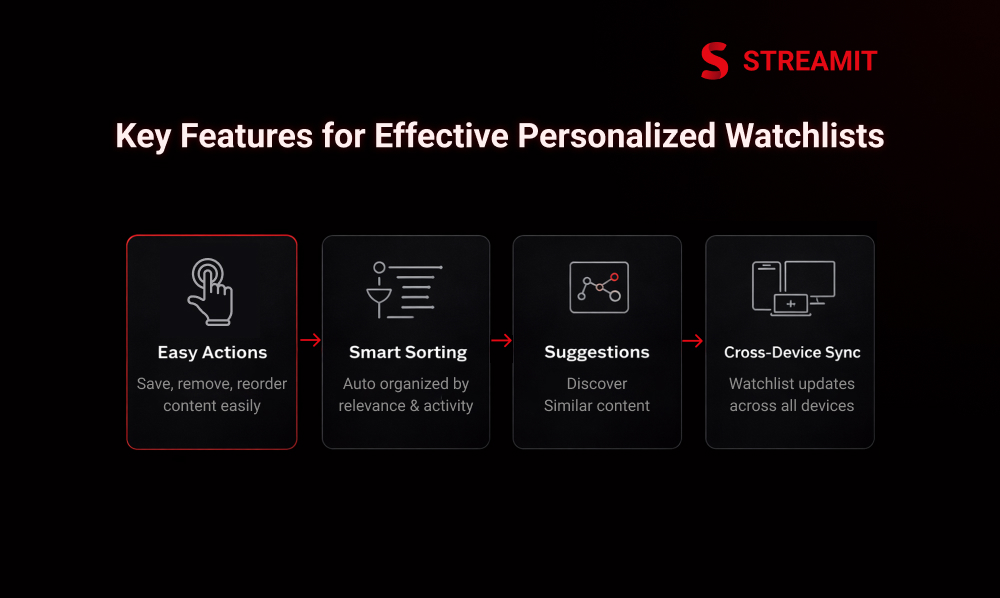
The success of a watchlist depends on more than relevance. It also depends on usability, visibility, and continuity.
A watchlist that is technically smart but hard to use will still underperform. That is why product design matters as much as logic.
Easy watchlist actions improve usability
Saving content should feel natural. Managing saved content should feel simple. If either action creates friction, adoption drops.
Add to watchlist from homepage, search, and content pages
Users should be able to save content wherever interest forms. That includes the homepage, recommendation rows, search results, and title detail pages.
The save action must stay close to the moment of decision. That improves usage and supports stronger watchlist adoption.
Easy edit, remove, and reorder options improve use
Watchlists need light maintenance. Users should be able to remove titles, reorder priorities, or clean up old saves without effort.
This keeps the watchlist usable over time and prevents it from becoming cluttered or stale.
Smart watchlist features improve viewer engagement
Once the basic experience works, smarter features make the watchlist more helpful and more likely to drive repeat behavior.
Auto-sort by interest, freshness, or unfinished content
Automatic sorting can reduce manual effort and make the list feel alive. Unfinished content, recent saves, and newly relevant titles should naturally rise where appropriate.
That supports faster decisions and better viewing continuity.
Suggest similar titles inside the watchlist
A smart watchlist can gently extend discovery by showing similar or related content within the saved-content environment.
This helps users move from stored intent into broader engagement without losing focus.
Alert users when saved content gets new episodes
Episode alerts create strong return moments because they are tied to explicit prior interest. When a saved series gets a new release, the user already has a reason to come back.
This makes the watchlist useful beyond the session itself and supports OTT retention more directly.
Cross-device watchlists make the experience smoother
OTT users move across screens. The watchlist experience should move with them.
Sync watchlists across mobile, web, and smart TV
Cross-device sync ensures the user sees the same saved content state across every interface. That consistency reduces confusion and makes the feature feel trustworthy.
Without this, watchlists feel fragmented and less useful in real-world viewing behavior.
Keep saved actions updated on every device
If a user saves something on mobile, removes it on the web, or starts watching it on TV, those actions should update everywhere.
That kind of continuity improves OTT user experience because it respects how users actually watch across multiple environments.
How Personalized Watchlists Support the Full OTT User Journey
Personalized watchlists should not sit in isolation. They work best when connected to discovery, re-engagement, and homepage logic throughout the user journey.
The stronger the watchlist is across the journey, the more often saved intent becomes repeat behavior.
Watchlists improve the homepage experience
The homepage is often where discovery either works or fails. Personalized watchlists can make that surface more useful by reducing randomness and highlighting prior intent.
Personalized rows make discovery easier
Rows built around saved content, unfinished titles, or watchlist-based relevance can improve content discovery because they create clearer decision paths.
Users do not have to search deeply or rely entirely on general recommendations. Their own intent is already present in the interface.
Watchlists make saved content more visible
A saved title has little value if it disappears behind menus or secondary tabs. The homepage should bring watchlist value back into view, where re-entry decisions actually happen.
That improves feature usage and strengthens the user journey from return to playback.
Watchlists support re-engagement beyond the app
A strong personalized watchlist also powers better communication outside the platform. It gives the business a more relevant reason to reconnect with users.
Personalized emails can bring users back to saved content
Emails tied to saved intent tend to feel more relevant than broad promotional messages. A reminder about a title the user saved, or a series they intended to continue, is more likely to trigger return behavior.
This improves re-engagement without relying on generic outreach.
Timely notifications can increase return visits
Push notifications and alerts work better when they align with something the user already cares about. Watchlist-based timing creates that alignment.
That makes return visits feel prompted by relevance, not interruption.
| Journey Stage | Watchlist Role | Outcome |
| Discovery | Preserve interest | Better content recall |
| Return session | Reduce browsing friction | Faster playback starts |
| Homepage visit | Highlight saved intent | Easier re-entry |
| Re-engagement | Power relevant reminders | More repeat visits |
How Personalized Watchlists Improve OTT Retention and Business Results
Personalized watchlists improve more than usability. They influence the business outcomes that matter most to OTT platforms.
When engagement becomes easier to sustain, retention becomes easier to protect. That is where watchlists move from feature thinking to business thinking.
Better watchlists can increase viewing and repeat usage
If saved content is easier to find, more relevant to the moment, and visible across devices, users are more likely to watch and return.
Relevant watchlists can increase content starts
A relevant watchlist helps content start because it reduces hesitation. The user does not need to start the selection process from zero.
That is a meaningful gain because more content usually starts to create stronger session value.
Better engagement can lead to stronger retention
Repeated positive sessions build trust in the platform. Users come back because they expect the experience to feel easy, relevant, and worth the time.
That is one of the clearest ways personalized watchlists support OTT retention.
Better engagement can also support monetization
Stronger engagement often improves monetization indirectly. The more consistently users return and watch, the more stable the revenue base becomes.
More viewing time can improve subscription value
Subscription value is not defined only by content volume. It is also shaped by how often users feel they are getting value from the platform.
Personalized watchlists support that by helping users find and continue meaningful content with less effort.
Personalized watchlists can support upsell opportunities
Saved behavior also reveals valuable intent for segmentation. Users who repeatedly save premium content, a certain genre bundle, or franchise-related titles may be better candidates for targeted upsell paths.
This makes watchlists useful not only for engagement, but also for smarter monetization decisions.
How OTT Platforms Can Build Better Personalized Watchlists
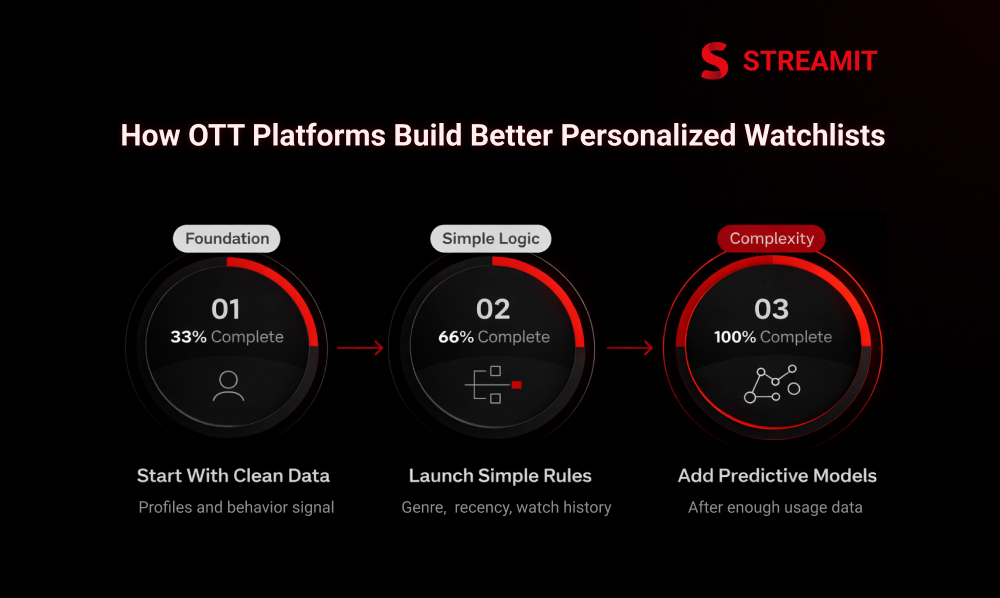
Many OTT teams assume this requires advanced logic from day one. It usually does not. Strong watchlists often begin with clean fundamentals.
The better path is to build with discipline first, then add complexity when the signal quality justifies it.
Start with clear user profiles and clean data
Personalization works best when user identity and behavioral signals are clean. Without that, watchlists become noisy and inconsistent.
Track viewing, saving, skipping, and search behavior
These signals help the platform understand what the user values, what they ignore, and what they intend to return to. That creates the base for more useful watchlist logic.
A platform that does not track these actions clearly will struggle to personalize with confidence.
Keep user data connected across devices
Profiles should remain connected across mobile, web, and TV. Otherwise, the watchlist reflects incomplete behavior and loses relevance.
Cross-device continuity is essential for OTT personalization that feels stable.
Launch simple watchlist logic before advanced AI
The strongest early systems are often rule-based, not overly predictive. Teams should solve clarity before sophistication.
Start with genre, recency, and watch history rules
Simple logic, such as ranking recent saves higher, surfacing unfinished titles, and boosting familiar genres, can already improve watchlist usefulness.
This gives the platform a functional and measurable base before more advanced personalization is added.
Add predictive models after enough usage data
Predictive logic becomes more valuable when there is enough behavior to support it. Without that depth, advanced models often create more noise than relevance.
That is why it makes sense to earn complexity rather than start with it.
Keep testing and improving watchlist relevance
Personalized watchlists should be treated like evolving product systems. Relevance changes. User behavior changes. The feature should adapt.
Test layout, content order, and reminder timing
Placement matters. Content order matters. Timing matters. These factors often influence watchlist performance as much as logic itself.
Testing helps reveal whether users are not engaging because the system is weak or because the presentation is.
Use engagement data to improve results
Engagement data should drive iteration. Save rate, revisit behavior, watchlist-to-play performance, and retention patterns all help show whether the feature is actually improving OTT engagement.
That keeps optimization grounded in outcomes rather than assumptions.
Common Mistakes That Make Personalized Watchlists Less Effective
Watchlists often underperform for avoidable reasons. Most of them come from treating the feature as static, generic, or separate from the broader user journey.
Using the same watchlist logic for all OTT users
Not all users save content the same way. Some save with immediate intent. Others save casually. Some rely heavily on the feature, while others only use it occasionally.
One-size-fits-all watchlists reduce relevance
When the same rules apply to every user, relevance drops. The feature starts to feel mechanical instead of responsive.
Personalization works better when the watchlist reflects actual patterns, not a universal template.
Shared account behavior can weaken personalization
Shared accounts can distort watch history, preferences, and watchlist relevance. Without profile separation, one viewer’s behavior can interfere with another’s experience.
This weakens content discovery and lowers trust in the personalization layer.
Ignoring user experience and feature placement
Even good logic fails when the feature is hard to find or hard to use. Adoption depends on visibility and ease.
A smart watchlist still fails if it is hard to use
Users will not continue using a feature that feels awkward, hidden, or overcomplicated. A watchlist has to feel lightweight and intuitive.
Otherwise, the platform loses the engagement benefit even if the underlying logic is strong.
Poor visibility lowers watchlist usage
If users must dig through menus to access the feature, it will not become part of regular behavior. Visibility is not a minor design choice. It shapes adoption directly.
Ignoring freshness and timing
Even a strong personalized watchlist loses value when it stops reflecting current user interest. OTT users expect saved content to feel timely, relevant, and connected to what they are most likely to watch now.
Old saved titles can make the watchlist feel stale
If the list is filled with outdated or forgotten titles, users stop trusting it. The feature begins to feel like storage clutter rather than a useful guide.
That weakens viewer engagement and lowers return value.
Generic reminders reduce re-engagement
Reminders should connect to real user intent. Generic reminders often fail because they provide no meaningful reason to come back.
Personalized timing and specific saved-content triggers perform better because they feel earned, not broadcast.
Metrics to Measure the Success of Personalized Watchlists
A watchlist should be measured by how it changes behavior, not by whether it exists. Clear metrics help OTT teams understand whether the feature is improving engagement, retention, and user experience.
Watchlist usage metrics show feature adoption
Adoption is the first sign that the feature is entering the user journey in a meaningful way.
Save rate, open rate, and watchlist-to-play rate matter
Save rate shows whether users see value in preserving intent. Open rate shows whether they return to that saved layer. Watchlist-to-play rate shows whether stored interest becomes actual viewing.
Together, these metrics reveal whether the feature is active or passive.
Revisit rate shows whether users come back
Revisit rate helps show whether the watchlist supports repeat entry into the platform. If users return because saved content remains relevant and visible, the feature is doing strategic work.
Engagement metrics show viewing impact
Adoption alone is not enough. The feature should improve content consumption after interaction.
Session length and viewing frequency should improve
If personalized watchlists reduce browsing friction, session quality should improve over time. Users should reach playback sooner and return more often.
That supports stronger OTT user engagement across cohorts.
Content starts, and the completion rate should increase
When saved content is well-ranked and still relevant, users are more likely to start it and complete it. That gives the watchlist stronger product value beyond simple feature usage.
Retention metrics show long-term value
Retention metrics help OTT platforms understand whether personalized watchlists are creating lasting user value. They show that stronger engagement is turning into repeat visits, lower inactivity, and more stable viewing habits.
Lower inactivity and churn show stronger results
If personalized watchlists help users keep returning and watching, inactivity should decline. Over time, that can contribute to lower churn and stronger retention performance.
Higher repeat visits show better habit formation
Repeat visits are one of the clearest signs that the watchlist is working. They show that the user is forming a routine around saved intent and easier discovery.
| Metric | What It Measures | Why It Matters |
| Save rate | Watchlist adoption | Shows if users value the feature |
| Open rate | Return to saved content | Indicates feature usefulness |
| Watchlist-to-play rate | Intent conversion | Shows content-start impact |
| Revisit rate | Repeat behavior | Supports retention analysis |
| Session length | Viewing depth | Measures session quality |
| Viewing frequency | Usage consistency | Reflects habit formation |
| Completion rate | Relevance strength | Shows content fit |
| Churn/inactivity | Long-term effect | Measures business value |
Key Takeaways
- Personalized Watchlists Improve OTT User Engagement: This blog explained how personalized watchlists help OTT users find relevant content faster, reduce browsing friction, and create smoother viewing journeys that improve overall engagement.
- Content Discovery Is a Major OTT Challenge: OTT users often struggle with large content libraries, too many viewing choices, and slow discovery paths, which can lower viewing time and weaken user satisfaction.
- Personalized Watchlists Are More Than Saved Lists: A personalized watchlist is not just a place to store content. It works as an intent-based feature that combines saved titles with watch history, user behavior, and relevance signals.
- Watchlists and Recommendations Serve Different Roles: The blog highlighted that recommendations help users discover what to watch next, while personalized watchlists help them return to content they already cared enough to save.
- Better Watchlists Reduce Friction and Build Habits: Personalized watchlists improve the OTT user experience by making content easier to resume, helping users start watching faster, and encouraging repeat visits over time.
- User Data Makes Watchlists More Relevant: Signals like watch history, search behavior, clicks, device usage, and session patterns help shape smarter watchlists that feel more aligned with real viewer intent.
- Smart Features Strengthen Watchlist Performance: Features such as easy add-to-watchlist actions, auto-sorting, similar-title suggestions, new episode alerts, and cross-device sync make watchlists more useful and more engaging.
- Watchlists Support the Full OTT User Journey: The blog showed how personalized watchlists improve homepage discovery, support re-engagement through emails and notifications, and keep saved content visible across user touchpoints.
- Personalized Watchlists Can Improve Retention and Monetization: Stronger watchlists can increase content starts, repeat usage, subscription value, and upsell opportunities, making them important for both OTT retention and business growth.
- Success Depends on Strategy, Testing, and Metrics: To build effective personalized watchlists, OTT platforms should start with clean user data, simple logic, and continuous testing, while tracking metrics like save rate, revisit rate, watchlist-to-play rate, session length, and churn.
Conclusion
Most OTT platforms focus heavily on what content to offer and not enough on how viewers return to it. That is where engagement often weakens.
Personalized watchlists solve a practical but important problem. They help OTT users save intent, return with less friction, and move through the platform with more confidence. That makes them more than a convenience feature. They become part of how the product supports viewing continuity, stronger engagement, and better retention.
For OTT platforms that care about long-term control, scalable performance, and sustainable growth, this matters. A watchlist should not be treated as a static save folder buried inside the interface. It should be designed as a living layer of the user journey, shaped by behavior, refined by context, and connected to discovery, re-engagement, and retention strategy.
That is where personalized watchlists start creating real value.
FAQs
How do personalized watchlists improve OTT user engagement?
Personalized watchlists improve OTT user engagement by reducing browsing friction, preserving user intent, and helping viewers return to relevant content faster. This makes it easier for users to start watching and come back more often.
How are personalized watchlists different from OTT recommendations?
OTT recommendations suggest new content based on viewing behavior and relevance patterns. Personalized watchlists focus on content the user already chose to save, making them more useful for returning to prior intent.
Can personalized watchlists help OTT platforms reduce churn?
Yes. Personalized watchlists can reduce OTT churn by improving repeat visits, making discovery easier, and helping users maintain stronger viewing habits over time.
Can AI improve personalized watchlists on OTT platforms?
Yes, but it should usually come after clean user data and simple watchlist logic are in place. Predictive systems work better when the platform already has enough behavioral data to support stronger relevance.
How do OTT platforms measure the success of personalized watchlists?
OTT platforms can measure success through save rate, open rate, watchlist-to-play rate, revisit rate, session length, viewing frequency, completion rate, inactivity, and churn.
Read Also
1. OTT Personalization vs Content Quantity: What Drives Retention
2. 7 Best OTT Security Solutions for Streaming Platforms
3. Subscriber Retention for OTT Platforms: 15 Proven Tactics to Reduce Churn
4. Personalized Recommendation Engine for Streaming Platforms
5. 10 Powerful Netflix Retention Strategies Every Brand Should Use