AI Content Recommendations for Better OTT User Engagement


Most OTT platforms do not lose users because the content library is empty. They lose users because the right content stays invisible.
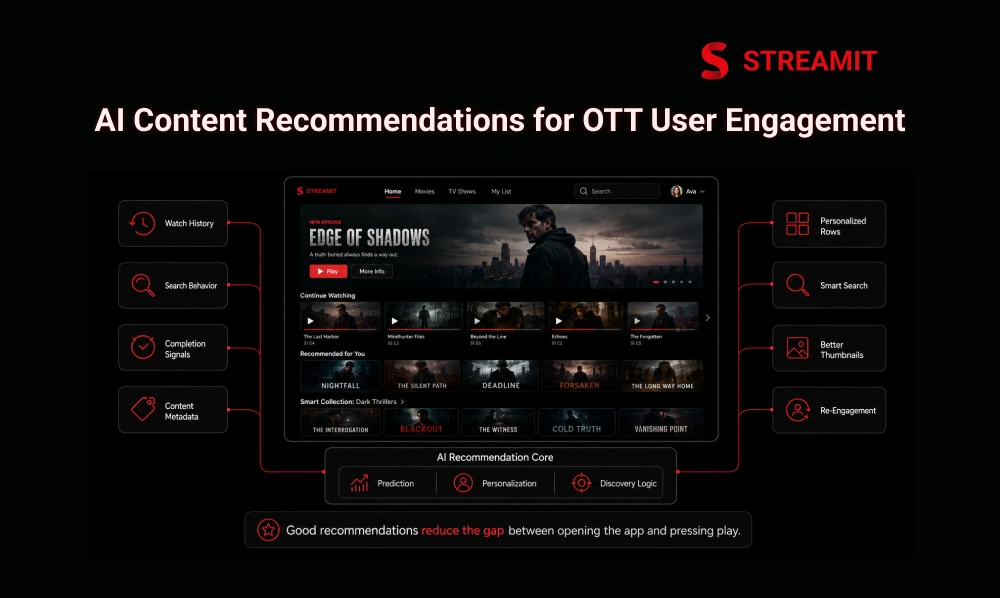
AI content recommendations help solve that problem. They turn watch history, search behavior, content metadata, completion signals, and user context into better discovery. For a serious OTT business, this is not a decorative feature. It is part of retention, monetization, and long-term platform control.
Part 1
Why AI Content Recommendations Matter More in OTT Today
The real competition in OTT is not only content volume. It is attention.
Users open a streaming app with limited patience. If they spend too much time searching, skipping, or scrolling, the platform starts losing trust before the viewer cancels. AI content recommendations reduce that delay by helping users reach relevant titles faster.
OTT Platforms Lose Users When the Right Content Stays Hidden
A large content library can still perform poorly when discovery is weak.
Good titles do not automatically create engagement. They need the right placement, timing, category, thumbnail, and audience match. Without that, strong content quietly becomes dead inventory.
Choice Overload Turns Big Content Libraries Into a User Experience Problem
More content can create more friction.
When users see too many unrelated options, they delay the decision. That delay affects watch time, return visits, and OTT retention. The platform may have enough value, but the user cannot reach it quickly.
AI Helps Users Find Something Worth Watching Faster
The best recommendation systems do not simply push popular titles.
They shorten the path between intent and playback. When the platform understands taste, timing, device, and behavior, content discovery starts feeling useful instead of random.
Part 2
What AI Content Recommendations Actually Mean in OTT
AI content recommendations are not only one row on the homepage.
They are a discovery layer across the platform. They can influence homepage rows, search results, content detail pages, continue-watching logic, smart collections, thumbnails, notifications, and even retention campaigns.
It Is More Than “Because You Watched This” Suggestions
Basic similarity is only the starting point.
A serious recommendation engine looks at patterns across users, titles, time, genres, languages, devices, and engagement depth. The goal is not to guess once. The goal is to improve every session.
It Uses Behavior, Context, and Metadata to Improve Relevance
Recommendations need clean inputs.
Watch history, skips, search terms, completion rate, content tags, language, duration, cast, theme, and device type all help the system understand what should appear next. Weak metadata usually creates weak personalization.
The Goal Is Better Discovery, Longer Sessions, and Stronger Return Behavior
The real win is not a single click.
Good recommendations increase meaningful viewing. That means more starts, better completion, longer sessions, stronger return frequency, and fewer users drifting away without a clear cancellation signal.
Part 3
How AI Recommendation Engines Work in OTT Platforms
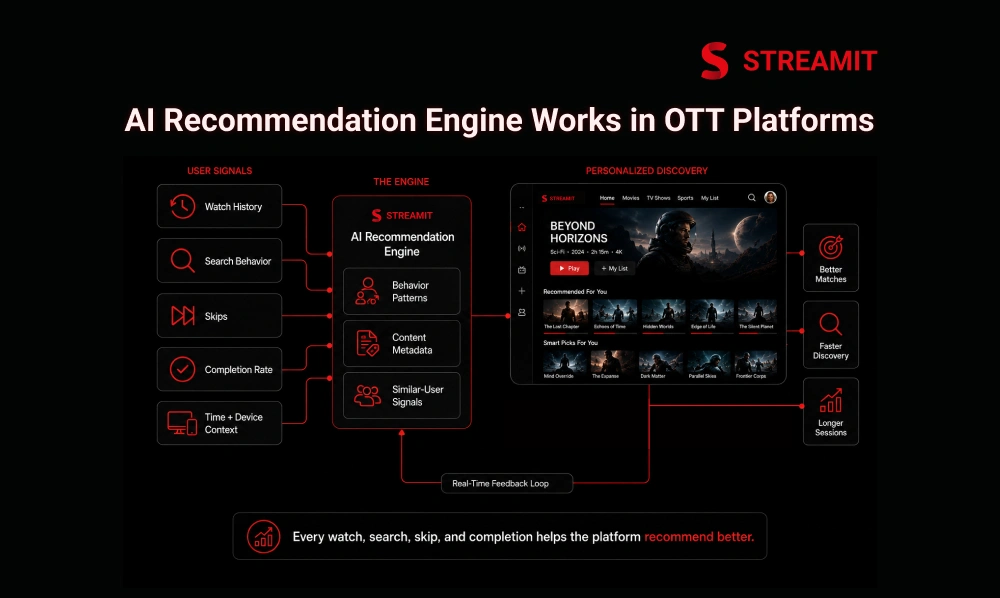
Recommendation engines work by connecting user behavior with content intelligence.
They learn what people watch, where they stop, what they search, what they ignore, and what similar users complete. Then the platform uses those patterns to improve what each user sees.
They Learn From Watch History, Search, Skips, Completion Rate, and Time Patterns
Every useful action tells a story.
A completed episode says something different from a 20-second drop-off. A late-night search says something different from a weekend binge. Good systems treat these signals differently.
They Combine User Behavior, Similar-User Patterns, Metadata, and Context
No single method is enough.
A hybrid recommendation system combines user behavior, similar-user patterns, and content metadata. This gives the platform more balance, especially when users are new or when fresh titles have limited viewing data.
They Improve Through Real-Time Feedback and Ongoing Model Updates
Recommendation accuracy is not a one-time setup.
User taste changes, catalog strategy changes, and seasonal demand changes. The platform needs feedback loops, fresh analytics, and ongoing testing so recommendations stay aligned with the business.
| Recommendation Input | What It Helps Improve |
|---|---|
| Watch history | Taste prediction |
| Completion rate | Quality of match |
| Search behavior | User intent |
| Content metadata | Discovery accuracy |
| Device and time patterns | Context-aware placement |
Part 4
How AI Improves OTT User Engagement Across the Product
Better recommendations improve more than one content row.
They influence how users move through the whole platform. A strong OTT product uses personalization across homepage design, search, collections, notifications, thumbnails, and cross-device journeys.
It Reduces Search Fatigue and Decision Delay
Search fatigue is a quiet churn signal.
Users may not complain. They simply stop returning. AI content recommendations reduce browsing pressure by giving users a stronger first screen and fewer irrelevant paths.
It Increases Watch Time and Return Visits With Better-Fit Titles
Watch time improves when recommendations match real intent.
The platform should not only ask, “What will get a click?” It should ask, “What will this viewer actually watch, complete, and come back for?”
It Improves More Than the Recommendation Row With Better Homepages, Search, and Visual Prompts
Personalization should shape the whole experience.
Dynamic homepage rows, NLP search, smart thumbnails, and contextual collections can all improve discovery. Personalization should quietly improve content discovery without making viewers notice the system working behind it.
It Helps Surface Niche Titles, Older Content, and Hidden Catalog Value
The homepage should not only reward the newest content.
AI recommendations can bring older titles, niche content, regional content, and long-tail catalog assets back into circulation. This improves content ROI without always increasing acquisition spend.
Part 5
The Recommendation Metric Most OTT Teams Get Wrong
Click rate is useful, but it can be misleading.
A title can get clicks because of a strong thumbnail, not because it creates satisfaction. If users click and leave quickly, the recommendation looked successful but failed the product.
Click Rate Alone Does Not Prove Recommendation Quality
Clicks show curiosity, not value.
OTT teams need to know what happened after the click. Did the user start playback? Did they watch enough? Did they return later? Did the session continue?
Start Rate, Completion, Return Frequency, and Churn Matter More
Stronger recommendation metrics look deeper.
Start rate, completion rate, average watch time, repeat sessions, return frequency, and churn movement show whether recommendations are building habit or only creating surface engagement.
The Best Systems Balance Relevance, Exploration, and Long-Term Value
Too much relevance can become boring.
If the system only repeats known preferences, users may stop discovering. The best recommendation engines balance familiar content with controlled exploration, new categories, and long-term engagement value.
| Weak Measurement | Better Measurement |
|---|---|
| Click rate only | Start rate and completion |
| Views only | Watch time and return frequency |
| Trending titles only | Personalized engagement |
| One-time campaign lift | Long-term retention impact |
Part 6
The AI Recommendation Challenges OTT Teams Must Solve
AI recommendations fail when the platform foundation is weak.
The issue is rarely the model alone. Poor tracking, messy metadata, shared accounts, privacy gaps, and slow analytics can all damage recommendation quality before users ever see the output.
The Cold Start Problem for New Users and New Titles
New users create a data gap.
The platform does not yet know their taste. New titles also create uncertainty because there is no strong viewing pattern. Good systems use onboarding, metadata, trending context, and early signals to reduce this gap.
Weak Data and Poor Tagging Lead to Weak Recommendations
Bad metadata creates bad discovery.
If content is poorly tagged, the recommendation system cannot understand it properly. Genres alone are not enough. Themes, mood, language, talent, duration, format, and audience fit matter.
Shared Accounts Can Distort User Intent and Taste Signals
One account may represent many viewers.
A family profile, shared login, or TV-based account can mix children, adults, sports fans, and casual viewers into one signal. OTT platforms need profile logic and session context to avoid confused recommendations.
Privacy, Consent, and Trust Must Be Part of the System
Personalization should not feel invasive.
Users need clear privacy controls, safe data handling, and consent logic. Trust matters because recommendations depend on behavior data, and users must feel that data is being handled responsibly.
Part 7
Best Practices for Implementing AI Recommendations in OTT
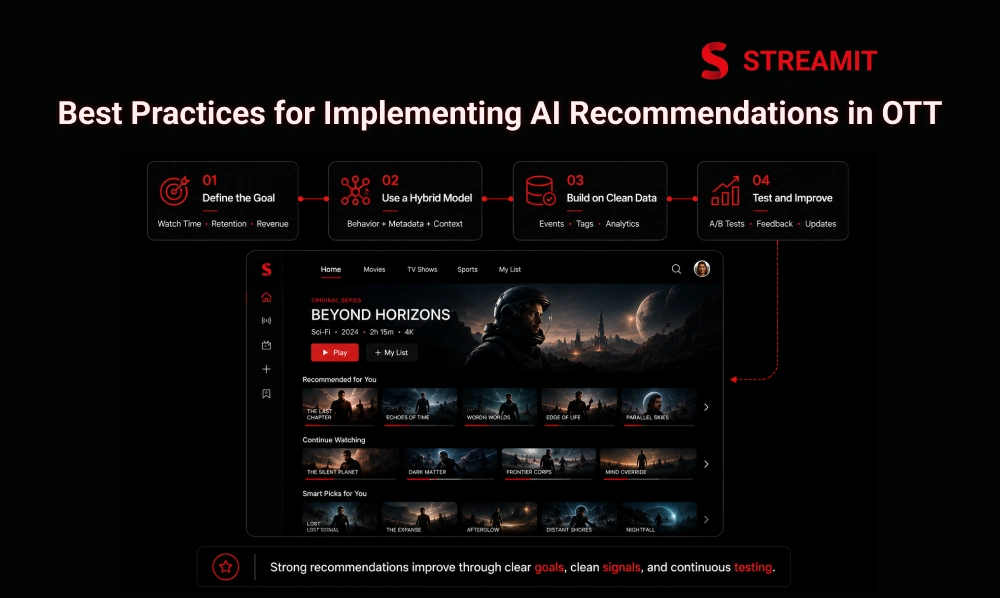
The best recommendation strategy starts with business goals, not technical excitement.
Before choosing a model, teams should define what they want to improve: watch time, subscription retention, content ROI, ad revenue, paid discovery, or cross-device engagement.
Start With a Clear Business Goal, Not Just a Model
A model without a goal becomes a feature demo.
For a subscription platform, the goal may be reducing churn. For an ad-supported platform, it may be longer sessions. For education or fitness, it may be progress and habit.
Use Hybrid Models Instead of Relying on One Recommendation Method
One method usually creates blind spots.
Collaborative filtering needs enough behavior data. Content-based logic depends on strong metadata. Hybrid systems give OTT teams more flexibility across new users, new titles, and changing catalog patterns.
Build Around Clean Events, Structured Metadata, and Fast Analytics
The platform needs clean data before smart personalization.
Track meaningful events like search, start, skip, pause, completion, device switch, and return visit. Then connect those events with structured metadata and analytics that teams can actually use.
Test, Measure, and Improve Continuously Instead of Expecting One-Time Accuracy
Recommendations should evolve with the audience.
A/B testing, content row testing, thumbnail testing, and segment analysis help teams improve gradually. The system should learn from real behavior, not just assumptions made before launch.
Part 8
Business Impact of AI Content Recommendations in OTT
AI content recommendations matter because they connect product experience with business performance.
Better discovery can improve retention, increase watch time, unlock more catalog value, and support smarter monetization without making the platform feel overly commercial.
Better Recommendations Improve Watch Time and Reduce Churn
Users stay when they find value quickly.
If the platform repeatedly helps them find relevant content, the product becomes part of their routine. That routine is stronger than any one campaign or discount.
Better Discovery Improves Content ROI Across the Library
Content ROI depends on visibility.
When older, niche, regional, or under-promoted titles get matched with the right audience, the platform extracts more value from existing assets instead of constantly relying on fresh content spend.
Better Personalization Can Support Upsells, Bundles, and Paid Discovery
Monetization should feel connected to user interest.
AI recommendations can support premium bundles, add-ons, rentals, paid events, and targeted offers when they are based on real behavior. The result feels helpful, not pushy.
Part 9
AI Recommendation Priorities by OTT Business Type
Different OTT businesses need different recommendation logic.
An entertainment app, sports platform, learning product, fitness app, and creator platform should not use the same personalization rules. The business model decides the recommendation priority.
Entertainment Platforms Need Better Discovery Across Large Libraries
Entertainment OTT platforms usually fight catalog overload.
They need stronger homepage logic, smarter collections, and title-level personalization that turns a large library into a manageable viewing journey.
Sports Platforms Need Fast, Context-Aware Recommendation Logic
Sports discovery is time-sensitive.
Users may care about live matches, highlights, teams, players, leagues, replays, and post-match clips. The recommendation system must react quickly because relevance changes fast.
Learning and Fitness Platforms Need Progress-Based Personalization
Education and fitness platforms need habit-building logic.
Recommendations should consider progress, level, goals, completion, difficulty, and consistency. The best suggestion is not always the most popular content. It is the next useful step.
Creator Platforms Need Better Matchmaking Between Audience and Niche Content
Creator-led platforms depend on audience fit.
AI content recommendations can connect niche creators, episodes, collections, and subscriber interests more accurately. This helps improve retention without forcing every creator to chase mass appeal.
| OTT Business Type | Recommendation Priority |
|---|---|
| Entertainment | Large-library discovery |
| Sports | Real-time context and highlights |
| Learning | Progress-based content paths |
| Fitness | Goal, level, and routine matching |
| Creator platforms | Audience-to-content matchmaking |
Part 10
What a Good OTT Platform Must Support for AI Recommendations to Work
Recommendations are only as strong as the platform underneath them.
A good OTT platform must support metadata, analytics, event tracking, personalization logic, privacy controls, and cross-device continuity. Without that base, AI becomes a patch, not an advantage.
Clean Metadata, Fast Analytics, and Reliable User Event Tracking
The platform must know what is happening.
That means clean title data, structured tags, accurate user events, and analytics that show how people actually move through the product.
Dynamic Homepage, Search, and Cross-Device Personalization Support
Personalization should follow the user.
A viewer may search on mobile, watch on TV, and return on web. The OTT platform should connect these journeys without losing context or forcing the user to restart.
Privacy Controls, Consent Logic, and Safe Data Handling
Trust should be built into the architecture.
Recommendation systems need clear data rules, access control, secure storage, and user-facing privacy options. Personalization should improve the experience without weakening confidence.
Recommendation Infrastructure That Can Improve With Business Goals
The system should not be frozen after launch.
As the business scales, priorities often shift toward keeping subscribers engaged, increasing revenue, improving local content relevance, and getting more value from the catalog. Recommendation infrastructure should be flexible enough to evolve.
Part 11
Why Streamit Fits Teams Building AI-Led OTT Discovery
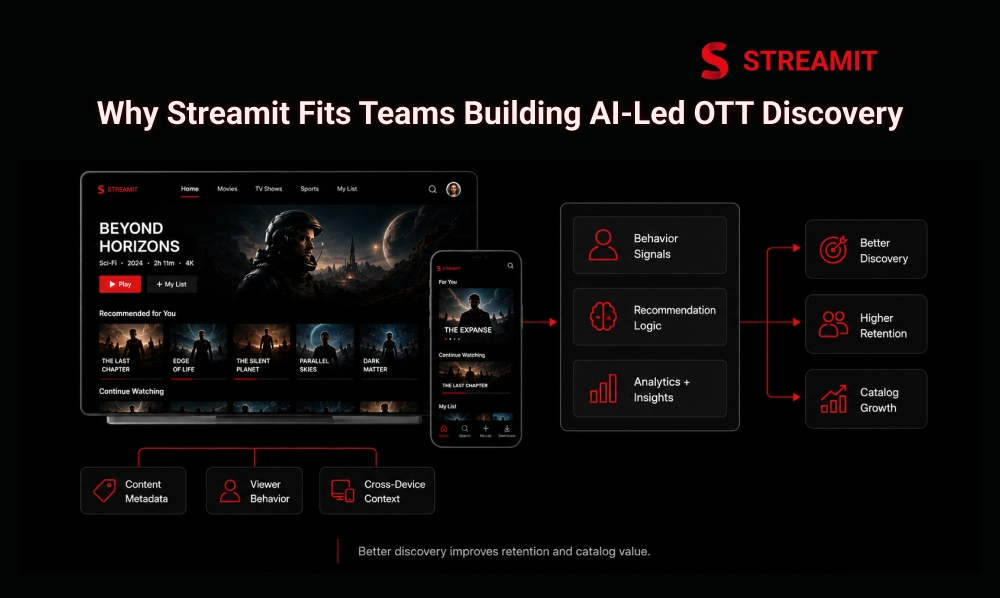
Streamit is built for teams that see OTT as a long-term business, not just an app launch.
Its positioning around AI-first OTT infrastructure, ownership, scalability, and multi-device streaming makes it a stronger fit for businesses that want better discovery, retention, monetization, and control from day one.
It Supports AI Recommendations, Discovery Logic, and Better User Engagement
Streamit helps teams build OTT experiences where discovery is part of the product foundation.
Recommendations, analytics, homepage logic, and engagement systems can work together instead of being added later as disconnected tools.
It Supports Metadata, Personalization, and Smarter Content Surfacing
Better content surfacing starts with better structure.
Streamit gives OTT teams a stronger base for organizing content, tracking behavior, and improving how titles appear across web, mobile, and TV experiences.
It Gives Teams a Stronger Base for Retention, Monetization, and Catalog Growth
Growth needs more than launch speed.
Streamit supports OTT businesses that care about performance, ownership, monetization, catalog value, and long-term control. That is where serious recommendation systems create real business impact.
Conclusion
Conclusion
AI content recommendations help OTT platforms turn large content libraries into easier, smarter, and more engaging viewing experiences.
For founders and teams building serious streaming products, the goal is not to copy a popular platform. The goal is to build an OTT foundation that understands users, improves discovery, protects data, supports monetization, and grows without forcing a rebuild later.
Streamit fits that direction because it is built around AI-first OTT infrastructure, scalable architecture, ownership, and long-term product control.
Summary
Key Takeaways
AI Recommendations Drive Engagement
They help users find relevant content faster and increase watch time, return visits, and retention – making the platform a routine, not a one-time visit.
Hidden Content Reduces Platform Value
Even a strong library underperforms when users cannot discover the right titles easily. Discovery is as important as the catalog itself.
Metadata Is the Foundation
Weak tags, poor categories, and incomplete content data damage recommendation quality. Structured metadata is the prerequisite for smart personalization.
Measure Beyond Clicks
OTT teams should track start rate, completion rate, watch time, return frequency, and churn signals – not just whether a title got clicked.
Hybrid Systems Perform Better
Combining user behavior, metadata, similar-user patterns, and context creates more reliable personalization across new users and changing catalogs.
Privacy Builds Long-Term Trust
Clear consent, secure data handling, and safe personalization are essential for user confidence. Recommendations that feel invasive erode retention, not build it.
FAQs
Frequently Asked Questions
-
What is the first sign that OTT recommendations are not working?
The first sign is usually not cancellation. Early warning signs include fewer return visits, brief browsing sessions, repeated searches, and viewers exiting before choosing anything to watch.
-
Can weak metadata hurt recommendations more than weak AI models?
Yes. Poor metadata can make even a strong recommendation engine perform badly. If the platform cannot understand the content, it cannot match it well.
-
What should OTT teams measure beyond recommendation clicks?
OTT teams should measure start rate, completion rate, watch time, return frequency, session length, and churn movement. These show whether recommendations create real engagement.
-
How do cold start problems hurt new OTT users first?
New users give the platform very little behavior data. Without good onboarding, metadata, and early session signals, the first recommendations may feel generic.
-
Can AI recommendations reduce churn before users cancel?
Yes. Better recommendations can detect disengagement signals early and help users find relevant content before they stop returning.
-
How do AI recommendations help OTT monetization without feeling pushy?
They connect offers, bundles, paid events, and premium content to real user interest. When timing and relevance are right, monetization feels useful instead of forced.
-
What must an OTT platform support before AI recommendations can work well?
It needs clean metadata, reliable event tracking, fast analytics, privacy controls, dynamic UI support, and cross-device personalization logic.