Netflix-Like OTT Platform: Complete Build Guide


Accio reports that the global video streaming market was estimated at USD 129.26 billion in 2024 and is projected to reach USD 416.8 billion by 2030, highlighting the growing opportunity for OTT platform businesses. That growth is exactly why more founders are exploring a Netflix-like OTT platform, but the opportunity is often misunderstood. Most platforms do not fail because video demand is weak. They fail because product, infrastructure, monetization, and control were treated as launch decisions instead of business decisions.
A serious OTT platform is not a “clone” project. It is a long-term distribution business with its own economics, retention mechanics, and operational complexity. For brands, media companies, educators, sports operators, and niche communities, the right platform creates ownership over audience, pricing, experience, and growth.
That is where Streamit fits into the conversation. Streamit positions itself as an AI-first streaming infrastructure partner built for real traffic, monetization, long-term ownership, and multi-device delivery across web, mobile, and smart TVs. The signal here is important: premium OTT buyers are not looking for a cheap app. They are looking for a platform foundation that survives scale.
What Is a Netflix-Like OTT Platform?
A Netflix-like OTT platform is a direct-to-consumer video business that lets users discover, access, and watch content on demand across multiple devices. It combines content delivery, user accounts, recommendations, payments, analytics, and content control into one product experience.
The phrase matters less than the operating model behind it. In practice, businesses are not trying to imitate Netflix’s brand. They are trying to build a streaming platform with the same structural strengths: scalable delivery, recurring revenue, personalized discovery, and tight control over the customer journey.
What does a Netflix-Like OTT Platform Means?
At its core, a Netflix-like OTT platform is a video streaming platform where the business owns the app, the user relationship, and the monetization layer. That means content is not just uploaded and played; it is packaged, surfaced, priced, measured, and improved.
For founders, the real shift is strategic. You stop depending on third-party distribution rules and start building a platform where product decisions compound over time.
Core parts of a Netflix-like platform
The essential layers are content ingestion, transcoding, storage, CDN delivery, playback, authentication, subscriptions, recommendation logic, and analytics. Remove one weak layer, and the user feels it immediately.
A stable OTT app structure is less about flashy features and more about making these layers work together without friction.
How is it different from a normal video website?
A normal video site can host content. A Netflix-like streaming platform has to manage concurrency, multi-device sessions, access rules, retention flows, subscription billing, and content discovery at scale.
That is why many “video websites” feel acceptable at launch but fragile under real usage.
How a Netflix-Like OTT Platform Works?
The OTT streaming process starts when content is uploaded, processed into multiple renditions, stored securely, and distributed through a CDN for fast playback. The user then logs in, purchases or accesses a plan, and streams content through a player optimized for their device and network.
Behind that simple experience is a chain of business logic. Access control, watch history, personalized rows, buffering logic, and event tracking all work together to make viewing feel effortless.
Content upload, encoding, storage, and delivery
The video upload workflow begins with ingestion and media processing. Files are transcoded into different resolutions and bitrates, stored in cloud infrastructure, and delivered through a CDN so playback stays smooth across markets and devices.
The user never sees this pipeline directly, but they judge the platform through it every minute they watch.
User login, subscription, and access control
The OTT subscription system handles registration, authentication, plan access, renewals, free trials, and entitlement checks. This layer determines who can watch what, where, and under which payment conditions.
If access rules are unclear or brittle, churn often starts before viewers finish their first session.
Playback, recommendations, and analytics
Playback is the visible experience; analytics is the invisible feedback loop. Recommendation systems, watch events, completion rates, and drop-off points tell the platform what users value and where the journey is breaking.
Without analytics, most OTT teams are guessing. With it, they can shape retention with precision.
Why Is the Demand for Netflix-Like OTT Platforms Growing?
Mobile network data traffic continues to accelerate, and Ericsson projects 5G will account for 43% of mobile data traffic by the end of 2025. At the same time, the broader OTT and video streaming economy continues to expand, which means user expectations are rising along with market demand.
That growth does not simply create more viewers. It creates a more demanding market. Audiences now expect streaming to be fast, personalized, available everywhere, and easy to pay for.
Why do viewers prefer on-demand streaming?
On-demand streaming fits how people actually consume content now across fragmented schedules, multiple screens, and highly personalized interests. Audiences want control over when they watch, how they watch, and what appears next.
That preference has reshaped not just entertainment, but education, sports, wellness, and niche publishing.
Watch anytime on any device
Smartphones and tablets accounted for the dominant platform share in the video streaming market in 2024, which reinforces a simple truth: viewers no longer think in channels. They think in access.
A multi-device OTT platform meets users where they already are instead of asking them to adapt to the platform.
Personalized content and better user experience
Recommendation-led discovery reduces decision fatigue and helps users get value from a content library faster. It is one of the clearest differences between a content archive and a real streaming business.
Personalization is not a luxury feature anymore. In crowded libraries, it is often the product itself.
Industries That Can Launch a Netflix-Like OTT Platform
The OTT model is no longer limited to movies and series. Any business with recurring video value, audience depth, or live event potential can build a viable streaming product.
The strongest use cases are usually built around focused audiences, not broad ambition.
Entertainment and movies
Entertainment platforms benefit from large libraries, premium originals, content curation, and subscription-led revenue. In this category, content freshness and discovery quality heavily influence retention.
The challenge is less about having content online and more about shaping a viewing habit.
Sports and live events
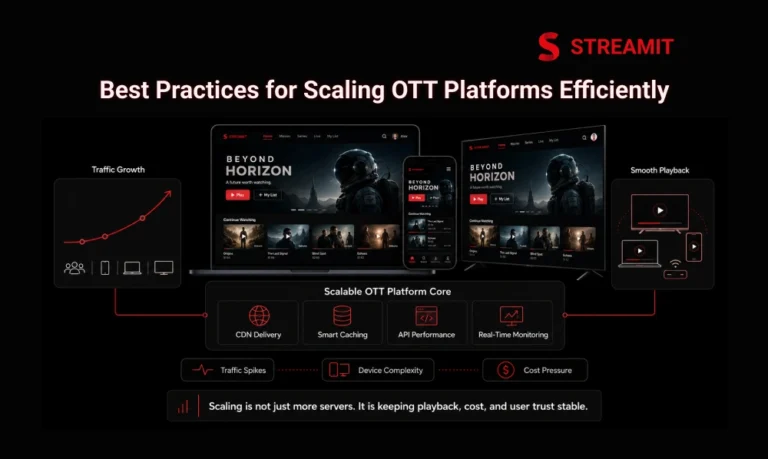
Sports OTT platforms require high concurrency, reliable live delivery, and fast recovery during traffic spikes. Streamit explicitly positions its sports and live-event infrastructure around these pressures, which is the right lens because fans judge reliability in real time.
In live environments, buffering is not a minor flaw. It is a brand-level failure.
Education, fitness, faith, and niche communities
Niche OTT platforms often outperform broad platforms in retention because the audience intent is clearer. Educational OTT platforms, fitness streaming apps, and faith-based platforms can combine subscription revenue with stronger community alignment.
The narrower the positioning, the easier it is to design pricing, discovery, and engagement around real user needs.
Types of OTT Platforms You Can Build
Businesses typically choose between VOD, live streaming, hybrid, or niche-focused models. The right choice depends on content behavior, monetization logic, and operational complexity.
The mistake is choosing the model by trend rather than by the actual content engine behind the business.
Video on Demand (VOD)
A VOD platform works best when users value flexible access, evergreen content, and personalized browsing. It is well-suited for entertainment libraries, education catalogs, and member-only content.
VOD also gives teams more operational control over quality and publishing schedules.
Live streaming OTT platform
Live OTT works well for sports, broadcasts, events, webinars, and community experiences where immediacy drives value. It demands stronger infrastructure and tighter operational readiness.
The payoff is engagement intensity, but the margin for technical error is smaller.
Hybrid OTT platform
A hybrid OTT platform combines live and on-demand experiences. This is often the strongest model because live events create spikes in engagement while VOD extends watch time afterward.
From a business perspective, hybrid models usually support better retention and more content monetization pathways.
How to Plan a Netflix-Like OTT Platform Before Development?
Planning determines whether the platform becomes a business asset or an expensive rebuild. Before writing code, teams need clarity on audience, content, monetization, devices, launch scope, and what success will actually mean.
Most OTT platforms do not underperform because the team lacked ambition. They underperform because planning was vague, where infrastructure needed precision.
Choose Your Niche and Target Audience
A platform without a defined audience ends up with generic UX, unclear pricing, and weak retention. The sharper the audience definition, the better the product decisions become.
This is where founder discipline matters more than creativity.
Define your ideal user
Create a user persona around intent, not just demographics. Why are they subscribing? What device do they use most? Do they binge, sample, or return for live events?
Those answers shape everything from homepage rows to billing logic.
Choose countries, languages, and devices
Global expansion sounds attractive, but early OTT growth usually comes from focused geography and controlled device support. Countries, languages, and device mix affect infrastructure, subtitles, payments, customer support, and content rights.
Overexpansion at launch usually creates operational drag before revenue catches up.
Define Your Content Strategy
Content strategy is not only about volume. It is about release rhythm, quality thresholds, licensing logic, and how often a subscriber has a reason to come back.
A weak content plan can make even a well-built product feel empty.
Licensed content vs original content
Licensed content can speed up launch and broaden the catalog. Original content creates differentiation and long-term brand equity.
Most serious platforms use a mix of licensed content for depth, original content for identity.
Launch library size and content pipeline
The launch library should feel intentional, not inflated. A smaller but well-structured catalog with clear categories often performs better than a large, confusing one.
What matters after launch is not just what you have, but what arrives next and how predictably it arrives.
Set Clear Business Goals
OTT business goals should cover revenue, growth, retention, and product stability. If the goals are vague, teams end up optimizing for vanity metrics instead of business outcomes.
The strongest teams define what matters before dashboards start filling up.
Revenue goals and pricing goals
Set targets around average revenue per user, trial-to-paid conversion, upgrade rate, and plan mix. Pricing should reflect content value, not competitor imitation.
A cheap plan does not fix a weak value proposition. It just hides it temporarily.
User growth and retention goals
Growth without retention creates expensive churn loops. Retention goals should include watch frequency, completion rates, subscriber lifespan, and returning session patterns.
That is where OTT becomes a system, not just an app.
Must-Have Features of a Netflix-Like OTT Platform
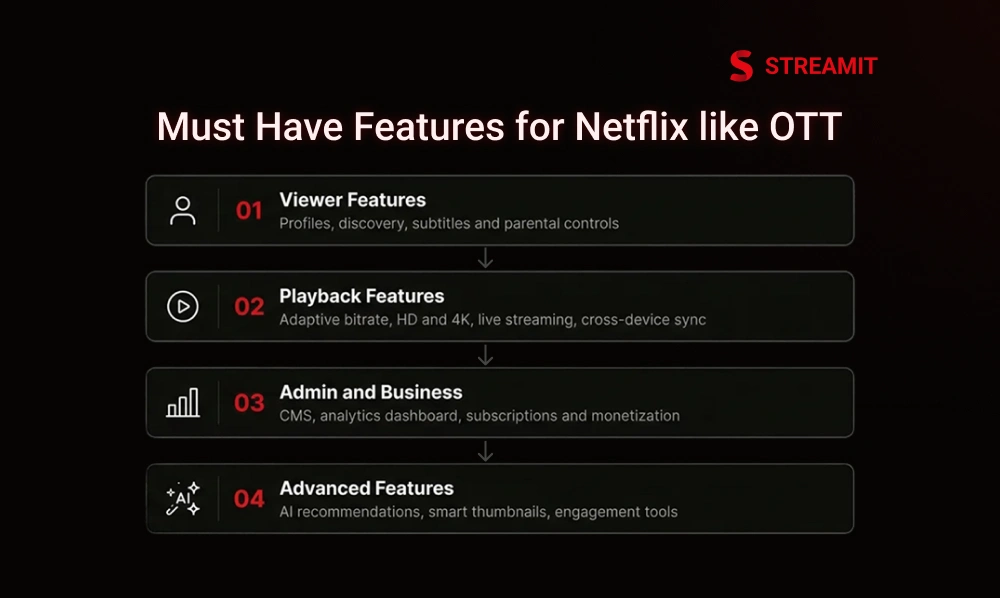
Features should reduce friction, increase watch time, and improve business control. The strongest OTT platforms do not win because they have more features. They win because the right features are connected to measurable outcomes.
For premium buyers, feature decisions should always answer one question: Does this improve retention, revenue, or operational leverage?
Viewer Features Every OTT Platform Needs
User-facing features shape first impressions and daily habits. This layer should feel intuitive enough that viewers stop thinking about the interface and focus on the content.
The best viewer experience is usually the one users barely notice.
Sign up, log in, and create multiple user profiles
Registration must be simple, secure, and fast. Multiple profiles help households personalize recommendations, protect watch history, and support different viewing preferences.
This is a small feature on paper and a major retention tool in practice.
Search, filters, watchlist, and continue watching
Search, categories, and watchlists help users find intent quickly. Continue Watching reduces re-entry friction and increases repeat sessions.
Discovery features are not design accessories. They are decision engines.
Subtitles, audio options, and parental controls
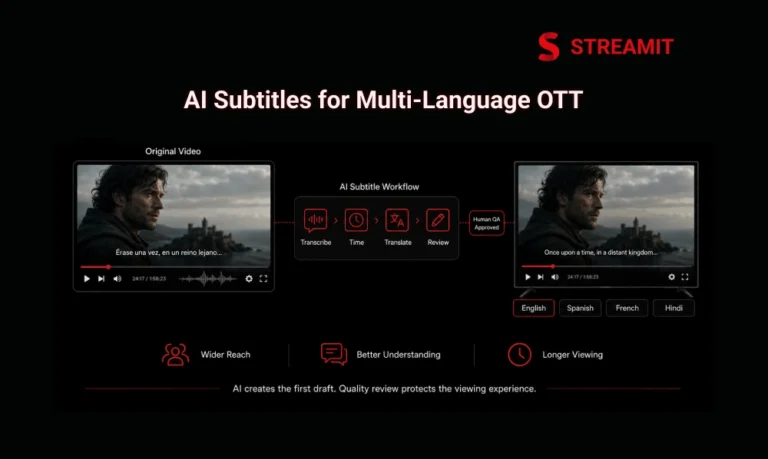
Multi-language support expands reach, while subtitles and alternate audio improve accessibility and regional relevance. Parental controls and kids mode are essential for family-oriented platforms.
These features directly affect trust, not just usability.
Streaming and Playback Features
Playback is where platform quality becomes visible. Even the best content loses value when playback feels unstable or inconsistent.
This is why performance often matters more than feature count.
Adaptive bitrate streaming and low-buffer playback
Adaptive bitrate streaming adjusts video quality based on network conditions so the viewer gets the smoothest possible experience. It is a core requirement, not an advanced enhancement.
In OTT, stability usually beats theoretical maximum quality.
HD, 4K, live streaming, and cross-device sync
A premium platform should support high-quality playback where relevant, smooth live delivery, and cross-device continuity so users can resume across web, mobile, and TV.
Consistency across screens is part of the product promise now.
Admin and Business Features
The admin layer is where OTT businesses either become operationally efficient or quietly chaotic. CMS, analytics, subscriptions, and campaign controls are the backbone of scale.
A polished frontend cannot compensate for weak business operations.
Content management system and analytics dashboard
An OTT CMS should control upload flows, metadata, scheduling, categories, visibility, and publishing. Analytics dashboards should expose watch time, completion, drop-off, engagement, and revenue performance.
If the team cannot see the system clearly, it cannot improve the system intelligently.
Subscription management, notifications, and monetization controls
You need plan creation, trials, coupons, renewals, cancellation flows, push notifications, email triggers, and ad controls if the model includes AVOD or hybrid monetization.
Monetization breaks faster than playback when billing logic is treated casually.
Advanced Features to Make the Platform Better
Advanced features create differentiation once the foundation is stable. They should come after reliability, not before it.
The wrong sequencing here creates impressive demos and disappointing products.
AI recommendations and personalized home screen
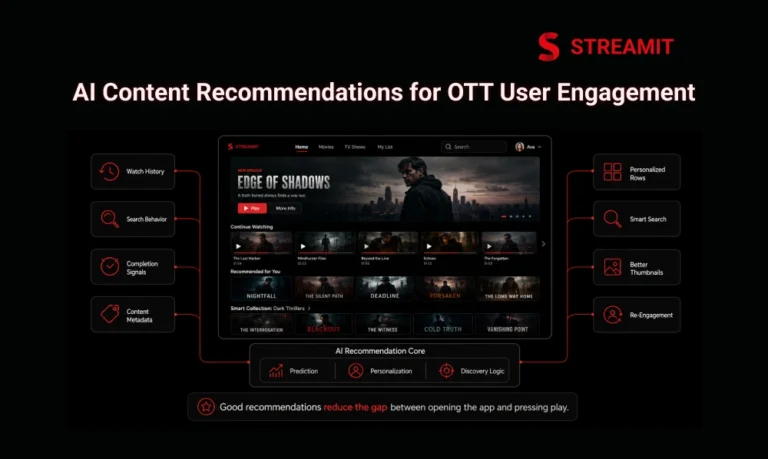
Streamit highlights AI analytics, personalization, and retention-oriented platform intelligence as part of its positioning. That makes sense because personalized discovery is where larger OTT businesses compound their advantage over time.
Recommendation quality improves the value of the entire catalog, not just the next click.
Smart thumbnails, reviews, and engagement tools
Smart thumbnails, ratings, reviews, and community features increase content clarity and user interaction. These features are especially useful in niche platforms where trust and participation drive retention.
Not every platform needs a social layer, but every platform needs stronger reasons to return.
Technology Stack for a Netflix-Like OTT Platform
The technology stack should match the business model, not just the development team’s comfort zone. OTT platforms have to support fast interfaces, strong backend logic, resilient media delivery, secure billing, and content protection.
A modern stack is not about trendiness. It is about choosing technologies that reduce future rewrites.
Frontend and Backend Technologies
Web apps often use React or similar modern frameworks, while mobile apps may be built natively or with cross-platform tools depending on performance needs. OTT TV apps introduce their own complexity and usually need platform-specific planning.
The broader the device footprint, the more the architecture discipline matters.
APIs, authentication, databases, and microservices
The backend manages users, subscriptions, metadata, entitlements, analytics, and content workflows through APIs. As platforms scale, microservices and modular backend design become more useful for reliability and operational separation.
Monoliths can launch quickly. They rarely age gracefully in streaming.
Video Infrastructure, Cloud, and Security
Video infrastructure includes ingestion, encoding, transcoding, storage, CDN delivery, playback, DRM, signed URLs, watermarking, and anti-piracy controls. The stack also needs dependable cloud hosting and backup planning.
This layer is usually under-scoped by teams that are new to OTT.
HLS, DASH, CDN, cloud hosting, and payment stack
HLS and DASH remain standard formats for reliable adaptive streaming, while payment infrastructure usually integrates providers like Stripe, PayPal, or Paddle, depending on region and tax requirements.
A smart stack treats payments, playback, and protection as one commercial system rather than separate integrations.
Technology Stack Snapshot
| Layer | Recommended Direction | Why It Matters |
| Frontend | Web, mobile, and TV apps with a consistent design system | Keeps user experience aligned across devices |
| Backend | API-first services, user auth, subscription logic, analytics events | Supports scale, control, and integrations |
| Media Pipeline | Ingestion, transcoding, packaging, player integration | Determines playback quality and flexibility |
| Cloud + CDN | Reliable hosting, distributed delivery, backup planning | Reduces latency and protects uptime |
| Billing | Subscription plans, renewals, coupons, and failed-payment handling | Protects recurring revenue |
| Security | DRM, signed URLs, token access, watermarking | Protects content and access rights |
Netflix-Like OTT Platform Architecture Explained
Architecture defines how content moves from upload to playback and how business events are captured around it. A clear architecture helps teams scale traffic, features, and monetization without rebuilding core systems.
The goal is not complexity for its own sake. The goal is controlled complexity.
Content Workflow From Upload to Playback
A typical OTT architecture includes an upload layer, processing layer, storage layer, CDN delivery layer, and app playback layer. Each step has to be resilient, observable, and secure.
Good architecture makes growth boring, which is exactly what a serious business wants.
Upload, transcoding, storage, and delivery layers
The ingestion layer receives media, the processing layer creates optimized renditions, storage preserves the assets, and the CDN distributes them globally for fast retrieval.
Every delay or inconsistency introduced here shows up later as a user complaint.
Metadata, Discovery, Analytics, and Webhooks
Metadata drives categories, search, recommendations, and homepage rows. Event tracking captures watch time, completion, conversion, and drop-off. Webhooks trigger automation across CRM, billing, and internal workflows.
This is where OTT shifts from media delivery to growth operations.
Search, personalized rows, and event tracking
Genres, tags, custom fields, autocomplete, dynamic rows, and real-time event capture help teams understand what content is working and what friction users are facing.
Without discovery logic and event depth, the platform cannot learn from its own audience.
Step-by-Step Process to Build a Netflix-Like OTT Platform
A structured build process reduces waste and clarifies priorities. The goal is not to ship everything. The goal is to launch a stable version that proves demand and can scale cleanly.
The smartest OTT roadmap is usually narrower than the founder expected.
Step 1 to Step 3: Discovery, Design, and Core Platform
Start with product discovery, define MVP features, and split phase one from later enhancements. Then design the user journey across the homepage, detail pages, playback, subscription, and account flows. After that, build the backend, CMS, and admin logic.
If phase one already looks crowded, it is probably too large.
Define MVP features and core journeys
Your MVP should prove content value, playback quality, and billing logic. It does not need every advanced personalization or engagement feature on day one.
Early restraint is often the reason later scale becomes possible.
Step 4 to Step 7: Streaming Setup, Payments, Testing, and Launch
Set up VOD or live streaming workflows, integrate plans and billing logic, test aggressively across devices and networks, then launch with soft monitoring and rapid iteration.
Testing is not the final step. In OTT, it is continuous product protection.
Playback tests, load tests, security tests, and launch feedback
Run buffering checks, session tests, payment flow tests, and security validations before release. Then monitor watch behavior, errors, support signals, and early churn patterns after launch.
The first month should be treated as product intelligence, not just a release celebration.
Cost to Build a Netflix-Like OTT Platform
Cost depends on platform scope, device coverage, feature depth, infrastructure design, content complexity, and whether the build is custom, white-label, or hybrid. Teams usually underestimate post-launch costs more than development costs.
The question is not “how cheap can we launch?” but “what cost structure can this business sustain?”
Main Factors That Affect OTT Platform Cost
Web, mobile, and TV app coverage increases effort. Live streaming adds complexity beyond VOD. Personalization, analytics, DRM, and custom workflows push costs upward but often improve long-term control.
The cheapest architecture is often the one you pay to replace later.
Cost by Development Approach
| Approach | Best For | Trade-Off |
| Custom-built from scratch | Businesses with unique workflows and long-term product control needs | Higher upfront cost, longer build time |
| White-label OTT platform | Faster launch with lower initial cost | Lower flexibility and ownership over time |
| Hybrid build approach | Teams that want speed with selective customization | Requires careful integration discipline |
Ongoing costs after launch
Post-launch costs include hosting, CDN usage, storage, maintenance, support, content licensing, production, and subscriber acquisition.
A realistic OTT plan includes operational cost discipline from the beginning.
How long does it take to build?
An MVP may take a few months depending on scope, while a fuller multi-device OTT platform can take much longer once TV apps, advanced analytics, security layers, and live workflows are involved.
Speed matters, but sequencing matters more.
Build From Scratch vs White-Label OTT Platform
This choice should be based on business model maturity, required control, speed-to-market, and the uniqueness of the product vision. Founders often frame it as a technical decision when it is really a capital-allocation decision.
The right answer depends on what you need to own now versus later.
When custom is the right choice
Custom OTT development is stronger when the platform needs unique content workflows, advanced monetization logic, special integrations, or long-term control over product evolution.
If the platform is core to enterprise value, ownership usually matters more.
When white-label is the right choice
White-label OTT platforms are useful when launch speed, budget, and proven infrastructure matter most. They reduce time to market and can be effective for early validation.
The trade-off is that you inherit other people’s product boundaries.
When a hybrid approach makes sense
A hybrid build uses ready video infrastructure with a custom frontend and selective business logic. For many mid-market and growth-stage teams, this is the most practical route.
It offers a better balance between speed, flexibility, and future expansion.
How to Choose the Right OTT Development Company?
A strong OTT partner should offer strategy, UX, development, infrastructure guidance, launch readiness, and post-launch optimization. They should also understand traffic spikes, delivery quality, content protection, and retention economics.
The partner matters because most expensive mistakes in OTT are architectural, not visual.
What should a good development partner offer?
Look for end-to-end clarity: product strategy, CMS logic, multi-device delivery, payments, analytics, security, and scaling support. Streamit’s positioning around real traffic, long-term ownership, and enterprise architecture speaks directly to this premium buyer concern.
A capable partner should sound structured, not theatrical.
How to Evaluate an OTT Development Company?
Ask whether they support web, mobile, and TV apps; whether they handle DRM, CDN, and payments; and whether they can show actual OTT case studies. Avoid vendors with vague pricing, weak support plans, or no evidence of scale experience.
In OTT, the wrong partner is rarely exposed during the pitch. They are exposed during traffic.
How to Launch, Market, and Scale a Netflix-Like OTT Platform?
Launch is where technology meets distribution. Before going live, the platform needs content readiness, pricing clarity, analytics setup, CRM flows, subscriber tracking, and device approvals.
A great product without acquisition discipline becomes an internal success story and a commercial disappointment.
Pre-launch and subscriber acquisition
Your pre-launch checklist should include content structure, plan pages, landing pages, app store preparation, and event tracking. For acquisition, use SEO content, paid ads, retargeting, partnerships, waitlists, and referral offers based on audience fit.
Subscriber growth usually starts before the app is fully live.
Retention and scale after launch
Retention comes from content freshness, personalized recommendations, lifecycle messaging, and better pricing-fit decisions. Scale comes from regional expansion, subtitles, dubbing, local payments, new monetization layers, and continuous optimization.
The best OTT businesses do not scale by adding noise. They scale by reducing friction.
Key Takeaways
Netflix-Like OTT Platform Meaning: This blog explained that a Netflix-like OTT platform is a complete video streaming platform with content delivery, user management, subscriptions, recommendations, analytics, and monetization features built into one system.
OTT Platform Demand Is Rising: The guide showed why more businesses want to build OTT platforms, as viewers now prefer on-demand streaming, personalized content, and the flexibility to watch across web, mobile, and smart TV devices.
Planning is the First Step in OTT Development: A strong OTT platform starts with choosing the right niche, identifying the target audience, defining the content strategy, selecting supported devices, and setting clear business and growth goals.
Must-Have OTT Features Improve User Experience: Important features like login, multiple profiles, search, filters, watchlist, continue watching, subtitles, offline viewing, adaptive bitrate streaming, and parental controls help create a better streaming experience.
The OTT Tech Stack Matters: Frontend tools, backend systems, media infrastructure, cloud hosting, CDN setup, payment gateways, and security tools all play a major role in OTT platform performance, scalability, and reliability.
Architecture Supports Smooth Streaming: A Netflix-like OTT platform depends on a strong architecture that handles content upload, transcoding, storage, delivery, playback, metadata, recommendations, analytics, and automation efficiently.
The Build Process Should Be Step by Step: The blog covered a structured process for OTT platform development, including discovery, feature planning, UI/UX design, backend and CMS development, player setup, monetization setup, testing, and launch.
OTT Platform Cost Depends on Scope: Cost is affected by the number of features, device support, VOD or live streaming requirements, AI personalization, security needs, and whether the platform is custom-built or based on a white-label solution.
Custom vs White-Label Is a Strategic Decision: Custom OTT development is better for control and flexibility, white-label OTT platforms work well for speed and lower upfront cost, and hybrid models help balance both.
Launch Is Only the Beginning: Long-term success depends on OTT marketing, subscriber acquisition, retention strategy, content freshness, analytics, new revenue streams, and continuous optimization after launch.
Conclusion
A Netflix-like OTT platform is not valuable because it looks modern. It is valuable because it gives the business direct ownership over audience, experience, pricing, and platform evolution.
That is the real difference between uploading content and building a streaming company. If the goal is long-term control, recurring revenue, and infrastructure that holds under pressure, then the build strategy needs to reflect that from day one. Calm planning, not launch excitement, is what usually decides whether the platform becomes a growth asset or a maintenance burden.
FAQs
1. How do you build a Netflix-like OTT platform from scratch?
Start with audience, content model, monetization, and device scope. Then define MVP features, build the backend and CMS, set up video infrastructure, integrate payments, test across devices, and launch with analytics and feedback loops in place.
2. What is the best technology stack for OTT platform development?
The best stack is the one aligned with your business model. Most platforms need modern web and mobile frameworks, API-first backend services, cloud hosting, CDN delivery, adaptive streaming formats, secure billing, and content protection layers.
3. Should you build a custom OTT platform or choose a white-label OTT solution?
Choose custom when you need ownership, unique workflows, and long-term control. Choose white-label when speed and lower initial cost matter more. Choose a hybrid when you want a faster launch without giving up future flexibility.
4. What security features are needed for a Netflix-like OTT platform?
At minimum, use DRM where required, signed URLs, token-based access, encryption, watermarking, secure authentication, entitlement checks, and strong payment security practices.
5. What role do CDN, DRM, and cloud hosting play in OTT platform development?
CDN improves global delivery speed, DRM protects premium content rights, and cloud hosting provides the infrastructure foundation for storage, processing, scale, and reliability.
6. Can a startup build a Netflix-like OTT platform on a limited budget?
Yes, but only with a disciplined scope. A focused niche, limited device rollout, strong MVP definition, and hybrid infrastructure decisions can reduce cost without undermining the business model.
Read Also
1. 10 Powerful Netflix Retention Strategies Every Brand Should Use
2. The Subscriber Retention Secrets Netflix Doesn’t Want Streaming Platforms to Know
3. 5 Proven Retention Tactics Every Streaming Platform Can Steal from Netflix
4. Building Long-Term Viewer Relationships: What Netflix Can Teach OTT Startups
5. How to Reduce Subscriber Churn in OTT Platforms: Lessons from Netflix