Subscriber Retention for OTT Platforms: 15 Proven Tactics to Reduce Churn

Subscriber retention for OTT platforms is the discipline of keeping paying viewers subscribed after the first week and the first month. It’s built by delivering consistent value through content relevance, smooth playback, and a product experience that feels effortless.
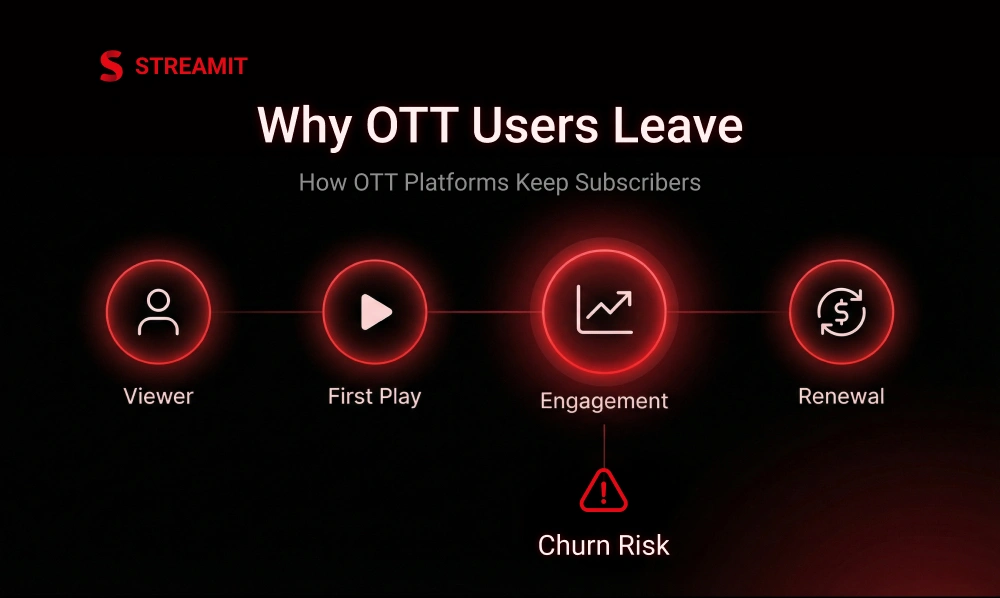
Churn usually isn’t dramatic, it’s quiet. Viewers cancel when discovery feels like work, when streaming quality breaks trust, when the app feels slow, or when pricing no longer matches perceived value.
Retention is not one feature or one campaign. It’s a system that connects onboarding, personalization, engagement loops, and billing reliability to remove reasons to leave before renewal day arrives.
This blog breaks down the real drivers behind OTT churn reduction and the metrics that reveal risk early. You’ll see how cohorts, watch frequency, time-to-first-play, and payment failures predict churn before it becomes a cancellation.
Then you’ll get 15 proven, practical tactics to reduce subscriber churn in OTT, from faster first play and smarter discovery to QoE protection, flexible plans, payment recovery, and win-back flows. The goal is a calm, scalable streaming retention strategy that improves LTV without discount dependency.
What Is Subscriber Retention for OTT Platforms?
Streaming doesn’t win on “more content.” It wins on “more continuity.” Subscriber retention for OTT platforms is your ability to keep paying users active, engaged, and renewing month after month, without needing constant discounts or blockbuster drops.
Retention is not a single feature. It’s the outcome of playback reliability, content discovery, pricing fit, and lifecycle messaging working together.
Subscriber Retention vs Subscriber Churn
Churn is the symptom, retention is the system that prevents it. Churn rate in OTT measures how many subscribers cancel in a given period, while retention measures how many stay and continue paying.
A healthy retention strategy focuses on the “why” behind churn: weak activation, low engagement, payment friction, or easy switching.
Why Retention Is More Profitable Than Acquisition?
OTT acquisition scales cost faster than it scales loyalty. As competition rises, CAC increases, and LTV becomes your only real margin lever.
Retention improves LTV, stabilizes forecasting, and reduces dependency on spikes (new seasons, sports calendars, promotions). This is why serious platforms build for 12 months, not a launch week.
Why do OTT Subscribers Cancel?
One buffering incident can reduce the amount of video watched by 39%, and viewers rarely complain before they leave. Retention breaks when experience breaks.
Most cancellations come from predictable churn drivers. The difference is whether you measure them early enough to act.
Content Fatigue and Poor Discovery
“Nothing to watch” is often “nothing surfaced for me.” When discovery fails, your catalog becomes invisible, even if it’s objectively strong.
Cold-start recommendations, weak metadata, and generic homepages create fast drop-offs because viewers don’t feel momentum.
Poor Streaming Quality
Playback stability is retention infrastructure, not “engineering hygiene.” Rebuffering, startup delay, and playback errors directly reduce watch time and trust.
When viewers can’t rely on playback, they don’t build a routine, and routine is the real moat.
Bad App Experience
A frictiony UI creates “soft churn” long before cancellation. Slow navigation, inconsistent TV app behavior, and clunky search create low engagement and higher switching intent.
OTT UX isn’t about beauty. It’s about speed-to-content and confidence.
Pricing and Value Perception
Subscription fatigue is real, and the bar for “worth it” keeps moving. Deloitte notes households are reaching limits on streaming spend; perceived value often lags rising costs.
If the value story isn’t clear (content cadence, exclusives, bundles, usability), churn becomes “budget optimization.”
Payment Failures
A surprising amount of churn is passive, users didn’t decide to leave, their card did. Recurly highlights meaningful risk from involuntary churn due to failed payments.
If you don’t have retries, account updater logic, and smart dunning, you lose revenue you already earned.
Easy Switching to Competitors
OTT competitors don’t need to be better, they just need to be “good enough” at the moment your user is bored. With low switching cost, viewers toggle services around content drops.
Bundling and stickiness features reduce this “subscribe-watch-cancel” loop.
Types of OTT Churn You Must Understand
Not all churn is equal, treating it as one bucket leads to wrong fixes. You need to separate intentional cancellations from billing failures and seasonal behavior.
This clarity changes your roadmap: product fixes vs pricing tweaks vs payment recovery.
Voluntary Churn
Users cancel because value, content cadence, or experience didn’t justify renewal. This is where onboarding, discovery, quality, and habit loops matter most.
Involuntary Churn
Users churn due to card expiry, bank declines, or payment friction, not dissatisfaction. This is the highest-ROI churn to fix because intent to stay often exists.
Seasonal / Event-Based Churn
Sports and event-driven platforms see predictable churn around calendars. Viewers join for a tournament, then pause until the next season.
Plan flexibility + off-season value protects retention here.
Passive Churn
Low engagement is churn in slow motion. Viewers stop opening the app, then cancel when a renewal reminder arrives.
Your goal is to detect this early (signals like fewer sessions/week, lower watch time, search exits).
OTT Retention Benchmarks and Industry Data
Retention benchmarks help OTT platforms understand whether their churn levels are normal or a signal of deeper issues in the subscriber experience. Without industry comparison, retention numbers often lack real context.
Because viewers can easily switch between streaming services, retention becomes a critical measure of platform health. Benchmarking helps identify where improvements in engagement, discovery, or streaming performance can reduce churn.
Average Monthly Churn in Streaming Industry
Monthly churn rate is one of the most important indicators of OTT platform health. It measures the percentage of subscribers who cancel their subscriptions within a given month.
In the streaming industry, churn levels vary depending on content strategy, pricing, and competition. Platforms that maintain stable engagement, strong discovery, and reliable streaming quality generally experience lower churn rates.
Retention Rate Benchmarks (Day 7, Day 30, Month 3)
Day 7 retention reflects activation; Day 30 reflects habit formation; Month 3 reflects product-market fit. In OTT, most damage happens early, when discovery and first-play experience disappoint.
The right question isn’t “what’s our churn?” It’s “where do users fall off in the first 30 days?”
What Is a “Healthy” OTT Retention Rate?
Healthy retention depends on your model (SVOD/AVOD/hybrid), content cadence, and audience intent. News and sports behave differently than entertainment libraries.
Focus less on a universal number and more on improving your own cohort curves month over month.
How Subscription Fatigue Is Changing Retention?
Households are juggling multiple services, and price/value sensitivity is rising. Deloitte reports average spend levels that indicate limits, while research also shows meaningful intent to cancel services.
This is why bundles, ad-supported tiers, and flexibility are becoming retention tools, not just monetization tools.
Core Metrics to Track for Subscriber Retention in OTT Platforms
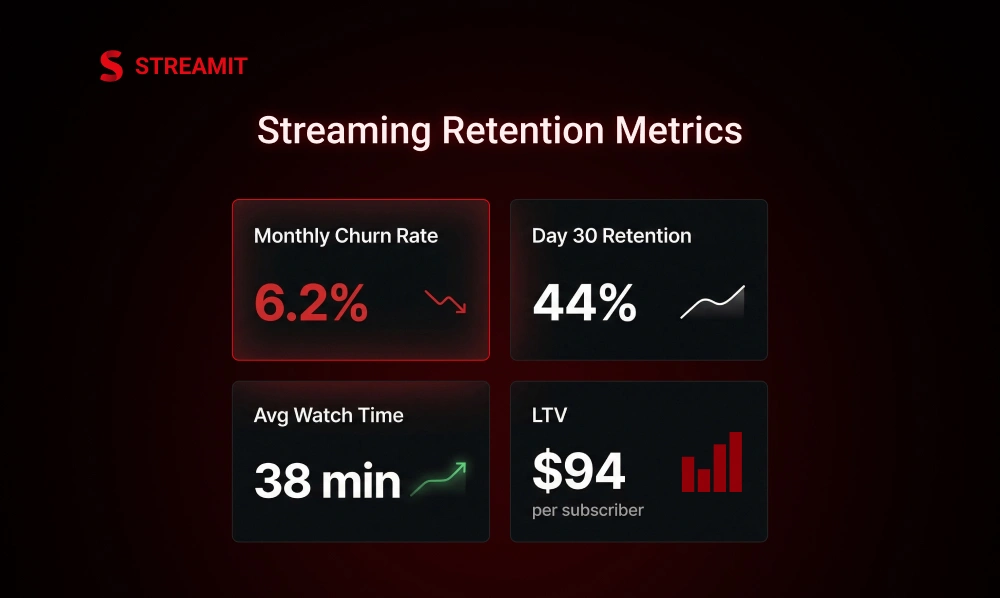
You can’t reduce churn with opinions, you reduce it with cohorts, funnels, and failure rates. These metrics tell you where retention breaks: activation, engagement, payments, or value.
Track them weekly, not quarterly, especially in the first 90 days after launch.
Monthly Churn Rate and Net Churn
Gross churn tells you loss, net churn tells you whether expansion offsets it. In OTT, upsells (add-ons, bundles) can meaningfully improve net retention when executed cleanly.
Cohort Retention Analysis
Cohorts expose whether your improvements actually work. Compare users by signup month, acquisition channel, device type, and plan.
Retention should rise for newer cohorts if your product is improving.
Watch Time and Engagement Frequency
Watch time is the leading indicator, cancellation is the trailing indicator. Track sessions/week and “days active” to identify passive churn.
Time-to-First-Play (TTFP)
TTFP is your activation truth. If users don’t reach first play fast, they don’t form a habit, and many never return.
TTFP is influenced by signup friction, app performance, and discovery relevance.
Subscriber Lifetime Value (LTV)
LTV is the scoreboard, not the lever. Use it to prioritize which churn problems to fix first (involuntary churn often has the fastest ROI).
ARPU and Revenue Retention
Not all retention is equal, retaining high-ARPU cohorts can outperform growing low-ARPU cohorts. Track revenue retention by plan and segment.
Early Churn Warning Signals
The earliest churn signals are behavioral, not survey-based. Examples: fewer searches ending in play, lower completion rates, fewer weekly sessions, or repeated playback errors.
OTT Retention Metrics (What to Track + Why It Matters)
| Metric | What it measures | Why it matters | Quick interpretation |
| Monthly churn rate | % of subscribers who cancel per month | Core health indicator | High churn = weak value, habit, or billing |
| Cohort retention | Retention by signup group over time | Shows if changes improve outcomes | New cohorts should outperform old |
| TTFP | Time from install/signup to first play | Activation speed | Longer TTFP = higher early churn risk |
| Watch time / week | Depth of engagement | Leading churn indicator | Drops precede cancellations |
| Sessions / week | Frequency of habit | Habit strength | In OTT, frequency often beats depth |
| Payment failure rate | Declines and failed renewals | Involuntary churn driver | High = fix dunning + retries |
| Reactivation rate | % returning after inactivity | Win-back potential | Low = weak lifecycle messaging |
| Plan downgrade rate | Value pressure | Pricing fit | Rising = perceived value mismatch |
Building a Data-Driven OTT Retention Strategy
Retention improves fastest when you stop treating all subscribers the same. A data-driven retention approach uses segmentation and lifecycle mapping to target the right intervention at the right time.
This is where platforms move from “marketing pushes” to “behavior-based systems.”
Audience Segmentation for OTT Platforms
Segmentation is how you avoid discounting everyone to save a few. Build segments based on intent and behavior, not demographics.
New Subscribers
First impressions determine whether viewers build routine. Focus on fast activation, discovery, and stable playback.
Trial Users
Trials churn when value isn’t felt quickly. Reduce TTFP, surface “sure bets,” and remove friction from the first session.
Power Users
Power users are your retention anchors. Protect them with reliability, profiles, watchlists, and advanced discovery.
At-Risk Users
At-risk users show behavior shifts before they cancel. Trigger targeted nudges when engagement drops.
Seasonal Viewers
Seasonal viewers aren’t “bad customers”, they’re predictable customers. Offer pause plans, bundles, and off-season programming.
Mapping the Subscriber Lifecycle
Retention is a journey problem, not a single feature problem. Map touchpoints from acquisition to renewal to win-back.
Acquisition
Quality traffic beats cheap traffic. If you acquire the wrong audience, churn looks like a product problem.
Activation
Activation is getting to first play fast, and enjoying it. Remove signup friction and cold-start discovery failure.
Engagement
Engagement is habit formation. Weekly routines, reminders, profiles, and continuity features matter here.
Renewal
Renewal happens before billing day. If engagement drops 2–3 weeks earlier, your renewal is already at risk.
Win-Back
Win-back succeeds when you know why they left. Personalize the offer: content relevance, plan flexibility, or billing rescue.
Personalization That Increases OTT Subscriber Retention
Personalization isn’t a luxury, it’s how you fight “nothing to watch.” The best retention systems make the catalog feel smaller and more relevant, not larger and overwhelming.
Done right, personalization reduces decision fatigue and increases weekly frequency.
Personalized Home Screen
Your homepage should feel like a concierge, not a warehouse. Surface “continue watching,” “because you watched,” and short rails built from recent signals.
AI-Based Content Recommendations
Recommendations work when they learn fast and recover from wrong guesses. Weight recent behavior heavily, and avoid repetitive rails that feel stale.
Smart Search and Discovery
Search is retention plumbing. Autocomplete, typo tolerance, and semantic discovery reduce exits and frustration, especially on TV.
Personalized Push Notifications
Push is effective when it’s behavioral, not promotional. Notify based on unfinished episodes, new seasons, watchlist drops, or “you’ll like this” confidence.
Personalized Offers and Plans
The right plan for the wrong user becomes churn. Use behavior-based plan nudges: downgrade instead of cancel, pause instead of churn, add-on instead of switching.
Technical Infrastructure That Protects Retention
Streaming quality is a retention feature because trust is a product outcome. When playback fails, viewers assume your platform is unreliable, even if content is great.
This is why serious OTT businesses invest in performance, monitoring, and resilience early.
Why Streaming Performance Directly Impacts Retention?
QoE metrics correlate with churn because interruptions break immersion. Minimize startup delay, rebuffering, and playback errors, especially on TVs where frustration tolerance is lower.
Multi-CDN Strategy to Reduce Outages
Single-CDN dependence is a hidden churn risk. Multi-CDN improves reliability by routing around regional issues and congestion, protecting peak events and live spikes.
Real-Time QoE Monitoring
You can’t fix what you can’t see. Monitor startup time, rebuffer ratio, bitrate shifts, and error rates in real time, then link QoE issues to cohorts and churn.
Scalable Architecture During Traffic Spikes
Traffic spikes don’t just cause downtime, they destroy first impressions. Live sports streaming and major releases require elastic scaling, cache strategy, and graceful degradation.
15 Proven Tactics for Subscriber Retention for OTT Platforms
Retention tactics work when they reduce friction, increase habit, and prevent silent failures. Below are 15 practical, proven tactics to reduce subscriber churn OTT businesses facewithout turning your platform into a discount machine.
1. Improve First-Time User Experience (Fast Signup to First Play)
A better first-time experience can materially reduce early churn. Field-testing cited by TiVo showed optimizing first-time UX reduced 15-day churn by 30%.
Make signup short, defer non-essential fields, and land users into “start watching” fast.
2. Reduce Time to Value (Help Users Find Content Fast)
If users browse too long, they assume your catalog is weak. Build “starter rails” by intent: popular, short, trending, and “safe picks.”
Time-to-first-watch is often your most actionable retention lever.
3. Create Strong Onboarding Flows Inside the App
Onboarding should teach the product, not explain the company. Highlight watchlist, profiles, downloads, and search, then get out of the way.
Use progressive onboarding: 1 tip per session, not 12 tips at once.
4. Improve Streaming Quality to Protect QoE
Playback stability is non-negotiable because it directly reduces watch time when it fails.
Prioritize buffering reduction, faster startup, and error recovery. Fix TV device edge cases early, they churn quietly.
5. Fix Navigation and App Performance Issues
A fast UI increases “sessions per week,” which increases habit. Reduce scroll lag, improve rail loading, and stabilize playback transitions.
On OTT TV apps, optimize remote navigation ruthlessly.
6. Use Behavioral Push Notifications
Push should trigger because behavior changed, not because marketing needs a send. Examples: “New episode dropped,” “Continue where you left off,” “Your watchlist is now available.”
Set frequency caps so you don’t train users to ignore you.
7. Send Lifecycle Emails Based on Viewing Behavior
Email is where you explain value calmly. Use it for weekly digests, “new for you” picks, and “you might have missed” nudges.
Tie content picks up actual watch history to avoid generic blasts.
8. Offer Flexible Plans (Pause, Downgrade, Switch)
Plan flexibility turns cancellations into controlled retention. Offer pause for 1–3 months, downgrade to a cheaper tier, or switch to annual with a clear value story.
Flexibility is a premium experience signal, not a desperation tactic.
9. Reduce Involuntary Churn with Smart Payment Recovery
Payment recovery is one of the highest-ROI retention fixes. Evergent notes recovery improvements (via smarter retry strategies and proactive updates) can be substantial.
Use smart retries, card updater, pre-dunning reminders, and in-app “fix payment” flows.
10. Introduce Bundles and Add-Ons
Bundling reduces toggle behavior by making cancellation feel like losing more than one thing. Evergent shares an example where bundle subscribers had far lower churn versus core-only subscribers.
Bundles can be internal (kids + sports + premium) or external (telco, ISP, device partnerships).
11. Use Data to Predict Churn Before It Happens
Churn prediction doesn’t need to be fancy, it needs to be timely. Use a simple risk score: engagement drop + search exits + payment friction + QoE errors.
Start with rules, then graduate to models when data volume supports it.
12. Add Engagement Features (Watchlist, Reminders, Profiles)
“Sticky” features create switching costs without locking people in. Watchlists, profiles, continue-watching, and reminders make users feel invested.
These also improve personalization quality over time.
13. Build Habit Through Weekly Release Strategy
Weekly releases often retain better than “all at once” drops because they create routine. If you binge-drop everything, you also binge-churn.
Even partial weekly cadence (flagship shows) can stabilize retention curves.
14. Launch Win-Back Campaigns for Cancelled Users
Win-back works when the reason is addressed, not when the offer is bigger. Use exit reasons: “content ended,” “price,” “technical issues,” “too many services.”
Time win-backs around new seasons, live events, or meaningful product fixes.
15. Increase Switching Costs with Sticky Features
Switching costs should feel like convenience, not lock-in. Examples: multi-profile history, personalized rails, curated lists, and cross-device continuity.
The goal is “this feels like mine,” not “I can’t leave.”
30-Day Action Plan to Improve Subscriber Retention for OTT Platforms
You don’t need 6 months of planning, you need 30 days of execution with clean measurement. This plan prioritizes fixes that move retention fastest: tracking, activation, discovery, payments, and win-back.
If you run this properly, you’ll know exactly what’s driving churn by Day 30.
Week 1: Fix Tracking and Identify Churn Drivers
Start with visibility, not assumptions. Implement cohort dashboards, churn reasons, QoE reporting, and payment failure tracking.
You’re looking for the biggest “leak” in the bucket.
Week 2: Improve Onboarding and Personalization
Make first play faster and content selection easier. Tighten signup, improve homepage rails, and add “start here” curation.
Measure TTFP and Day 7 retention by cohort.
Week 3: Optimize Payments and Pricing
Stop losing subscribers to preventable billing failures. Add smart retries, card updater, and pause/downgrade paths.
Measure involuntary churn separately from voluntary churn.
Week 4: Launch Win-Back and Predictive Retention
Bring back the “high intent” churners and protect at-risk users early. Launch win-back sequences, churn risk rules, and targeted messaging.
Measure reactivation rate and Month 2 retention lift for new cohorts.
30-Day OTT Churn Reduction Plan (Execution Checklist)
| Week | Focus | Deliverables | Success metric |
| Week 1 | Measurement + diagnosis | Cohorts, churn tagging, QoE dashboard, payment failure reporting | Clear top 3 churn drivers identified |
| Week 2 | Activation + discovery | Faster signup, improved homepage rails, onboarding prompts | TTFP down, Day 7 retention up |
| Week 3 | Billing + plan fit | Smart retries, card updater, pause/downgrade flows | Involuntary churn down |
| Week 4 | Win-back + prevention | Churn-risk triggers, win-back campaigns, lifecycle messaging | Reactivation up, Month 2 retention lift |
OTT Retention vs SaaS Retention – Key Differences
OTT churn is emotional and seasonal, SaaS churn is functional and continuous. If you copy SaaS retention playbooks blindly, you’ll optimize the wrong things.
Streaming retention strategy must account for content cadence, discovery fatigue, and “toggle behavior.”
Emotional vs Functional Usage
People cancel tools when they don’t work; they cancel entertainment when it doesn’t feel worth it. That difference changes messaging, pricing, and product priorities.
Content Dependency vs Tool Dependency
A SaaS tool is useful daily, a streaming service competes for leisure time. Habit creation (weekly cadence, continuity features) matters more.
Seasonal Behavior in OTT
OTT churn spikes around calendars: sports seasons, new releases, holidays, exams, travel. Plan flexibility and bundles reduce this volatility.
Key Takeaways
- Subscriber Retention Drives OTT Growth : Subscriber retention plays a crucial role in long-term OTT platform success. When viewers continue renewing their subscriptions, platforms improve lifetime value, maintain steady revenue, and reduce dependency on constant user acquisition.
- Churn Often Begins Before Cancellation : Most subscribers do not cancel immediately. Reduced engagement, lower watch time, or difficulty discovering content often appear weeks before cancellation.
- Different Types of Churn Require Different Solutions : OTT platforms face voluntary, involuntary, seasonal, and passive churn. Understanding these types helps businesses apply the right retention strategies.
- Retention Metrics Reveal Platform Performance : Metrics like churn rate, cohort retention, watch frequency, and time-to-first-play help identify where the subscriber journey is breaking.
- Personalization Improves Content Discovery : Personalized home screens, recommendation engines, and smart search help viewers find relevant content faster and reduce browsing frustration.
- Streaming Quality Directly Impacts Retention : Reliable playback, minimal buffering, and faster startup time build viewer trust and encourage subscribers to keep their subscriptions active.
- Flexible Plans and Payment Recovery Reduce Churn : Pause options, plan downgrades, and smart payment recovery systems help retain subscribers who might otherwise cancel.
- Engagement Features Create Viewing Habits : Watchlists, reminders, profiles, and episodic releases encourage viewers to return regularly and increase long-term platform engagement.
- Data-Driven Retention Strategies Support Sustainable Growth : When OTT platforms combine analytics, personalization, and strong infrastructure, they can detect churn risks early and build stable subscriber revenue.
Conclusion
Retention isn’t a growth tactic in OTT, it’s the operating system that determines whether revenue compounds or resets every month. When retention is strong, acquisition becomes profitable; when it’s weak, acquisition just funds churn.
Viewers stay when the basics never break: playback is reliable, the app feels fast, and content is easy to find without endless scrolling. Trust is built through consistency, not through occasional big releases.
If you want real OTT churn reduction, don’t start with discounts or last-minute offers. Start with activation speed, discovery relevance, QoE stability, and payment recovery, because these fix the highest-impact leaks first.
Once the foundation is stable, layer in lifecycle messaging and sticky features that create habits. That’s how OTT platforms stop chasing spikes and build predictable, compounding subscriber revenue.
Netflix Retention Playbook
The Netflix retention playbook focuses on improving engagement through personalized discovery and smooth streaming performance. Platforms that combine recommendations and strong user experience retain viewers longer.
Netflix AI Framework Playbook
The Netflix AI Framework Playbook explains how streaming platforms use AI to analyze viewer behavior and deliver personalized content recommendations. This approach improves discovery, engagement, and long-term subscriber retention across the platform.
FAQs
1. What Is Subscriber Retention for OTT Platforms and Why Is It Important?
Subscriber retention is how consistently your platform keeps users renewing. It matters because it compounds LTV and reduces dependency on rising CAC.
2. How Can OTT Platforms Reduce Subscriber Churn Quickly?
Fix the fastest levers first: TTFP, discovery relevance, QoE issues, and payment recovery. These typically move Day 7 and Day 30 retention the most.
3. What Are the Main Reasons Subscribers Cancel OTT Platforms?
Content fatigue, poor discovery, playback problems, pricing/value mismatch, and switching to competitors are common drivers. Payment failures add a major involuntary churn layer.
4. Are Win-Back Campaigns Effective for OTT Platforms?
Yes, when they’re timed around a real reason to return (new season, live event, product fix). Generic “come back” discounts underperform targeted win-backs.
5. What Is the Fastest Way to Improve OTT Retention Without Increasing Budget?
Reduce friction: speed up first play, improve search/home rails, and fix the biggest QoE and app performance issues. One buffering event alone can reduce viewing materially.
6. How Long Should OTT Platforms Focus on Retention Before Scaling Acquisition?
Until cohorts stabilize and Month 2 retention improves for newer cohorts. Scaling acquisition into weak retention is just paying to amplify churn.
Read Also
1. Smart Retention Engine: Driving Growth Through Smarter Monetization
2. 10 Powerful Netflix Retention Strategies Every Brand Should Use
3. The Subscriber Retention Secrets Netflix Doesn’t Want Streaming Platforms to Know
4. Why Most Streaming Platforms Fail at Retention (and How to Fix It Like Netflix)
5. 7 Reasons Why OTT Platforms Will Fail in 2026 Without Retention